


In the world of network cabling, the evolution from Cat5 to Cat8 represents a monumental leap in technology. Choosing the right Ethernet cable is crucial for unlocking the full potential of your network, whether it’s a simple home setup or a high-demand data center. As a leading manufacturer of high-performance network solutions, we at D-Lay Cable believe in empowering our clients with knowledge. Understanding the difference between these cables isn’t just technical trivia; it’s the key to building a reliable, efficient, and future-proof infrastructure.
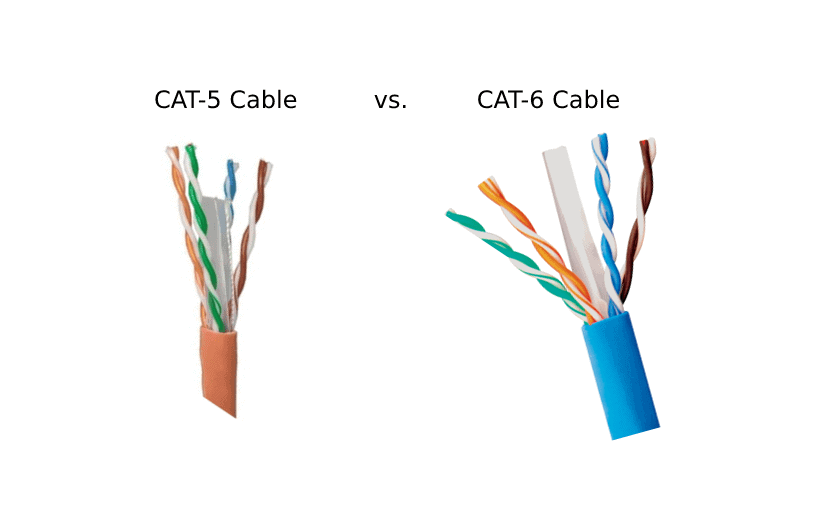
This comprehensive guide will break down the essential differences between the once-ubiquitous Cat5 and the powerhouse Cat8, helping you determine the perfect solution for your specific needs.
Quick Comparison: Cat5 vs. Cat8 at a Glance
For those who need a fast answer, this table highlights the fundamental distinctions between Cat5e (the successor to Cat5) and Cat8.
| Specification | Cat5e | Cat8 |
|---|---|---|
| Max Speed | 1 Gbps (1,000 Mbps) | 25 Gbps / 40 Gbps |
| Max Bandwidth (Frequency) | 100 MHz | 2000 MHz (2 GHz) |
| Max Cable Length | 100 meters (328 feet) | 30 meters (98 feet) |
| Shielding | Unshielded (UTP) or Shielded (FTP) | Always Shielded (S/FTP) |
| Primary Application | Older home & office networks, VoIP | Data centers, server rooms, high-end enterprise networks |
| Cost | Low | Very High |
A Look Back: What is Cat5/Cat5e Cable?
Category 5 (Cat5) cable was the standard for Ethernet for many years, but it has long been obsolete. Its successor, Cat5e (Category 5 Enhanced), became the baseline for modern networking. It was a significant improvement, designed to support speeds up to 1 Gigabit per second (Gbps) at a frequency of 100 MHz.
Key Characteristics of Cat5e:
- Adequate for Basic Internet: For standard web browsing, streaming HD video, and basic office tasks, 1 Gbps is often sufficient.
- Cost-Effective: It is the most affordable Ethernet cable, making it a popular choice for budget-conscious installations.
- Construction: Most Cat5e cables are Unshielded Twisted Pair (UTP), meaning the internal wires are not protected by a metallic shield, making them more susceptible to electronic noise or “crosstalk.”
While still functional, we at D-Lay Cable view Cat5e as a legacy technology, not recommended for new, performance-critical installations.
The New Standard: Introducing Cat8 Cable
Cat8 is the pinnacle of copper Ethernet cabling. It represents a quantum leap in data transfer capabilities, designed specifically for the demanding environments of data centers and enterprise-level server rooms. It is engineered for 25GBASE-T and 40GBASE-T applications.
Key Characteristics of Cat8:
- Incredible Speed: Supporting speeds of 25 Gbps or even 40 Gbps, Cat8 is 40 times faster than Cat5e.
- Massive Bandwidth: With a frequency of 2000 MHz, it offers 20 times the bandwidth of Cat5e. Think of it as a 20-lane superhighway compared to Cat5e’s single-lane road, allowing vast amounts of data to travel simultaneously.
- Mandatory Shielding: All Cat8 cables are Shielded/Foiled Twisted Pair (S/FTP). Each pair of wires is wrapped in foil, and all four pairs are wrapped in a sturdy outer braid. This robust construction is essential to eliminate crosstalk and interference, ensuring signal integrity at such high frequencies.
The Core Differences Analyzed in Detail
1. Speed and Bandwidth: The Generational Leap
The most dramatic difference is performance. A Cat5e cable tops out at 1 Gbps, which is perfectly fine for connecting a laptop to a standard home router. A Cat8 cable, however, can handle 40 Gbps. This immense capacity is not for checking email; it’s for connecting servers to switches or for inter-rack connections in a data center where terabytes of data are moved constantly.
2. Construction and Shielding: Durability Meets Performance
Physically, a Cat8 cable is thicker and more rigid than a Cat5e cable due to its mandatory S/FTP shielding and thicker copper conductors. This shielding is not optional; it’s a requirement to handle the 2000 MHz frequency. Without it, the signal would degrade rapidly due to interference. Cat5e’s common unshielded design is simpler and more flexible but offers minimal protection against noise from power lines or other cables.
3. Application and Intended Use: Home vs. Data Center
This is the most practical differentiator. Cat8 is not designed for general home or office use. Its power is harnessed over short distances (up to 30 meters) in a fixed “top-of-rack” or “end-of-row” data center architecture. For your home internet, gaming console, or office PC, your hardware and internet service simply cannot take advantage of Cat8’s capabilities.
Cat5e, on the other hand, was designed for the exact opposite: horizontal, in-wall cabling for general-purpose office and home networks over distances up to 100 meters.
Finding the Sweet Spot: Where Do Cat6 & Cat6a Fit In?
Comparing only Cat5e and Cat8 creates a massive gap. For the vast majority of modern applications, the ideal choice lies in between. This is where Cat6 and Cat6a come in.
- Cat6 Cable: Supports speeds up to 10 Gbps over shorter distances (around 37-55 meters) and 1 Gbps up to 100 meters. It operates at 250 MHz. It’s an excellent, affordable upgrade from Cat5e for modern home and small business networks.
- Cat6a (Augmented) Cable: This is the current sweet spot for future-proofing. It reliably delivers 10 Gbps speeds over the full 100-meter distance and operates at 500 MHz. It’s the standard we recommend for new office installations, powerful home networks, and connections for high-speed Wi-Fi 6/7 access points.
Which Ethernet Cable Should You Choose?
Here’s our expert recommendation from D-Lay Cable:
- For existing, basic networks (under 1 Gbps): Your current Cat5e cables will suffice.
- For new home or small office installations: Use Cat6 as a minimum for a great balance of price and performance.
- For future-proofing, gaming, 4K streaming, and professional home offices: Choose Cat6a. It provides the 10 Gbps headroom needed for the next generation of devices.
- For data centers, server rooms, or connecting network backbone hardware: Cat8 is the only choice for achieving 25/40 Gbps over copper.
The D-Lay Cable Commitment to Performance
At D-Lay Cable, we don’t just sell cables; we manufacture solutions. From dependable Cat5e patch cords for legacy systems to our rigorously tested, high-performance Cat8 cables for enterprise clients, every product is built to meet and exceed industry standards like UL, ETL, and RoHS. Our OEM/ODM services allow us to create custom cabling solutions tailored to your exact specifications because we know that the right connection is the foundation of every great network.
Choosing between Cat5 and Cat8 is about understanding the application. One represents the reliable past, and the other, the high-performance future of data centers. For most users today, the answer lies with the powerful and versatile Cat6 and Cat6a standards. Whatever your requirement, our team of experts is here to help you navigate the options and build a network that performs flawlessly today and is ready for the challenges of tomorrow.