


As a leading manufacturer in structured cabling solutions, we at Dlaycable often receive questions about network upgrades. One of the most common is: “I have a Cat5 or Cat5e network. Can I use Cat6 cables instead?” This is an excellent question, as choosing the right cable is fundamental to network performance and future-readiness.
This comprehensive guide will not only answer your question but also provide the expert insights you need to make the best decision for your home or business network, drawing on our experience in producing high-performance, certified cabling.
Article Contents:
- The Quick Answer: Yes, You Absolutely Can
- Understanding the Key Differences: Cat6 vs. Cat5e
- At a Glance: Cat6 vs. Cat5e Comparison Table
- Practical Scenarios: When to Choose Each Cable
- The Dlaycable Advantage: Why Cable Quality is Crucial
- Frequently Asked Questions (FAQ)
- The Final Verdict from Dlaycable
The Quick Answer: Yes, You Absolutely Can
Yes, you can use Cat6 cable in place of Cat5 or Cat5e. Cat6 cables are fully backward compatible with Cat5 and Cat5e standards. This means you can plug a Cat6 cable into a device or network jack designed for Cat5e and it will work perfectly. The RJ45 connector is the same for both.
However, the real question isn’t just “can you,” but “should you?” While a Cat6 cable will work in a Cat5e network, it will only perform at the speed of the weakest component. To get the full benefit of Cat6, your entire network channel (jacks, patch panels, switches) should also be Cat6-rated. Despite this, using Cat6 for new runs or replacements is almost always the superior choice.
Understanding the Key Differences: Cat6 vs. Cat5e
While they may look similar, Cat6 cables are engineered to a higher standard than their Cat5e predecessors. At Dlaycable, we see these differences firsthand during our rigorous manufacturing and testing processes. The primary improvements are in performance and construction, which directly combat interference.
1. Superior Performance (Speed and Bandwidth)
- Cat5e (Category 5 Enhanced): Is rated for speeds up to 1 Gigabit per second (Gbps) at a frequency of 100 MHz. This has been the standard for many years for home and office networking.
- Cat6 (Category 6): Supports speeds up to 10 Gbps, but only over shorter distances (typically 37-55 meters). For distances up to 100 meters, it reliably delivers 1 Gbps. More importantly, it supports a much higher frequency of 250 MHz. This increased bandwidth means more data can be transmitted simultaneously, reducing congestion and improving performance for demanding applications like 4K video streaming, online gaming, and large file transfers.
2. Advanced Construction and Crosstalk Reduction
The biggest enemy of a stable network connection is “crosstalk” – the unwanted signal interference between adjacent wire pairs inside the cable. Cat6 is specifically designed to minimize this.
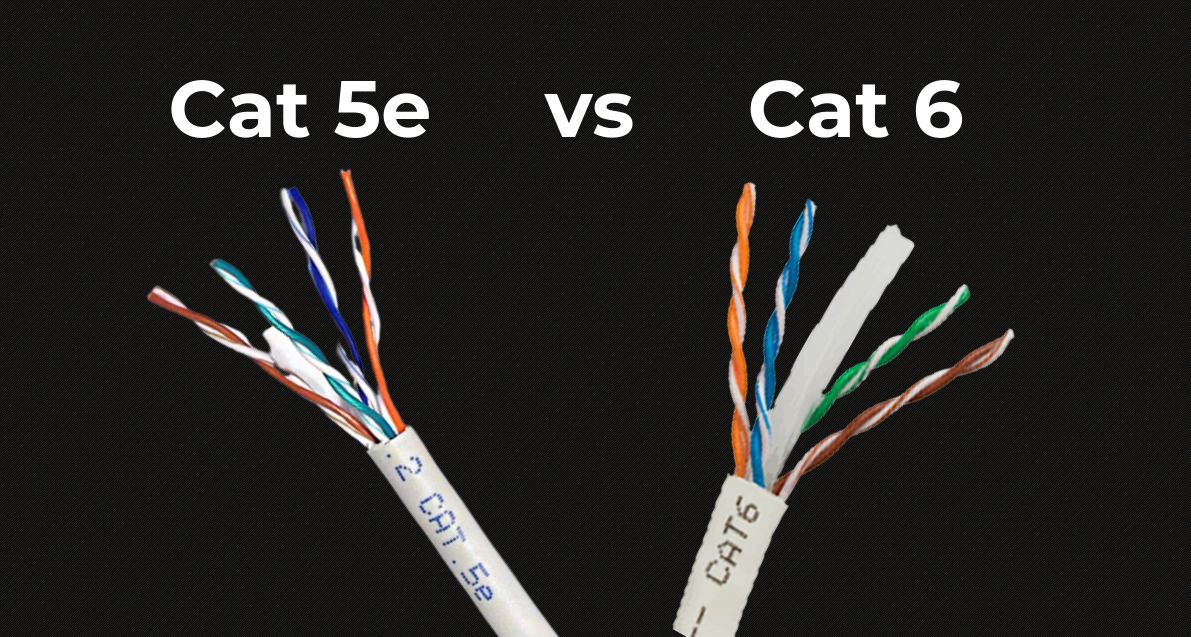
- Tighter Twists: Cat6 cables feature more twists per inch in the copper wire pairs. This engineering detail significantly improves the cable’s resistance to crosstalk.
- Spline (Separator): Most Cat6 cables include a plastic separator, known as a spline, that runs down the center of the cable, isolating each of the four twisted pairs. This physical barrier is a key feature that drastically reduces internal crosstalk and allows for higher performance. Cat5e cables do not have a spline.
- Thicker Copper Conductors: Cat6 cables often use a slightly thicker copper wire (e.g., 23 AWG) compared to Cat5e (e.g., 24 AWG), which improves signal strength.
At a Glance: Cat6 vs. Cat5e Comparison Table
| Feature | Cat5e | Cat6 |
|---|---|---|
| Max Speed (at 100m) | 1 Gbps | 1 Gbps |
| Max Speed (at <55m) | 1 Gbps | 10 Gbps |
| Max Bandwidth | 100 MHz | 250 MHz |
| Crosstalk Reduction | Standard | Superior (Tighter Twists, Spline) |
| Internal Separator (Spline) | No | Yes (Typically) |
| Best For | Basic home/office networks, budget constraints | New installations, future-proofing, PoE, high-demand apps |
Practical Scenarios: When to Choose Each Cable
When Cat5e Might Still Be Sufficient
- Existing Infrastructure: If you are simply replacing a single faulty cable in an established Cat5e network and have no plans for a major upgrade, a high-quality Cat5e patch cord is a cost-effective solution.
- Strict Budget Constraints: For large-scale deployments where the budget is the primary driver and the network demands will not exceed 1 Gbps, Cat5e can still be a viable choice.
Why Cat6 is the Modern Standard and Recommended Choice
- New Installations: For any new network wiring, whether in a home or office, Cat6 is the minimum standard you should consider. The labor cost of installing cable is often higher than the material cost, so installing a more capable cable now saves significant money and hassle later.
- Future-Proofing: The demand for bandwidth is only increasing. Smart TVs, high-resolution security cameras, cloud computing, and IoT devices all consume more data. Installing Cat6 ensures your network infrastructure can handle these future demands.
- Power over Ethernet (PoE): Cat6’s thicker conductors handle the heat generated by PoE applications more efficiently than Cat5e, making it a more reliable choice for powering devices like VoIP phones, wireless access points, and IP cameras.
- Improved Reliability: The superior resistance to crosstalk means a more stable and reliable connection with fewer data errors, which is critical for business operations and high-quality media streaming.
The Dlaycable Advantage: Why Cable Quality is Crucial
Simply choosing “Cat6” isn’t enough. The performance gains of Cat6 are only realized when the cable is manufactured to strict specifications. This is where Dlaycable excels.
- Certified Performance: All our Cat6 cables are rigorously tested with professional Fluke testers to ensure they meet or exceed TIA/EIA standards. We guarantee the 250 MHz bandwidth and data rates you expect.
- Pure Copper Conductors: We use 100% pure bare copper conductors, not copper-clad aluminum (CCA). Pure copper offers superior conductivity and durability, ensuring a long-lasting, high-performance link.
- Quality Materials: From the spline to the jacket material, every component is selected for durability and performance, meeting certifications like UL, ETL, and RoHS.
Choosing a Dlaycable Cat6 product means you are not just buying a cable; you are investing in a guaranteed level of performance for your network’s foundation.
Frequently Asked Questions (FAQ)
Can I mix Cat5e and Cat6 cables in the same network?
Yes. As mentioned, the network will run at the speed of its slowest component. For example, if you connect a Cat6 patch cord from your router to a Cat5e wall jack, the connection between those two points will perform to Cat5e standards.
Do I need special tools or connectors for Cat6?
Cat6 uses the same standard RJ45 connector as Cat5e. However, due to the thicker wires and the internal spline, terminating Cat6 cables can be slightly more challenging. It’s recommended to use RJ45 connectors specifically designed for Cat6’s larger wire diameter for the most reliable connection.
Is Cat6 cable harder to install?
Slightly. The thicker diameter and reduced flexibility of Cat6 cable can make it a bit more difficult to pull through tight conduits or bend around sharp corners compared to Cat5e. This is a minor trade-off for its superior performance.
What about Cat6a? When do I need it?
Cat6a (Augmented Category 6) is an even higher standard, supporting 10 Gbps speeds over the full 100-meter distance and a bandwidth of 500 MHz. You should consider Cat6a for data centers, server rooms, or any new installation where you want to guarantee 10 Gbps performance over long distances.
The Final Verdict from Dlaycable
You can absolutely use Cat6 cable instead of Cat5e. For any new installation or significant upgrade, we strongly recommend it.
The marginal increase in material cost for Cat6 is a small price to pay for the significant benefits in performance, reliability, and future-proofing. By building your network on a robust Cat6 foundation, you ensure it can handle the escalating demands of modern technology for years to come.
Ready to upgrade your network with confidence? Explore our range of Fluke-tested, certified Cat6 Ethernet cables or contact our expert team for a personalized consultation on your structured cabling needs.