


In the ever-accelerating world of digital connectivity, the demand for higher network speeds is relentless. From high-definition streaming and competitive online gaming to data-intensive cloud services and robust office networks, the 10 Gigabit per second (Gbps) benchmark is rapidly becoming the new standard. This leads to a critical question for homeowners, IT professionals, and network installers: Can my existing Cat6 cabling handle 10Gbps speeds?
As a leading manufacturer of high-performance network cabling solutions, we at D-Lay Cable understand the importance of clear, accurate information. The short answer is yes, Cat6 can support 10Gbps. However, the complete answer is more nuanced and comes with a crucial caveat: distance.
This comprehensive guide will break down everything you need to know about running 10Gbps over Cat6, the factors that affect performance, and how to make the right choice for your specific needs.
Article Contents
- Understanding the Standards: 10GBASE-T and Cat6
- The Critical Factor: Cat6 10Gbps Distance Limitation
- The Technical Hurdle: What is Alien Crosstalk (ANEXT)?
- The Superior Alternative: Cat6 vs. Cat6A for 10Gbps
- Practical Scenarios: When is Cat6 for 10Gbps a Good Idea?
- The D-Lay Cable Advantage: Why Cable Quality is Non-Negotiable
- Final Verdict: Making the Right Cabling Decision
Understanding the Standards: 10GBASE-T and Cat6
To understand the capabilities, we first need to look at the official standards. The standard for running 10 Gbps Ethernet over twisted-pair cabling is known as 10GBASE-T.
Category 6 (Cat6) cabling was originally designed and specified for Gigabit Ethernet (1Gbps) over a full distance of 100 meters (328 feet). It operates at a frequency of 250 MHz. While it wasn’t initially built for the rigors of 10Gbps, the standards bodies (TIA/EIA) later confirmed its capability to handle this higher speed, but only under specific conditions.
The Critical Factor: Cat6 10Gbps Distance Limitation
This is the most important takeaway: The ability of a Cat6 cable to successfully transmit data at 10Gbps is entirely dependent on its length.
- For distances up to 37 meters (121 feet): Cat6 cabling can generally support 10Gbps, even in environments with some electromagnetic interference or when bundled with other cables.
- For distances between 37 and 55 meters (121 to 180 feet): Cat6 can support 10Gbps, but only in “ideal” environments with minimal alien crosstalk. This means it should not be tightly bundled with other cables carrying high-speed data.
- For distances over 55 meters (180 feet): Cat6 is not recommended or certified for 10Gbps speeds. At these lengths, you will likely experience significant performance degradation, packet loss, and connection instability, reverting to a 1Gbps or 5Gbps link speed.
The Technical Hurdle: What is Alien Crosstalk (ANEXT)?
The primary reason for the distance limitation on Cat6 at 10Gbps is a phenomenon called Alien Crosstalk (ANEXT). While regular crosstalk happens between the wire pairs inside a single cable, alien crosstalk is the interference or “noise” that jumps from one cable to another when they are laid in close proximity, such as in a bundle or conduit.
The 500 MHz signal frequency required for 10GBASE-T is much more sensitive to this “alien” noise than the 250 MHz of Cat6’s design. The construction of Cat6 cable, while excellent for gigabit speeds, isn’t robust enough to consistently shield against ANEXT over long distances at these higher frequencies.
The Superior Alternative: Cat6 vs. Cat6A for 10Gbps
This is where Category 6A (Augmented Cat6) enters the picture. Cat6A was designed from the ground up specifically for 10GBASE-T.
Cat6A is the industry-recommended standard for all new 10Gbps installations. It reliably delivers 10Gbps performance over the full channel distance of 100 meters (328 feet).
Here’s a quick comparison:
| Feature | Cat6 | Cat6A |
|---|---|---|
| Max Speed (10Gbps) Distance | Up to 55 meters | Up to 100 meters |
| Frequency | 250 MHz | 500 MHz |
| Alien Crosstalk Mitigation | Limited | Significantly Improved |
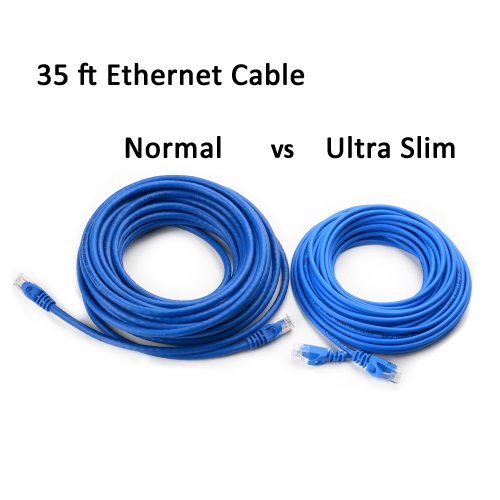
| Construction | Thinner jacket, standard pair twists | Thicker jacket, tighter twists, better insulation/shielding |
Cat6A achieves its superior performance through enhanced construction, including thicker conductors, tighter twists in the wire pairs, and improved shielding that specifically combats ANEXT.
Practical Scenarios: When is Cat6 for 10Gbps a Good Idea?
Despite its limitations, using Cat6 for 10Gbps can be a perfectly viable and cost-effective solution in several situations:
- Upgrading Existing Infrastructure: If you already have a high-quality Cat6 network installed and the runs are under 55 meters, you can likely upgrade your switches and network cards to 10Gbps without needing to re-cable your entire building.
- Data Center Rack-to-Rack Connections: Connections between servers and switches within the same or adjacent racks are typically very short, making high-quality Cat6 patch cords an excellent choice.
- Home and Small Office Networks: For a home lab or connecting a powerful workstation to a NAS (Network Attached Storage) in the same room, Cat6 is more than capable of handling 10Gbps speeds over these short distances.
For any new installation where 10Gbps is a requirement now or in the future, we strongly recommend using Cat6A to ensure full performance and future-proofing.
The D-Lay Cable Advantage: Why Cable Quality is Non-Negotiable
Whether you choose Cat6 or Cat6A, the performance you achieve is directly tied to the quality of the cable itself. This is where D-Lay Cable excels. As an OEM/ODM manufacturer with our own factory, we have complete control over the production process, ensuring every cable meets the highest standards.
Here’s why choosing a quality-certified cable from a trusted manufacturer like D-Lay Cable is crucial:
- Pure Copper Conductors: We use 100% pure bare copper conductors, which offer superior conductivity and performance compared to cheaper Copper Clad Aluminum (CCA) alternatives. CCA cables are prone to signal loss and failure, especially at higher frequencies.
- Strict Adherence to Standards: Our cables are manufactured to meet and exceed TIA/EIA specifications. This guarantees the correct wire gauge, twist rates, and jacket materials needed for certified performance.
- Rigorous Testing: Every batch of our high-performance cable undergoes Fluke testing to certify its performance for speed, frequency, and crosstalk. This verification ensures that a Cat6A cable from us will perform at 10Gbps up to 100 meters, guaranteed.
When you are pushing the limits of a standard, as with running 10Gbps over Cat6, using a poorly constructed cable is a recipe for failure. A certified, high-quality cable gives you the best possible chance of achieving a stable, high-speed connection.
Final Verdict: Making the Right Cabling Decision
So, can Cat6 support 10Gbps? Yes, it can, but with a maximum distance of 55 meters in ideal conditions.
Here is our expert recommendation:
- For NEW installations requiring 10Gbps speeds, always choose Cat6A. It is the official standard, provides a robust 100-meter reach, and future-proofs your network.
- For EXISTING installations with short Cat6 runs (under 55 meters), upgrading your hardware to 10Gbps is a feasible and economical option.
- For ALL installations, prioritize high-quality, certified cables from a reputable manufacturer. This single choice has the biggest impact on network reliability and performance.
At D-Lay Cable, we are dedicated to providing not just superior products like our Cat6, Cat6A, and fiber optic solutions, but also the expert knowledge to help you build a faster, more reliable network. If you have any questions about your specific project, don’t hesitate to reach out to our team of professionals.