


How fast can a Cat7 Ethernet cable really go? The maximum speed supported by a Cat7 cable is 10 Gigabit Ethernet (10 Gbps) over a full 100-meter (328 feet) distance, with a bandwidth of up to 600 MHz. While some manufacturers claim higher speeds over shorter distances, the official standard for Cat7 (ISO/IEC 11801 Class F) specifies 10 Gbps as its top speed at the standard length. This article will delve into the factors that influence Cat7’s speed, its key specifications, and how it compares to other cable categories to help you understand its true performance capabilities.
Table of Contents
- What is the Official Maximum Speed of Cat7 Cable?
- How Does Cat7’s Bandwidth Influence Its Speed?
- Why Is Cat7 Faster and More Reliable Than Cat6a?
- What Is the Role of Shielding in Cat7’s Performance?
- How Does Cat7’s Speed Compare to Cat8?
- Is Cat7 a Recommended Choice for Achieving High Speeds Today?
What is the Official Maximum Speed of Cat7 Cable?
The official maximum speed of Cat7 cable is 10 Gigabit Ethernet (10 Gbps), which it is designed to reliably support over its full 100-meter length. This performance is defined by the ISO/IEC 11801 Class F standard. This standard was established to provide a high-performance cabling solution for enterprise-level networks and data centers. Although Cat7 cables are technically capable of handling higher frequencies, the 10 Gbps speed is the officially supported maximum over the standard distance.
The 10 Gbps speed capability makes Cat7 a robust solution for a variety of high-bandwidth applications. These include large file transfers, server-to-switch connections, and data-intensive tasks. This level of performance is a significant step up from the 1 Gbps limit of Cat6 over a 100-meter span.
How Does Cat7’s Bandwidth Influence Its Speed?
Cat7 cable’s high bandwidth of up to 600 MHz is a key factor that enables its high-speed performance. Bandwidth refers to the range of frequencies a cable can use to transmit data. A higher bandwidth allows for more data to be transmitted simultaneously. This is analogous to having a wider highway for more cars to travel on at the same time.
Specifically, the 600 MHz bandwidth of Cat7 is a substantial upgrade from the 250 MHz of Cat6 and the 500 MHz of Cat6a. The increased frequency range is essential for reliably supporting 10 Gbps speeds without signal degradation or data errors over the full 100-meter distance. This capability provides a greater “headroom” for data signals, ensuring a cleaner and more stable connection.
Why Is Cat7 Faster and More Reliable Than Cat6a?
Cat7 is faster and more reliable than Cat6a due to its higher frequency and superior shielding, which provide better protection against both internal and external interference. While both are rated for 10 Gbps over 100 meters, Cat7’s 600 MHz bandwidth gives it a slight performance edge over Cat6a’s 500 MHz. This enables Cat7 to maintain signal integrity more effectively.
The Role of Shielding
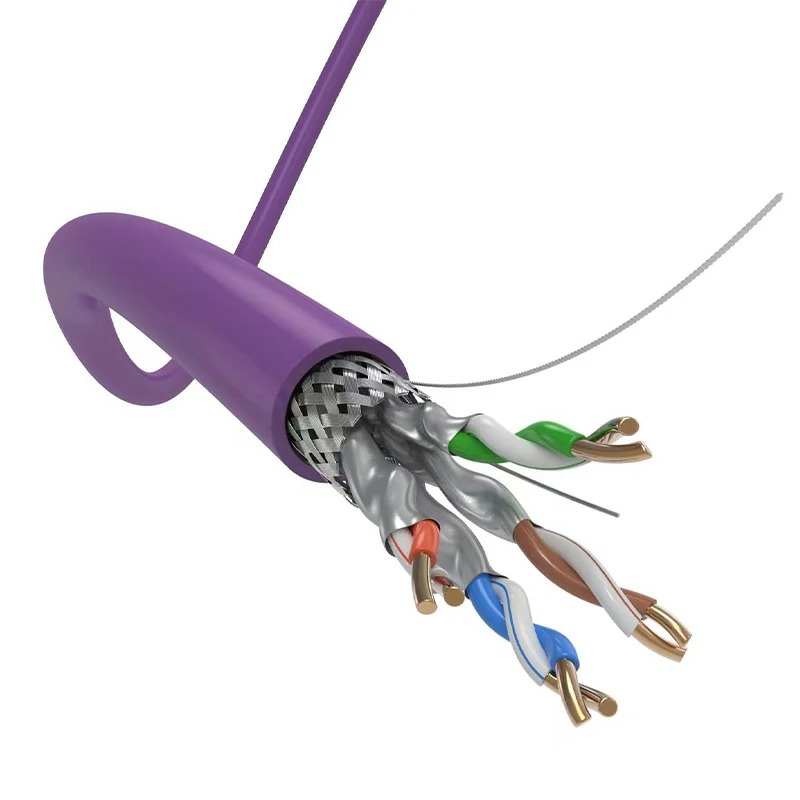
The core difference, however, lies in the shielding. Cat7 is designed with a Screened Foiled Twisted Pair (S/FTP) construction. This means each pair of wires is individually shielded with foil, and all four pairs are then wrapped in an overall shield. This dual-shielding method provides a higher level of noise immunity compared to the more common shielded Cat6a cables. Consequently, Cat7 is better suited for high-density, high-noise environments where Cat6a might struggle to maintain its top performance.
What Is the Role of Shielding in Cat7’s Performance?
The extensive shielding in a Cat7 cable is crucial for its high-speed performance and reliability, as it is the primary mechanism for mitigating both internal and external interference. The shielding protects the data signals from electromagnetic interference (EMI) from external sources, such as power lines or other electronics. It also prevents crosstalk, which is the signal bleeding between adjacent wire pairs.
Shielding’s Dual Function
The S/FTP shielding in Cat7 serves a dual function. The individual foil shield on each twisted pair effectively isolates the signals, preventing them from interfering with each other (crosstalk). The overall screen or braid shield then protects the entire cable from external EMI. This robust defense system allows Cat7 to operate at higher frequencies and carry more data with a lower chance of errors, which is fundamental to achieving and maintaining 10 Gbps speeds.
How Does Cat7’s Speed Compare to Cat8?
Cat7’s maximum speed of 10 Gbps at 100 meters is significantly lower than Cat8, which is specifically designed to support ultra-high speeds of 25 Gbps and 40 Gbps, though only over very short distances. Cat8 operates at a much higher bandwidth of 2000 MHz. This makes it a specialized cable for next-generation data center applications.
| Feature | Cat7 | Cat8 |
| Max Speed | 10 Gbps | 25/40 Gbps |
| Max Distance | 100 meters | 30 meters |
| Bandwidth | 600 MHz | 2000 MHz |
| Common Use | Enterprise networks, 10GbE backbones | Data center links (server to switch) |
Consequently, Cat7 and Cat8 serve different purposes. Cat7 is a longer-reach solution for 10 Gbps networks, while Cat8 is a short-reach solution for ultra-fast, future-proof connections within a single data center rack.
Is Cat7 a Recommended Choice for Achieving High Speeds Today?
No, Cat7 is generally not the recommended choice for achieving high speeds in most modern networks, as more widely-adopted and cost-effective alternatives exist. For 10 Gbps networks, Cat6a is the industry standard in North America and is typically more affordable and easier to install. For speeds beyond 10 Gbps, Cat8 is the preferred standard for short-distance data center applications. The lack of a TIA/EIA standard for Cat7 in the United States and its high cost and installation difficulty often outweigh its marginal performance advantages.
Ultimately, while Cat7 is a powerful cable, its niche market position means it is not the most practical choice for a majority of new installations today. Most users and businesses can achieve their high-speed goals more effectively with Cat6a for 10 Gbps or Cat8 for ultra-fast, short-haul links.
Conclusion
The maximum speed of a Cat7 cable is 10 Gbps over a 100-meter distance, driven by a 600 MHz bandwidth and superior shielding. This makes it a high-performance, niche solution for specialized environments. However, for most modern network needs, more widely-adopted and cost-effective alternatives like Cat6a and Cat8 provide a better balance of speed, cost, and practicality. Understanding Cat7’s specific capabilities is key to identifying its limited, high-end applications within the broader landscape of Ethernet cabling.
At DLAY Cable Technology Co., Ltd., we specialize in manufacturing high-quality network cabling solutions to meet all your connectivity needs. While Cat7 is a specialized option, our extensive product line focuses on the most widely-used and effective standards, including high-performance Cat5e, Cat6, Cat6a, and Cat8. Our cables are engineered for superior reliability, ease of installation, and exceptional value. With competitive pricing and rigorous quality control, DLAY Cable provides the robust infrastructure essential for maximizing your network’s speed and ensuring a future-ready connection.