


Why is a Cat7 cable so effective at reducing signal interference? Cat7 cables use a highly effective dual-shielding method, most commonly referred to as Screened Foiled Twisted Pair (S/FTP) shielding, to drastically reduce both internal crosstalk and external electromagnetic interference (EMI). This robust construction, where each wire pair is individually shielded with foil and the entire cable is wrapped in an additional screen, is a hallmark of the Cat7 standard. This article will explore the specifics of Cat7’s shielding, compare it to other cable types, and explain why this advanced design is critical for high-speed networking.
What is S/FTP Shielding and How Does it Work?
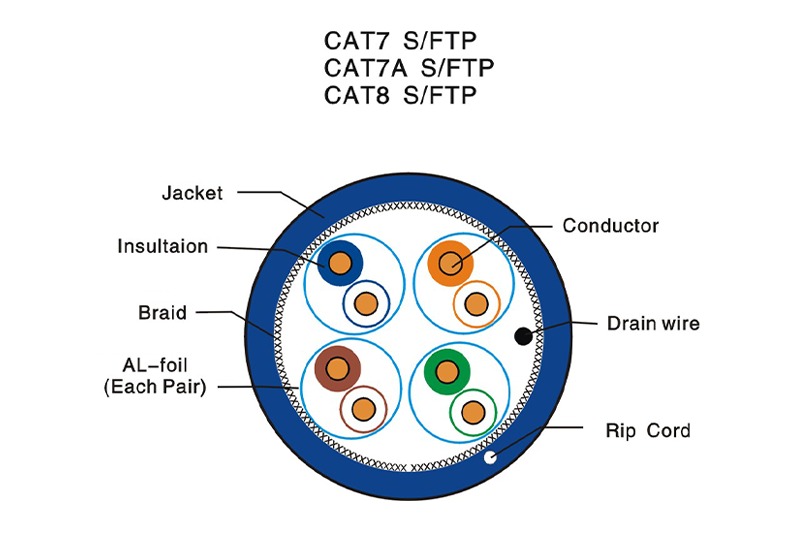
Cat7 cables primarily use S/FTP shielding, which stands for Screened Foiled Twisted Pair, a highly effective method that provides dual protection against interference. This construction involves individually wrapping each of the four twisted wire pairs in its own foil shield. An additional overall braided shield or foil screen then covers all four pairs.
This dual-layer approach provides maximum noise immunity. The individual foil shields on each pair prevent internal interference (crosstalk) from signals bleeding between pairs. Meanwhile, the outer overall screen or braid shield protects the entire cable from external electromagnetic interference (EMI), such as from power lines, fluorescent lights, or other network cables running nearby. This comprehensive shielding is what enables Cat7 to achieve its high-performance specifications.
How Does Cat7’s Shielding Differ from Cat6?
Cat7’s shielding is significantly more robust and complex than the shielding typically found on Cat6 cables, which are often unshielded. Standard Cat6 cables are Unshielded Twisted Pair (UTP) and rely solely on the twisting of the wire pairs to reduce crosstalk. Cat7, by contrast, utilizes its full dual-shielding (S/FTP) design.
While some Cat6 cables are shielded (often designated F/UTP or U/FTP), they typically feature only an overall foil or screen shield, without the individual foil shields on each pair. This means Cat7 offers a superior level of protection against both internal and external noise, which is essential for its higher bandwidth and performance specifications. The difference in shielding is a key reason why Cat7 can achieve a bandwidth of 600 MHz compared to Cat6’s 250 MHz.
Why is Dual-Shielding Important for High-Speed Networks?
Dual-shielding is critical for high-speed networks because it protects the integrity of the data signal as it travels across the cable, which is especially susceptible to interference at higher frequencies. As network speeds increase (e.g., from 1 Gbps to 10 Gbps), the frequency of the data signal also rises. At these higher frequencies, even minimal interference can cause data errors and a significant loss in performance.
The dual-shielding of Cat7 ensures that the high-frequency signals can be transmitted cleanly over the full 100-meter distance without corruption. The individual foil shields on each pair prevent signal corruption from within the cable itself, while the outer shield protects against noise from the surrounding environment. This comprehensive protection is what allows Cat7 to deliver reliable 10 Gbps performance.
What are the Advantages of S/FTP Shielding?
The S/FTP shielding used in Cat7 cables offers several key advantages, including superior protection against crosstalk and EMI, a higher bandwidth potential, and improved security against signal interception. These benefits are particularly important for specialized, high-demand networking environments.
- Exceptional Noise Immunity: The primary advantage is its ability to virtually eliminate crosstalk and protect against external EMI. This is vital in dense cable bundles found in data centers or industrial settings.
- Higher Bandwidth: The superior shielding allows the cable to operate at higher frequencies (up to 600 MHz) without signal degradation. This provides the necessary bandwidth for 10 Gbps and potentially higher speeds.
- Enhanced Data Security: Shielded cables offer better protection against signal “eavesdropping,” a method where data is intercepted by listening to the electromagnetic fields emitted by the cable. The shielding acts as a Faraday cage, making it more difficult to intercept the signal.
- Reliability: The robust design leads to more consistent and reliable performance, with a lower rate of data errors and dropped packets, which is crucial for mission-critical applications.
How Does Cat7’s Shielding Affect Installation and Cost?
Cat7’s advanced shielding directly impacts both its cost and the complexity of its installation, making it more expensive and difficult to work with compared to unshielded cables. The materials required for the multiple layers of shielding—foil and braid—increase manufacturing costs.
Additionally, the rigid nature of shielded cables presents challenges during installation:
- Thicker and Heavier: The extra layers of shielding and thicker jackets make Cat7 cables larger in diameter and less flexible than UTP cables. This requires larger cable conduits and can make pulling the cables in tight spaces difficult.
- Larger Bend Radius: To maintain the integrity of the shielding, Cat7 cables have a larger minimum bend radius. Bending them too sharply can damage the shielding and degrade performance.
- Proper Grounding: For the shielding to be effective, the cable must be properly grounded at both ends. This requires specialized shielded connectors (GG45 or TERA) and grounding procedures, which adds to the installation time and complexity. An improper ground can make the shield a conduit for noise rather than a barrier.
Are There Other Types of Shielding Besides S/FTP?
Yes, there are several other types of shielding used in Ethernet cables besides S/FTP, with the most common being UTP (Unshielded Twisted Pair), F/UTP (Foiled Twisted Pair), and SF/UTP (Screened Foiled Twisted Pair). Each shielding type offers a different level of protection and is used for various applications.
- UTP (Unshielded Twisted Pair): This is the most common type, used in Cat5e and Cat6 cables. It has no shielding and relies solely on the twisting of the wire pairs to reduce interference. UTP is inexpensive, flexible, and easy to install.
- F/UTP (Foiled Twisted Pair): This type has an overall foil shield that wraps all four pairs, but the pairs themselves are not shielded. This is a common form of shielded Cat6.
- SF/UTP (Screened Foiled Twisted Pair): This cable has a braided or foil screen around all the pairs, with no individual shielding on the pairs. It offers moderate protection against EMI.
- S/FTP (Screened Foiled Twisted Pair): The shielding type of Cat7. It has a foil shield on each pair and a braided or screened shield over all the pairs. This is the most robust shielding method.
The choice of shielding type depends on the required performance, the environment’s noise level, and the project’s budget.
Conclusion
The shielding is the defining feature of Cat7 cable and the primary reason for its high-performance capabilities. It uses a Screened Foiled Twisted Pair (S/FTP) design, where each individual wire pair and the entire cable are shielded, to provide unparalleled protection against interference. While this advanced construction makes Cat7 more expensive and difficult to install, it is critical for achieving reliable 10 Gbps speeds in high-noise, high-density environments. This robust shielding is a testament to the engineering required to push copper cabling to its performance limits.
At DLAY Cable Technology Co., Ltd., we specialize in manufacturing high-quality network cabling solutions to meet all your connectivity needs. While Cat7 is a specialized high-end option, our extensive product line focuses on a full range of cables from Cat5e to Cat8, including shielded and unshielded varieties like Cat6 and Cat6a. Our cables are engineered for superior reliability, ease of installation, and exceptional value. With competitive pricing and rigorous quality control, DLAY Cable provides the robust infrastructure essential for maximizing your network’s speed and ensuring a future-ready connection.