


While Category 7 (Cat7) Ethernet cables are widely sold online and in stores, the answer to whether a “real” one exists for your network is complex. The short answer is: Yes, but it is not a recognized standard for Ethernet networking by the Telecommunications Industry Association (TIA), the primary standards body in North America. This crucial distinction means that while the cable itself is manufactured to certain specifications, it is not the recommended or certified standard for most Ethernet applications, creating significant confusion for consumers and professionals who value performance and reliability.
At Dlaycable, we believe in empowering our customers with accurate, expert information to build robust and future-proof networks. dlaycable will demystify the Cat7 controversy, compare it to official TIA standards like Cat6A and Cat8, and help you make the right choice for your specific needs.
What is the Official “Cat7” Standard (ISO/IEC 11801)?
To be clear, a “Cat7” standard does exist, just not where most North American users should be looking. Category 7 is officially defined by the ISO/IEC 11801, an international standard for information technology cabling. It is designated as a Class F channel. The technical specifications for a genuine Cat7 cable are impressive on paper:
- Bandwidth: Up to 600 MHz
- Data Rate: 10 Gbps up to 100 meters (328 feet)
- Shielding: Critically, the Class F standard mandates comprehensive shielding. True Cat7 cables are typically S/FTP (Screened/Foiled Twisted Pair), meaning each individual pair is wrapped in foil, and an overall screen braid surrounds all four pairs. This design provides excellent protection against crosstalk and external electromagnetic interference (EMI).
So, if it’s a real international standard with high-performance specs, why is it so controversial? The problem arises when this standard meets the reality of the most widely used networking hardware in the world, particularly in the United States.
The Core of the Controversy: TIA Non-Recognition and the Connector Problem
The main issues with Cat7 for Ethernet networking stem from its relationship—or lack thereof—with the TIA and the physical connectors used. These two factors effectively disqualify it from being a practical choice for most projects.
Why Did the TIA Skip Cat7?
The Telecommunications Industry Association (TIA), along with the Electronic Industries Alliance (EIA), develops the TIA/EIA-568 standards that govern structured cabling in North America. This is the standard that system installers, network architects, and IT professionals rely on for guaranteed performance and interoperability. When the need for speeds beyond 10Gbps emerged, the TIA made a strategic decision. Instead of adopting the ISO’s Cat7, they focused their efforts on improving the already successful Cat6A standard and then developed Category 8 (Cat8) as the official next-generation solution for 25G/40G data center applications. In essence, the TIA leapfrogged Cat7 entirely, leaving it as a standard without a home in the TIA ecosystem.
The Critical Flaw: Most “Cat7” Cables Use the Wrong Connector
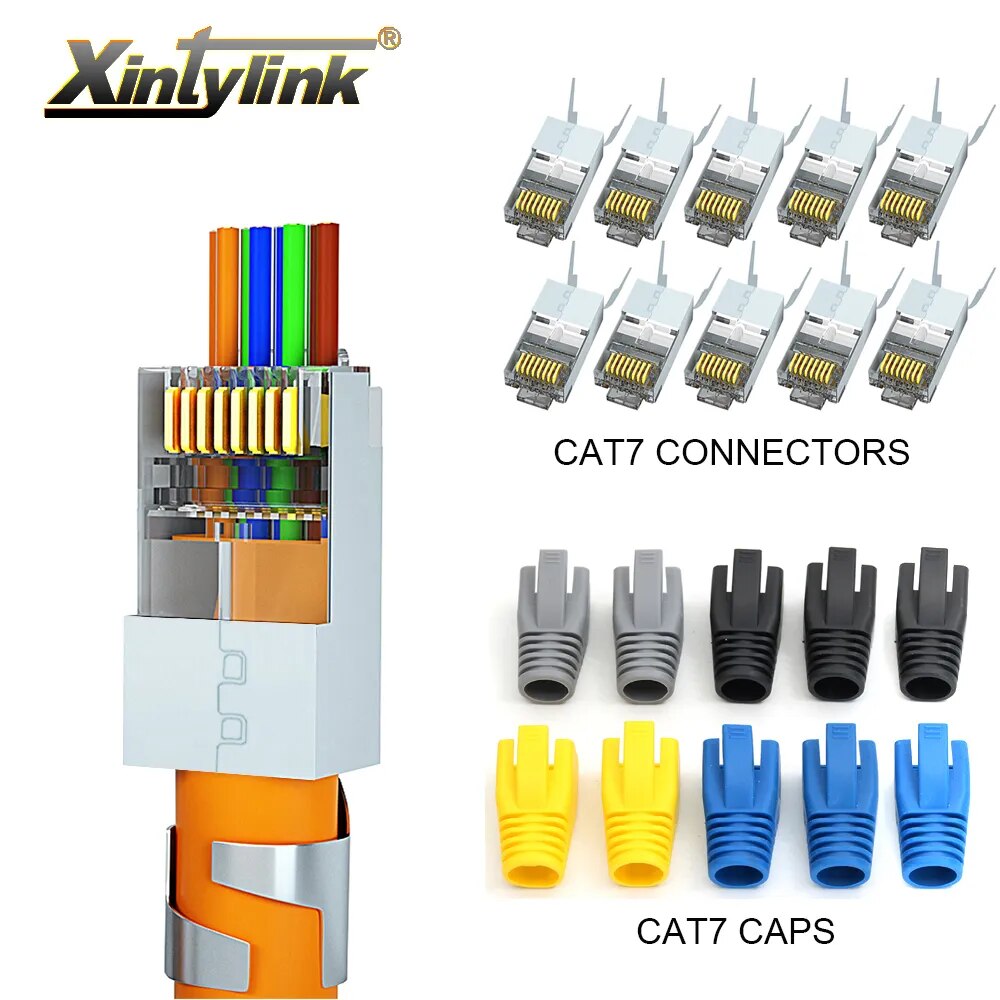
This is the most significant technical problem with the “Cat7” cables you find on the market. The official ISO standard for a Class F (Cat7) channel does not use the familiar 8P8C (RJ45) connector that every modern computer, router, and switch uses. Instead, it specifies more robust, proprietary connectors like the GG45 or TERA connector, which were designed to handle the higher 600 MHz frequency.
However, nearly every “Cat7” patch cord sold to consumers is terminated with standard RJ45 ends to ensure plug-and-play compatibility. When you put an RJ45 connector on a Cat7-rated cable, the connector itself becomes the bottleneck. The RJ45 connector is only rated up to the 500 MHz frequency of Cat6A. Therefore, a “Cat7” cable with RJ45 connectors is, by definition, unable to deliver true Cat7 performance. It functions identically to a high-quality Cat6A cable, completely negating the marketing claims and extra cost.
Head-to-Head Comparison: Cat7 vs. Other Modern Ethernet Categories
To see where Cat7 fits—or doesn’t fit—it’s best to compare it directly with the TIA-recognized standards. This chart breaks down the key differences.
| Feature | Cat6 | Cat6A (Augmented) | Cat7 (ISO Class F) | Cat8 (TIA Standard) |
|---|---|---|---|---|
| TIA Recognized? | Yes | Yes | No | Yes |
| Max Data Rate | 10 Gbps up to 55m | 10 Gbps up to 100m | 10 Gbps up to 100m | 25/40 Gbps up to 30m |
| Max Bandwidth | 250 MHz | 500 MHz | 600 MHz (Theoretical) | 2000 MHz |
| Standard Connector | RJ45 | RJ45 | GG45 / TERA (Not RJ45) | RJ45 |
| Best Use Case | Home & Small Office 1Gbps+ | Enterprise, Data Centers, High-end Homes (10Gbps) | Proprietary/Niche European systems | Data Center Switch-to-Server Links |
Cat7 vs. Cat6A: The Practical Choice for 10Gbps Networks
When you look at the facts, the choice becomes clear. For any network requiring 10Gbps speeds over standard distances up to 100 meters, Cat6A is the superior choice. It is fully recognized by the TIA, guaranteeing performance when used with certified keystone jacks and patch panels. It uses the ubiquitous RJ45 connector without issue and delivers the exact same 10Gbps/100m speed as Cat7’s marketing claims. Because it’s an industry standard, it’s more cost-effective and ensures you won’t face compatibility or certification issues down the line.
Cat7 vs. Cat8: The Misleading Path to Future-Proofing
Some marketers pitch Cat7 as a “future-proof” step up from Cat6A. This is misleading. The true TIA-approved path to speeds beyond 10Gbps is Cat8. Designed for 25GBASE-T and 40GBASE-T applications in data centers, Cat8 provides four times the bandwidth of Cat6A (2000 MHz). It is the official standard for high-speed switch-to-server connections. Choosing Cat7 is not a step toward a Cat8 infrastructure; it’s a step onto a divergent path that leads to a dead end in the TIA world.
So, Should I Buy a Cat7 Cable for My Network?
Based on the technical facts and standards, our expert recommendation varies by application, but the conclusion is consistent.
For Home Users, Gamers, and Streamers
No. A Cat7 cable offers zero practical advantages for home use. Your internet connection is almost certainly the bottleneck, not your LAN cable. For gaming, latency (ping) is far more important than raw bandwidth, and a good quality Cat6 cable or Cat6A cable will not be a source of latency. Save your money and invest in a certified Cat6 or Cat6A cable for a flawless experience.
For Businesses and Enterprise Installations
Absolutely not. Professional and commercial networks rely on strict adherence to TIA standards for certification, reliability, and warranty purposes. Installing non-standard Cat7 cabling can lead to network audit failures, interoperability nightmares with hardware from different vendors, and a lack of support from manufacturers. The industry standard for new 10Gbps commercial deployments is our fully certified Cat6A Ethernet cables.
For Data Centers
No. Cat7 is irrelevant in modern data center design. Cat6A remains a workhorse for many 10Gbps connections (like management ports), while the TIA-approved Cat8 standard for data centers is the only correct choice for new 25G/40G copper deployments between servers and switches.
The Dlaycable Verdict: Your Trusted Source for Cabling Standards
As experts in network cabling, our goal is to provide clarity and build trust. While you can physically buy a cable labeled “Cat7” with RJ45 connectors, you are essentially purchasing a heavily marketed, non-standard cable that performs, at best, like a Cat6A cable.
It is not a TIA-approved standard, it uses the wrong connectors for its official specification, and it offers no performance benefit over the proper industry standard. It is a marketing dead-end that provides no real value.
For this reason, Dlaycable recommends and stands behind these TIA-certified standards:
- For exceptional performance in home, office, and 10Gbps enterprise networks: Category 6A.
- For high-speed, short-distance data center connections looking to the future: Category 8.
By choosing a standards-compliant cable, you ensure maximum performance, guaranteed interoperability, and the long-term reliability your network deserves.
Frequently Asked Questions (FAQ) About Cat7 Cables
- Is Cat7 faster than Cat6A?
- Theoretically, Cat7 has a higher bandwidth frequency (600 MHz vs. 500 MHz), but both are rated for the same 10 Gbps data speed up to 100 meters. Because marketable “Cat7” cables use RJ45 connectors, they are limited to Cat6A’s 500 MHz frequency, making them functionally identical in speed.
- Can I plug a Cat7 cable into an RJ45 port?
- Yes, the “Cat7” cables sold on the market use standard RJ45 connectors and are backward compatible. They will work in any Ethernet port, but the connection will simply run at the speed of the slowest component in the link (e.g., a 1Gbps port will run at 1Gbps).
- Are Cat7 cables a scam?
- “Scam” is a strong word, but the marketing is often highly misleading. You are paying a premium for features that cannot be realized due to the lack of TIA recognition and the use of improper connectors. It’s more accurate to call it a poor value proposition compared to the standards-compliant alternatives.