


While Cat8 cable is technologically superior to Cat7 with a significantly higher bandwidth and data rate, it is not universally ‘better’ for all applications. Cat8 is specifically designed for short-distance, high-speed connections within data centers (up to 40Gbps over 30 meters), whereas the widely adopted Cat6a standard often represents a more practical and cost-effective solution for modern home and office networks. The main confusion arises because Cat7, despite its on-paper specifications, was never officially recognized by the Telecommunications Industry Association (TIA), making Cat8 the official TIA successor to Cat6a for next-generation speeds.
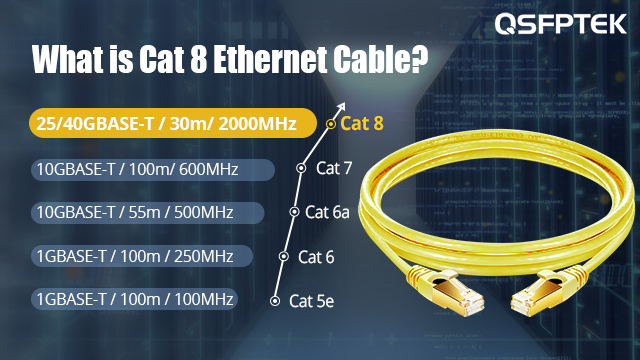
Table of Contents
- What is a Cat7 Cable? A Standard in Question
- What is a Cat8 Cable? The Data Center Powerhouse
- Cat8 vs. Cat7: A Head-to-Head Specification Comparison
- What are the Key Differences Between Cat7 and Cat8?
- Which Ethernet Cable Should You Choose?
- The Final Verdict: Application is Everything
What is a Cat7 Cable? A Standard in Question
Category 7 (Cat7) cable was developed as a Class F standard under the ISO/IEC 11801 guidelines. On paper, its specifications are impressive: it’s designed to support frequencies of up to 600 MHz and can deliver data transfer speeds of 10 Gbps up to 100 meters. Every Cat7 cable features extensive shielding, typically S/FTP (Screened/Foiled Twisted Pair), where each individual pair is foil-shielded, and an overall braid screen encases all four pairs. This robust construction makes it highly resistant to crosstalk and electromagnetic interference (EMI).
However, there’s a significant caveat, especially for the North American market. Cat7 was never formally recognized or ratified by the TIA/EIA. The TIA, a leading standards body, jumped from Cat6a directly to Cat8 for its next-generation copper cabling standard. This lack of TIA recognition means Cat7 uses a proprietary GigaGate45 (GG45) or TERA connector to achieve its full potential, not the ubiquitous 8P8C (RJ45) connector. While many manufacturers sell “Cat7” cables with RJ45 connectors, they are technically non-compliant with the official Class F standard and operate as modified, high-spec Cat6a cables. This ambiguity has made it a problematic choice for standardized, professional installations.
What is a Cat8 Cable? The Data Center Powerhouse
Category 8 (Cat8) is the powerhouse of twisted-pair copper cabling and the official successor to Cat6a according to TIA standards (ANSI/TIA-568-C.2-1). It represents a significant leap in performance, designed for a very specific environment: the data center. Cat8 cable supports an astonishing bandwidth of up to 2000 MHz—more than three times that of Cat7. This allows it to handle data rates of 25 Gbps (25GBASE-T) and even 40 Gbps (40GBASE-T).
The trade-off for this incredible speed is distance. Cat8’s maximum channel length is restricted to just 30 meters (98 feet). This limitation is intentional, as it’s designed for short-run “top-of-rack” or “end-of-row” connections between servers, switches, and storage area networks (SANs) within a data center. Like Cat7, Cat8 requires mandatory, heavy-duty shielding (F/UTP or S/FTP) to mitigate interference in electrically noisy environments and uses standard RJ45 connectors, ensuring backward compatibility with previous categories.
Cat8 vs. Cat7: A Head-to-Head Specification Comparison
To understand the practical differences, a direct comparison of specifications is essential. This table breaks down the core attributes of each cable category, highlighting why they are suited for vastly different roles.
| Specification | Cat7 (Class F) | Cat8 (Category 8) |
|---|---|---|
| Max Bandwidth (Frequency) | 600 MHz | 2000 MHz |
| Max Data Rate | 10 Gbps @ 100 meters | 25/40 Gbps @ 30 meters |
| Standardization | ISO/IEC 11801 (Not TIA/EIA recognized) | ANSI/TIA-568-C.2-1 and ISO/IEC 11801 |
| Shielding | Required (S/FTP, F/FTP) | Required (F/UTP, S/FTP) |
| Connector Type | GG45, TERA, RJ45 (non-compliant) | RJ45 |
| Primary Application | Ambiguous; some industrial/AV use | Data Centers (Switch-to-Server) |
| Cost | High | Very High |
What are the Key Differences Between Cat7 and Cat8?
Beyond the numbers in a table, the practical distinctions between these two cables determine their suitability. Understanding these differences is crucial for making a sound investment in your network infrastructure.
Standards and Recognition: The TIA vs. ISO Debate
This is arguably the most critical differentiator. Cat8 is a fully-fledged TIA standard, which means it has been rigorously tested, documented, and approved for use in professional, standards-compliant networks, particularly in North America. This ensures interoperability between components from different manufacturers. Cat7, on the other hand, exists in a standards limbo. Its lack of TIA approval means there’s no official TIA guideline for a Cat7 RJ45-based system, leading to market confusion and inconsistent performance from cables labeled “Cat7”. For any project where TIA compliance is required, Cat7 is not a viable option.
Performance: Speed and Bandwidth
In a pure performance race, Cat8 wins decisively, but only in a sprint. Its 2000 MHz bandwidth is a massive step up from Cat7’s 600 MHz, enabling it to transport 40 Gbps of data—four times the maximum of Cat7. However, this power is only available over a much shorter 30-meter channel. Cat7 can maintain its 10 Gbps speed over the full 100-meter length typical of a standard Ethernet run. Therefore, the “better” performer depends entirely on the distance of the connection.
Application and Use Case
The intended application is where the choice becomes clear. Cat8 was created for one a single purpose: to provide a copper-based solution for 25G/40GBASE-T in data centers. It’s the end-game for connecting high-throughput servers to switches. It was never intended for general office or residential deployment. Cat7’s application is less defined due to its standards issues but has seen niche adoption in some A/V and industrial settings where its heavy shielding is beneficial. For most other scenarios, from a premium home office to a corporate LAN, Cat6a remains the gold standard, offering 10 Gbps over 100 meters with full TIA recognition.
Shielding and Construction
Both categories mandate shielding to protect against interference. Cat7 cables almost universally use S/FTP shielding. Cat8 also requires robust shielding, with F/UTP (an overall foil shield around unshielded pairs) or S/FTP configurations being common. Due to its extremely high frequency, Cat8 cables are generally thicker and less flexible than Cat7 and significantly stiffer than Cat6a, which can make installation in tight conduits more challenging.
Cost and Practicality
The advanced technology and heavy construction of Cat8 cable make it the most expensive Ethernet cable on the market. This high cost, combined with its distance limitations, makes it impractical and a poor value for almost all non-data-center applications. While Cat7 is also a premium-priced cable, Cat8 takes the cost to another level. When considering a network installation, the price of the cable, compatible connectors, and the expertise needed for proper termination must all be factored in, making Cat8 a significant financial commitment reserved for specific needs.
Which Ethernet Cable Should You Choose?
The answer to “Is Cat8 better than Cat7?” is not a simple yes or no. The correct question is: “Which cable is right for my application?”
For Data Centers and Mission-Critical Infrastructure
You should choose Cat8 cable if, and only if, you are deploying a 25GBASE-T or 40GBASE-T network within a data center. If your connection distances between servers and switches are under 30 meters and you require the highest possible copper speeds, Cat8 is the TIA-approved standard designed precisely for this role.
For Modern Homes, Offices, and Gaming
For nearly every other scenario, Cat6a is the superior choice. It provides 10 Gbps speeds over a full 100 meters, which is more than enough to handle multi-gigabit internet connections, 4K streaming, competitive gaming, and heavy local file transfers for the foreseeable future. It is a mature, TIA-approved standard with a wide range of compatible hardware and is significantly more cost-effective and easier to install than both Cat7 and Cat8. It represents the perfect balance of performance, future-proofing, and value.
So, is There Ever a Reason to Use Cat7?
Given the lack of TIA recognition and the superior, standardized performance of Cat6a for long runs and Cat8 for short, high-speed runs, it is very difficult to recommend new Cat7 installations. Many cables marketed as “Cat7” are essentially well-shielded Cat6a cables that don’t conform to a recognized TIA standard. Opting for a high-quality, certified Cat6a cable from a reputable supplier like Dlaycable will provide guaranteed 10 Gbps performance and peace of mind.
The Final Verdict: Application is Everything
In conclusion, while Cat8 boasts the highest performance specifications of any copper Ethernet cable, its utility is highly specialized. It is the undisputed champion within the confines of the data center. However, for the vast majority of networking projects—from residential to commercial—labeling it as “better” is misleading. The true measure of a cable’s value is its suitability for the task at hand.
The problematic standardization of Cat7 and the extreme, specific-use nature of Cat8 make Cat6a the most logical and valuable choice for most users today. It delivers powerful 10 Gbps performance, is fully supported by industry standards, and provides ample headroom for the technological advancements of the coming years. At Dlaycable, we believe in empowering our clients with the knowledge to make informed decisions. Choosing the right cable is about matching proven technology to your specific needs, ensuring a reliable, high-performance network for years to come.