


A Category 8 (Cat8) Ethernet cable can handle a maximum data rate of **40 Gbps, which is equivalent to 40,000 Mbps**. This remarkable speed, however, is specifically engineered for distances up to 30 meters (approximately 98 feet). Designed as a significant leap forward from its predecessors, Cat8 cable supports a massive bandwidth of up to 2000 MHz, which is four times that of Cat6a. This combination of immense speed and bandwidth makes it the premier solution for short-distance, high-throughput connections, primarily found in modern data centers and server room environments.
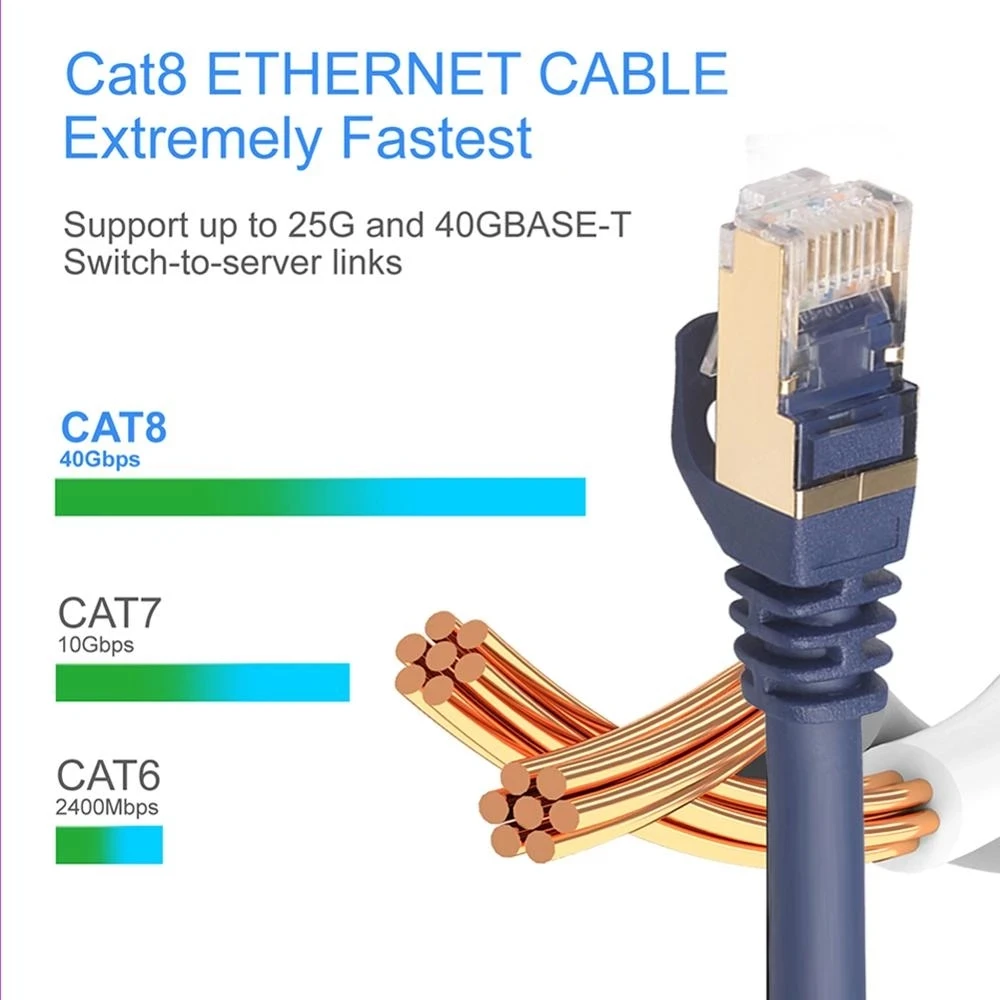
Table of Contents
- What Exactly is a Category 8 (Cat8) Cable?
- Cat8 Speed vs. Distance: The Critical Relationship
- How Does Cat8 Compare to Other Ethernet Categories?
- The Core Technical Specifications of Cat8 Cabling
- When is Using Cat8 Cable the Right Choice? (Practical Use Cases)
- Frequently Asked Questions (FAQ) About Cat8 Speed
- Conclusion: Harnessing the Power of Cat8 with DLAyCable
What Exactly is a Category 8 (Cat8) Cable?
Category 8, or Cat8, represents the latest generation of twisted-pair copper Ethernet cabling recognized by the ANSI/TIA-568 standard. It was developed specifically to address the burgeoning need for higher bandwidth inside data centers. Unlike previous categories that were designed for general office or home networking, Cat8’s primary application is for switch-to-server connections in a data center architecture. It is the designated cabling for emerging **25GBASE-T** and **40GBASE-T** network applications.
Think of it as a specialized tool for a very specific, high-demand job. While a Cat6 or Cat6a cable is a versatile workhorse for most networking needs, Cat8 is the high-performance engine designed to connect servers, storage area networks (SANs), and network switches that are located in close proximity, such as within the same server rack or adjacent racks (Top-of-Rack or End-of-Row configurations). This focus on short-distance, high-speed data transmission is what sets it apart from every other category.
Cat8 Speed vs. Distance: The Critical Relationship
The performance of any Ethernet cable is intrinsically linked to its length. For Cat8, this relationship is more critical than ever. The advertised speed of 40,000 Mbps is not a universal guarantee; it is a specification tied directly to a defined channel length. Understanding this limitation is key to properly implementing Cat8 and achieving its full potential.
The 40 Gbps / 30-Meter “Golden Rule”
The official TIA standard specifies that a Cat8 channel can support **40 Gbps speeds for a total length of 30 meters (98 feet)**. This 30-meter channel includes the permanently installed “backbone” cable (up to 24 meters) and two patch cords at either end (totaling up to 6 meters). This structure, known as a 2-connector channel, is typical for data center server connections. The 30-meter limit was deliberately chosen because it covers the vast majority of switch-to-server connection distances required in Top-of-Rack (ToR), Middle-of-Row (MoR), and End-of-Row (EoR) data center designs, making it a highly practical and cost-effective copper solution compared to fiber optics for these specific scenarios.
What Happens Beyond 30 Meters?
If you attempt to use a Cat8 cable for a run longer than 30 meters, you will not be able to reliably achieve 40 Gbps. The signal integrity will degrade significantly due to factors like insertion loss and crosstalk. While the cable will still function, its performance will “down-clock” and it will likely behave similarly to a high-quality Cat6a cable, supporting speeds closer to 10 Gbps. Therefore, for any network runs exceeding this 30-meter threshold, it is technically and financially more prudent to use a different cabling solution, such as Cat6a for up to 100 meters at 10 Gbps, or to transition to fiber optic cabling for longer distances or even higher speeds.
How Does Cat8 Compare to Other Ethernet Categories?
To truly appreciate the capabilities of Cat8, it’s helpful to see it in context with the other popular Ethernet standards. Each category was designed with a specific performance target and application in mind. Here’s a clear breakdown of their differences:
| Category | Max Speed | Max Bandwidth | Typical Application |
|---|---|---|---|
| Cat5e | 1 Gbps (1,000 Mbps) | 100 MHz | Basic Home & Small Office |
| Cat6 | 1 Gbps (up to 100m) 10 Gbps (up to 55m) |
250 MHz | Standard Home & Office, Gaming |
| Cat6a | 10 Gbps (10,000 Mbps) | 500 MHz | Business Networks, Prosumers, Future-Proofing |
| Cat7 | 10 Gbps (10,000 Mbps) | 600 MHz | *Proprietary standard, not TIA recognized* |
| Cat8 | 40 Gbps (40,000 Mbps) | 2000 MHz | Data Centers, Server-to-Switch Links |
As the table illustrates, the jump from Cat6a to Cat8 is not just an incremental improvement; it’s a monumental leap in performance. The data rate quadruples from 10 Gbps to **40 Gbps**, and the supported frequency also quadruples from 500 MHz to **2000 MHz**. This is why Cat8 is considered a new class of cable, specifically for the data center, while Cat6a remains the gold standard for most other high-performance enterprise and residential needs.
The Core Technical Specifications of Cat8 Cabling
The ability of Cat8 to handle 40,000 Mbps is not magic; it’s a result of stringent engineering and material requirements. Several key technical specifications work in concert to deliver this level of performance.
Unmatched Bandwidth: The 2000 MHz Advantage
While speed (Gbps) tells you how much data you can transfer per second, bandwidth (MHz) refers to the range of frequencies a cable can carry a signal over. A higher bandwidth is like a wider highway—it can accommodate more data traffic simultaneously and at higher speeds with less interference or “traffic jams.” Cat8’s **2000 MHz bandwidth** is a crucial component of its 40 Gbps capability. This extremely high frequency allows for more data to be encoded onto the signal, but it also makes the signal more susceptible to noise. This leads directly to the next critical specification: shielding.
Mandatory Shielding: Why S/FTP is Standard
To operate reliably at 2000 MHz, Cat8 cabling requires robust protection against electromagnetic interference (EMI) and crosstalk. Consequently, Cat8 cables are always shielded. The most common and effective construction is **S/FTP (Screened/Foiled Twisted Pair)**. This involves:
- Foil Shielding (FTP): Each individual pair of twisted wires is wrapped in a foil shield. This isolates the pairs from each other, drastically reducing near-end crosstalk (NEXT).
- Overall Screen (S): A braided screen is then wrapped around all four of the foil-shielded pairs. This outer shield protects the cable from external noise and, most importantly, *alien crosstalk* (AXT)—the interference from adjacent, separately-run cables.
This dual-shielding design is non-negotiable for achieving Cat8 performance standards and ensures a clean, stable signal capable of carrying 40 Gbps of data.
Connectors and Compatibility: The Familiar RJ45
Despite its advanced internal construction, a key advantage of Cat8 is its use of the standard **RJ45 connector**. This means it is physically backward compatible with all previous Ethernet categories and network equipment, from Cat5e to Cat6a. You can plug a Cat8 cable into a standard laptop, router, or switch. While you will only get the performance level supported by the weakest link in your network (e.g., a 1 Gbps port), this compatibility makes phased upgrades and integration in mixed-environment setups seamless. This is a significant practical advantage over some proprietary or fiber optic connector types.
When is Using Cat8 Cable the Right Choice? (Practical Use Cases)
Given its high cost and specific performance characteristics, deploying Cat8 cable requires careful consideration. It is a powerful but specialized solution.
The primary and intended use case is for **Data Centers and Server Rooms**. Here, Cat8 shines as a cost-effective alternative to fiber optics for short-run, high-speed interconnects. It’s perfect for linking network switches to servers within a single rack (ToR) or between adjacent racks. For IT managers planning a data center migration to 25GBASE-T or 40GBASE-T infrastructure, Cat8 is the copper cabling standard to use.
For most other applications, including **home networking, gaming, or standard office use**, Cat8 is considered overkill. Your internet connection, router, and devices are almost certainly not capable of transmitting or receiving data at 40 Gbps. A high-quality Cat6 or Cat6a cable, which comfortably handles 1 Gbps and 10 Gbps respectively, is far more practical, cost-effective, and provides all the performance needed for these tasks with headroom to spare.
Frequently Asked Questions (FAQ) About Cat8 Speed
Is Cat8 overkill for gaming?
Yes, absolutely. Online gaming relies more on low latency (ping) than raw throughput. A stable connection from a Cat6 or Cat6a cable is more than sufficient to provide a low-latency, high-quality gaming experience. You will see no tangible benefit from using a Cat8 cable for gaming.
Can I use a Cat8 cable for my home internet connection?
You can, as it is backward compatible. However, you will not experience 40 Gbps speeds. Your network speed will be limited by your Internet Service Plan (ISP) and your slowest piece of equipment (e.g., a 1 Gbps router port). Cat8 cables are also thicker, stiffer, and more expensive than Cat6a, making them less practical for residential wiring.
What is the difference between Cat8.1 and Cat8.2?
These are two classes defined within the ISO/IEC standard (a global counterpart to TIA). The main difference is the connector type. **Cat8.1** uses the standard RJ45 connector and is interoperable with Cat6a and previous categories. **Cat8.2** uses non-RJ45 connectors (like TERA or GG45) and offers slightly better performance but is not backward compatible with common equipment. For nearly all applications, Cat8.1 is the standard you will encounter and use.
Conclusion: Harnessing the Power of Cat8 with DLAyCable
In summary, a Cat8 cable is an engineering marvel capable of handling an immense **40,000 Mbps (40 Gbps)** over a distance of up to 30 meters. Its power is derived from its massive 2000 MHz bandwidth and mandatory S/FTP shielding, features designed exclusively for the high-density, short-distance demands of modern data centers.
While it represents the pinnacle of copper Ethernet technology, its application is highly specialized. For data center professionals building or upgrading infrastructure to support 25GBASE-T or 40GBASE-T applications, Cat8 is the definitive choice. For all other enterprise, small business, and residential networking, a high-quality Cat6a cable remains the more practical and cost-effective solution, delivering ample performance for years to come.
When your application demands the absolute highest performance and reliability, the quality of your cabling is non-negotiable. At DLAyCable, we provide rigorously tested, standards-compliant Cat8 cabling solutions designed to meet the mission-critical needs of your network infrastructure. Trusting in a certified partner ensures that when you invest in 40 Gbps technology, you get the performance you paid for.