


A Category 8 (Cat 8) Ethernet cable has a maximum channel length of 30 meters (98 feet) when used for its intended 25GBASE-T or 40GBASE-T speeds. This specific distance limitation is a crucial factor that defines Cat 8’s role as a specialized, high-performance solution, primarily designed for short-distance connections within data centers. Unlike its predecessors, which can run up to 100 meters, Cat 8 trades distance for an incredible leap in data transmission speed. At D-Lay Cable, with over two decades of hands-on experience in designing and implementing structured cabling systems, we understand that choosing the right cable is about more than just speed; it’s about matching the technology to the application. dlaycable will provide an in-depth look into the capabilities and limitations of Cat 8 cabling, helping you understand where it excels and when other solutions are more appropriate.
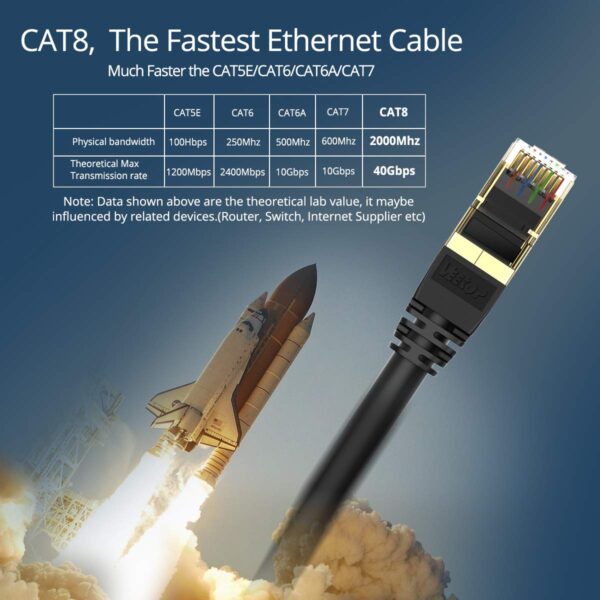
Table of Contents
- The Direct Answer: The Cat 8 Distance Limitation
- What is a Cat 8 Cable? Beyond the Basics
- Understanding the “30-Meter Channel”: Permanent Link vs. Patch Cords
- Cat 8 vs. Other Categories: A Comparative Analysis
- Where is Cat 8 Cable Actually Used? The Ideal Applications
- Why Cat 8 is (Usually) Overkill for Your Home or Office
- Frequently Asked Questions about Cat 8 Cabling
- Partner with D-Lay Cable for Your Structured Cabling Needs
The Direct Answer: The Cat 8 Distance Limitation
To be unequivocally clear, the maximum supported length for a Cat 8 Ethernet cable channel is 30 meters (approximately 98 feet). This is the standard set by the Telecommunications Industry Association (TIA) in the ANSI/TIA-568.2-D standard. This length is not an arbitrary number; it’s the maximum distance over which the cable can reliably support data transfer rates of 25 Gbps (25GBASE-T) and 40 Gbps (40GBASE-T). Attempting to run a Cat 8 cable beyond this 30-meter limit will likely result in significant signal degradation, increased errors, and a failure to achieve the target speeds. The signal simply attenuates, or weakens, too much over a longer distance to maintain the integrity needed for such high-frequency transmissions. This is a fundamental trade-off in physics: to push more data (higher frequency), you must reduce the distance it can travel over a copper medium.
What is a Cat 8 Cable? Beyond the Basics
Category 8 is the latest generation of twisted-pair copper Ethernet cabling, representing a significant advancement over previous categories like Cat 6a and Cat 7. Its primary purpose is to provide a copper-based alternative to fiber optics for high-speed, short-reach applications, particularly in data centers. What makes it so powerful? The key lies in its specifications. Cat 8 supports a frequency of up to 2000 MHz, which is four times that of Cat 6a (500 MHz) and double that of Cat 7 (1000 MHz). This massive bandwidth is what allows it to transport data at a staggering 40 Gbps.
To handle these incredibly high frequencies and prevent interference, Cat 8 cables are exclusively shielded. You will typically find them in F/UTP (foil over unshielded twisted pairs) or S/FTP (screened/braided shield over foiled twisted pairs) constructions. This robust shielding is non-negotiable; it’s essential for mitigating alien crosstalk (ANEXT) and electromagnetic interference (EMI) from adjacent cables and power sources, which become exponentially more problematic at 2000 MHz. This construction makes the cable thicker, less flexible, and more expensive than its unshielded counterparts, reinforcing its status as a specialized industrial-grade solution.
Understanding the “30-Meter Channel”: Permanent Link vs. Patch Cords
When professionals refer to the 30-meter limit, we’re not just talking about a single, long cable. We are referring to the *entire channel*. In a professionally installed structured cabling system, a channel is the complete end-to-end connection between two active devices, such as a server and a network switch. According to TIA standards, this channel is composed of a “permanent link” and patch cords.
The Permanent Link: The Backbone of Your Connection
The permanent link is the fixed portion of the cabling installed within the walls, ceilings, or data center racks. It runs from a patch panel at one end to a wall outlet or another patch panel at the other. For a Cat 8 channel, the permanent link has a maximum length of 24 meters (79 feet). This is the “backbone” of the connection and is not meant to be frequently moved or changed. Our BICSI-certified technicians at D-Lay Cable take meticulous care during the installation of this component, as its integrity is paramount for network performance.
Patch Cords: The Final Connection
Patch cords are the shorter, more flexible cables used to connect the active equipment to the permanent link. For instance, one patch cord connects a network switch to the patch panel, and another connects a server to the wall outlet. In a standard Cat 8 two-connector channel, the combined length of these patch cords cannot exceed 6 meters (20 feet). This architecture provides flexibility for moving equipment (a practice known as “Moves, Adds, and Changes”) without disturbing the critical permanent link infrastructure.
Cat 8 vs. Other Categories: A Comparative Analysis
To truly appreciate the role of Cat 8, it’s essential to see how it stacks up against other common Ethernet cable categories. While Cat 8 boasts the highest speed, other categories offer advantages in distance and cost, making them more suitable for different environments. As structured cabling experts, we believe in using the right tool for the job, and this table illustrates why.
| Feature | Cat 6 | Cat 6a | Cat 7 | Cat 8 |
|---|---|---|---|---|
| Max Speed | 1 Gbps (up to 10 Gbps at reduced distances) | 10 Gbps | 10 Gbps | 40 Gbps |
| Max Distance (at top speed) | 100 meters (328 feet) | 100 meters (328 feet) | 100 meters (328 feet) | 30 meters (98 feet) |
| Max Bandwidth (Frequency) | 250 MHz | 500 MHz | 600 MHz | 2000 MHz |
| Shielding | Optional (UTP is common) | Recommended (U/FTP or F/UTP) | Required (S/FTP) | Required (F/UTP or S/FTP) |
| Best Use Case | Home networks, small offices, VoIP | Modern offices, new builds, 10G networks | Data centers, shielded environments (Not TIA recognized) | Data centers, switch-to-server links |
The key takeaway from this comparison is the stark trade-off between speed and distance. While Cat 6a can reliably deliver 10 Gbps over the full 100-meter distance, making it an excellent and future-proof choice for entire office buildings, Cat 8 is purpose-built for short, high-velocity data transfers. It’s also important to note that Cat 7, while often marketed, is not an officially recognized standard by the TIA and uses a proprietary GG45 connector, leading to compatibility issues. For this reason, our professional recommendation for new 10G deployments is almost always Cat 6a.
Where is Cat 8 Cable Actually Used? The Ideal Applications
Given its short reach and high cost, Cat 8 is not a general-purpose cable. Its application is highly specific and targeted. You will find Cat 8 cabling deployed in environments where its unique combination of extreme speed and short distance is not a limitation, but a perfect fit for the infrastructure topology.
The Heart of the Data Center
The primary home for Cat 8 is the modern data center. In these facilities, server racks are arranged in rows, and the distance between a “Top-of-Rack” (ToR) switch and the servers within that same rack is typically only a few meters. Using Cat 8 here allows for lightning-fast 25G or 40G connections between servers and the switch, facilitating rapid data processing, storage access, and inter-server communication. This is far more cost-effective than using fiber optic transceivers and cables for these very short runs.
High-Speed Switch-to-Server Links
Cat 8 also excels in “End-of-Row” (EoR) or “Middle-of-Row” (MoR) architectures, where a central switch serves an entire row of server racks. As long as the total channel length from the switch to the furthest server remains within the 30-meter specification, Cat 8 provides a powerful and robust copper infrastructure. This avoids the need for more expensive active equipment and keeps operational costs down, a critical consideration in any large-scale data center deployment.
Why Cat 8 is (Usually) Overkill for Your Home or Office
We often get asked by enthusiastic tech adopters if they should wire their home or office with Cat 8 to “future-proof” their network. While we admire the forward-thinking, our honest, expert advice is that for 99% of residential and commercial applications, Cat 8 is unnecessary and impractical. Here’s why:
- Cost: Cat 8 cabling and its associated components (keystones, patch panels) are significantly more expensive than Cat 6a.
- Device Limitation: Virtually no consumer-grade or standard office equipment (laptops, desktops, printers, smart TVs) has a 25G or 40G Ethernet port. Your network is only as fast as its slowest component, meaning a Cat 8 cable will simply operate at the 1G or 10G speed of your device’s network card.
- Distance Limitation: The 30-meter distance limit can be a real problem in a home or office, where cable runs from a central networking closet to various rooms can easily exceed this length.
For these reasons, Cat 6a is the superior choice for future-proofing a home or modern office. It delivers a powerful 10 Gbps speed over the full 100-meter channel length, which is more than enough bandwidth for high-definition streaming, online gaming, and heavy office workloads for many years to come, all at a more reasonable cost and with greater installation flexibility.
Frequently Asked Questions about Cat 8 Cabling
As leaders in structured cabling solutions, we encounter many questions about this cutting-edge technology. Here are answers to some of the most common inquiries.
Is Cat 8 backwards compatible?
Yes, absolutely. Cat 8 cables use the same RJ45 connector that has been the standard for Ethernet for decades. You can plug a Cat 8 cable into a device with a 1 Gbps or 10 Gbps port, and it will work perfectly fine. The connection will simply auto-negotiate to the highest speed supported by both the cable and the device port, which in this case would be 1 Gbps or 10 Gbps. You won’t get 40 Gbps speed, but the connection will be stable and reliable.
Can I use Cat 8 for Power over Ethernet (PoE)?
Yes, Cat 8 is not only compatible with all PoE standards (including the latest high-power 802.3bt, or PoE++), but it’s also exceptionally good at it. Because Cat 8 cables have thicker copper conductors (typically 22AWG) compared to Cat 6 or Cat 6a, they offer less electrical resistance. This means they dissipate less heat and deliver power more efficiently over the cable, making them an excellent choice for powering high-wattage devices like PTZ security cameras or advanced wireless access points.
Is Cat 8 worth the investment?
This is the ultimate question, and the answer is: *it depends entirely on the application*.
- For a data center building a 25G/40G copper infrastructure: Yes, Cat 8 is absolutely worth it. It’s the TIA-standardized, cost-effective solution for short-reach, high-speed links.
- For a business wiring a new office for 10G connectivity: No, Cat 6a is the far better investment, offering the required performance over a longer distance at a lower cost.
- For a homeowner wanting the “best” cable: No, it is not worth the extra cost. Your money is better spent on a high-quality Cat 6a installation, which will serve all your needs for the foreseeable future.
Partner with D-Lay Cable for Your Structured Cabling Needs
Navigating the complexities of network cabling standards requires more than just reading specifications; it requires real-world experience. For over 20 years, D-Lay Cable has been the trusted partner for businesses across various industries, from commercial offices to mission-critical data centers. Our team of licensed, bonded, and BICSI-certified technicians doesn’t just install cables—we design and implement robust, scalable, and cost-effective structured cabling solutions.
Whether you’re building a new data center that requires a precise Cat 8 deployment, upgrading your office to a future-proof Cat 6a network, or need expert consultation on the best fiber optic solution, we are here to help. We prioritize quality, safety, and customer satisfaction in every project we undertake. Don’t guess what your network needs; let our experts provide a clear path forward. Contact D-Lay Cable today for a professional consultation and discover the difference that experience makes.