


FT4/CMR rated fireproof cabling is a specialized category of communications wire engineered to meet strict fire safety standards for vertical installations within building shafts, known as risers. This rating signifies that the cable has passed the FT4 vertical flame test (a Canadian standard) and is classified as ‘Communications Multipurpose Cable, Riser’ (CMR) under the U.S. National Electrical Code (NEC). Its primary function is to resist the spread of fire from one floor to another, making its use a critical component of building code compliance and life safety systems in multi-story structures. Choosing certified FT4/CMR Rated Fireproof Cabling ensures that your project will pass inspection, avoid costly rework, and most importantly, enhance the overall fire safety of the building.
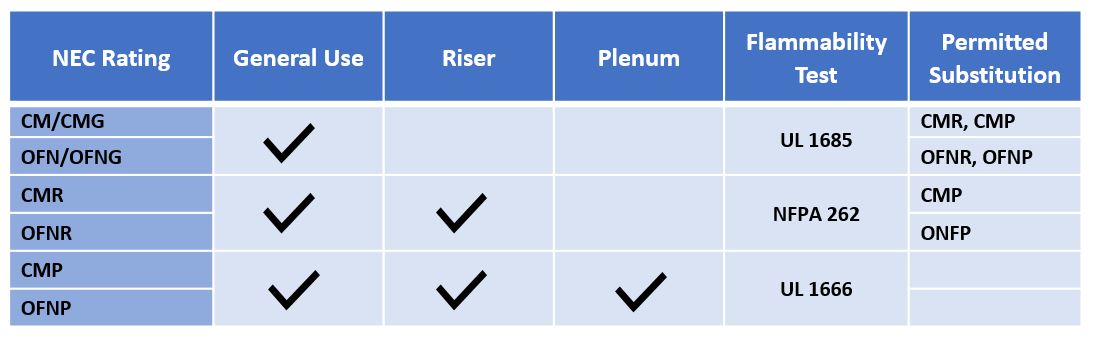
Table of Contents
- What Exactly Defines FT4 and CMR Rated Cabling?
- Why is Fire Rating So Important for Building Safety and Code Compliance?
- How Do You Navigate the National Electrical Code (NEC) for Riser Applications?
- Where Must FT4/CMR Cabling Be Installed?
- How Do Cable Fire Ratings Compare: CMR vs. CMP vs. CMG/CM?
- What Are the Repercussions of Using Non-Compliant Cabling?
- How to Reliably Select and Verify a Compliant FT4/CMR Cable
- D-Lay Cable: Your Partner in Code-Compliant Cabling Solutions
- Common Questions About Riser-Rated Cabling
What Exactly Defines FT4 and CMR Rated Cabling?
Understanding the terminology printed on a cable’s jacket is the first step toward ensuring compliance. The designations FT4 and CMR are not just arbitrary letters; they represent rigorous testing and specific applications mandated by safety codes. These ratings certify a cable’s performance during a fire, specifically its ability to resist burning and limit the vertical propagation of flames.
Unpacking the CMR (Communications Multipurpose Riser) Rating
The CMR rating is defined by the U.S. National Electrical Code (NEC). The ‘R’ in CMR stands for “Riser,” which refers to a vertical space or shaft that passes between floors, such as an elevator shaft or a dedicated utility chase. Cables installed in these spaces must be CMR rated to prevent a fire from “climbing” the cable from a lower floor to an upper one. To earn this rating, cables must pass the UL 1666 “Standard Test for Flame Propagation Height of Electrical and Optical-Fiber Cables Installed Vertically in Shafts.” This test simulates a riser environment to verify the cable will self-extinguish and not carry a flame more than a specified distance.
Understanding the FT4 Vertical Flame Test Rating
The FT4 rating is a Canadian standard, part of the Canadian Electrical Code (CEC) and managed by standards organizations like CSA Group. It involves the “Vertical Flame Test,” where a bundle of cables is subjected to a powerful, direct flame for 20 minutes. To pass, the char damage on the cables must not exceed a specific height (1.5 meters). The FT4 test is considered more stringent than the U.S. test for standard CM (General Purpose) cables and is widely accepted as being equivalent in performance to the CMR riser test. This is why many high-quality cables are dual-rated as FT4/CMR.
Are FT4 and CMR Interchangeable?
For all practical purposes in the context of fire resistance for vertical runs, yes. A cable marked with both FT4 and CMR ratings has been verified to meet the fire safety standards for riser installations in both the United States and Canada. This dual rating provides installers and inspectors with a clear and immediate confirmation of compliance. A cable that only carries an FT4 rating is generally accepted as meeting CMR requirements, and vice versa, due to the similar nature and intent of the flame tests.
Why is Fire Rating So Important for Building Safety and Code Compliance?
The emphasis on fire-rated cabling is not about bureaucratic red tape; it is a fundamental pillar of modern building safety engineering. In the event of a fire, every component within a building’s infrastructure can either contribute to the hazard or help contain it. Low-voltage cabling, which runs extensively throughout walls, ceilings, and shafts, plays a significant role in this dynamic.
The Role of Cabling in Fire Propagation
Standard, unrated cables often have jackets made from materials like PVC that can burn easily. In a vertical riser shaft, which can act like a chimney, a burning cable can rapidly transport fire from its point of origin to subsequent floors, bypassing fire-stopping measures and accelerating the spread of the disaster. FT4/CMR cabling is constructed with a jacket containing special flame-retardant compounds. When exposed to fire, these compounds create a char that resists burning and helps to self-extinguish the flame, effectively compartmentalizing the fire.
Mitigating Smoke and Toxic Fumes
Beyond the spread of flames, the smoke produced by burning materials is a primary threat to life. Burning plastics, including common cable jackets, can release dense, opaque smoke and highly toxic fumes, such as hydrogen chloride. This smoke obscures exit routes and can cause incapacitation or death long before the fire itself reaches occupants. While CMR cables are not “low-smoke” like their more advanced CMP (Plenum) counterparts, their flame-retardant properties mean they produce significantly less smoke and toxins than non-rated cables simply because they resist combustion more effectively.
How Do You Navigate the National Electrical Code (NEC) for Riser Applications?
The National Electrical Code (NEC), specifically NFPA 70, is the authoritative standard for electrical and communications wiring in the United States. It provides a clear hierarchy for cabling based on application to ensure a baseline level of safety. Understanding which articles apply is key to proper installation.
Key NEC Articles: 725, 760, and 800
Different types of low-voltage systems are governed by different articles within the NEC, but they share a similar fire-rating hierarchy.
- NEC Article 800: Covers Communications Circuits, such as Ethernet (Cat5e, Cat6), telephone, and data wiring. This is the most common article referenced for CMR cabling.
- NEC Article 760: Pertains to Fire Alarm Systems (FAS). These circuits require FPLR (Fire Power-Limited Riser) rated cables, which have similar fire-resistance properties to CMR.
- NEC Article 725: Addresses Class 1, 2, and 3 Remote-Control, Signaling, and Power-Limited Circuits, often used for access control, security, and building automation. The riser-rated cable here is CL2R or CL3R.
In all these cases, the ‘R’ signifies a Riser rating suitable for vertical runs.
Defining “Riser” Spaces in a Building
According to the NEC, a riser is any vertical pathway that extends through one or more floors. This is not limited to dedicated communications closets. It includes any opening or shaft, such as floor penetrations for conduits or cable trays that run from a basement to a top-floor office. If a cable passes from the first floor to the second floor through a hole in the floor, it is considered a riser application and must be, at minimum, CMR rated.
Where Must FT4/CMR Cabling Be Installed?
Correctly identifying the environment where a cable will be installed is mandatory for compliance. Buildings are divided into three primary zones for low-voltage cabling, each with its own minimum cable rating requirement. Using a cable rated for a less stringent environment in a more demanding one is a serious code violation.
FT4/CMR cable is specifically designed for use in vertical riser shafts connecting different floors. However, because it has a higher fire rating than general-purpose (CM/CMG) cable, it can also be used as a substitute in any area where CM/CMG cable would be appropriate, such as in walls or for horizontal runs on a single floor (that are not in a plenum space).
The following table breaks down the primary installation zones and their required cable ratings:
| Installation Zone | Description | Minimum Cable Rating |
|---|---|---|
| Plenum Space | The space used for air circulation in HVAC systems, such as the area above a drop ceiling or below a raised floor. This is the most restrictive zone due to the risk of circulating smoke. | CMP (Communications Multipurpose, Plenum) / FT6 |
| Riser Space | Vertical shafts, conduits, or pathways connecting two or more floors of a building. | CMR (Communications Multipurpose, Riser) / FT4 |
| General Purpose Space | All other areas that are not plenums or risers, such as horizontal runs within walls or conduit on a single floor. | CM/CMG (Communications Multipurpose / General) / FT1 |
How Do Cable Fire Ratings Compare: CMR vs. CMP vs. CMG/CM?
The NEC establishes a clear hierarchy for cable ratings. This system allows for substitution: a higher-rated cable can always be used in an application requiring a lower rating, but never the other way around. Understanding this hierarchy is essential for both compliance and cost-effective project planning.
CMP (Plenum): For Air Handling Spaces
CMP (Plenum) rated cable sits at the top of the hierarchy. It is designed for installation in plenum air spaces. It undergoes the most stringent fire test (NFPA 262 / UL 910), also known as the “Steiner Tunnel Test.” This test measures not only flame spread but also smoke density. CMP cables are made with jackets from low-smoke plastics like FEP (Fluorinated Ethylene Propylene) and are significantly more expensive than CMR or CM cables.
CMG/CM (General Purpose): For Limited, Non-Riser, Non-Plenum Use
CMG (General Purpose) or CM rated cable is at the bottom of the hierarchy. It is suitable only for general-purpose wiring, such as a patch cable in a room or a horizontal run inside a wall on a single floor. It passes a basic “tray flame test” (FT1 or VW-1) to show it resists ignition from a small flame but offers minimal protection against spreading a significant fire. It is strictly prohibited for use in riser or plenum applications.
Can a Higher-Rated Cable Substitute a Lower-Rated One?
Absolutely. This is a key principle of the NEC’s hierarchical system.
- A CMP (Plenum) cable can be used in a riser, in a general-purpose wall, or as a patch cord.
- A CMR (Riser) cable can be used in a general-purpose wall or as a patch cord, but not in a plenum space.
- A CM/CMG (General Purpose) cable can only be used in general-purpose applications.
This flexibility can be useful. For example, if an installer has leftover CMR cable from a riser pull, it is perfectly safe and compliant to use it for horizontal wall runs on the same project.
What Are the Repercussions of Using Non-Compliant Cabling?
Using an incorrectly rated cable, such as running a cheaper CM cable through a riser, is not a minor oversight. It carries significant and costly consequences that can impact a project’s budget, timeline, and legal standing.
Failed Inspections and Costly Rework
This is the most immediate consequence. A knowledgeable building inspector will check the markings on the communications cabling in risers and plenums. If non-compliant cable is found, the inspector will fail the inspection, halting the project. The contractor will then be required to remove all of the incorrect cable and replace it with the properly rated type. This “rip and replace” process is incredibly expensive, involving labor costs for both removal and re-installation, as well as the cost of the new, compliant cable.
Legal Liability and Insurance Complications
In the event of a fire, investigators will determine the cause and spread of the blaze. If it is found that non-compliant cabling contributed to the fire’s propagation or produced excessive smoke, the installer, contractor, and even the building owner can be held liable for damages and loss of life. Insurance companies may deny claims if it is proven that building codes were knowingly or negligently violated.
Compromised Safety
Ultimately, the most critical consequence is the risk to human life. Building codes exist for a reason: to create a safe environment. Bypassing cable fire ratings to save a small amount on material costs directly undermines the building’s integrated fire safety system and places occupants at unnecessary risk.
How to Reliably Select and Verify a Compliant FT4/CMR Cable
Ensuring you are purchasing and installing genuinely compliant cabling is straightforward if you know what to look for. The cable itself holds all the necessary information, provided it comes from a reputable source.
Reading and Verifying Cable Jacket Markings
All compliant communications cables have a legend printed along the length of the outer jacket. This legend is your primary source of truth. For a riser-rated data cable, you should look for several key pieces of information:
- Rating: The letters “CMR” must be clearly printed.
- Flame Test: The designation “(FT4)” should also be present for dual-rated cables.
- Certification Mark: A mark from a Nationally Recognized Testing Laboratory (NRTL) such as UL (Underwriters Laboratories) or ETL (Intertek). This proves it was independently tested.
- Manufacturer Name: Identifies the source of the cable.
- Cable Type: E.g., “CAT6,” “23AWG 4PR.”
If a cable is missing the CMR rating or a valid UL/ETL mark, it is not compliant for riser installations, regardless of any claims made by the seller.
The Importance of UL/ETL Certification
The UL or ETL mark is your guarantee that the cable has been tested by an independent third party and meets the safety standards it claims. Uncertified or counterfeit cables are a major problem in the industry. These cables may have fraudulent markings and are often made with substandard materials that will not perform as required in a fire. Sourcing cable from a trusted manufacturer or supplier that provides legitimate, certified products is the only way to guarantee compliance and performance.
D-Lay Cable: Your Partner in Code-Compliant Cabling Solutions
At D-Lay Cable, we recognize that compliance is non-negotiable. The integrity of your network infrastructure and the safety of the building’s occupants depend on using the correct, high-quality components. We are a direct manufacturer and supplier committed to providing professional-grade cabling solutions that meet and exceed industry standards.
Every spool of our FT4/CMR rated cable is manufactured with premium materials and subjected to stringent quality control. Our products are fully certified by UL and/or ETL, with all necessary markings clearly printed on the jacket for easy verification by installers and inspectors. By sourcing directly from us, you not only get access to competitively priced, high-performance cabling but also the peace of mind that comes from knowing your installation is built on a foundation of safety and compliance. We empower our clients to complete their projects correctly the first time, eliminating the risk of failed inspections and costly rework.
Common Questions About Riser-Rated Cabling
Even for seasoned professionals, specific scenarios can raise questions. Here are answers to some of the most common inquiries regarding FT4/CMR cable.
Can I use CMR cable in my home for residential wiring?
Yes, and it’s a good practice. While residential building codes (for single-family homes) are often less strict about low-voltage wiring than commercial codes, using CMR cable provides an added layer of fire safety. It is perfectly acceptable to use a higher-rated cable like CMR for residential network or media installations.
Is FT4/CMR cable suitable for outdoor or direct burial use?
No. The CMR rating pertains only to a cable’s fire resistance for indoor riser applications. It does not indicate that the cable has protection against moisture, UV radiation from sunlight, or the physical stress of being buried. For outdoor or direct burial applications, you must use a cable specifically designated as “Outdoor Rated,” “Direct Burial,” or “CABLE-TV (CATV)” which features a weather-resistant jacket, often made of LLDPE (Linear Low-Density Polyethylene).
What is the typical cost difference between CM, CMR, and CMP cable?
There is a distinct price hierarchy. CM/CMG cable is the least expensive. CMR cable is moderately more expensive due to the flame-retardant compounds in its jacket. CMP cable is the most expensive by a significant margin, often costing two to three times as much as CMR, because of the specialized low-smoke, low-flame plastics required for its construction.