


When planning your building’s network infrastructure, the choice between Cat6 and Cat6A cabling is a critical decision that impacts performance, budget, and future-readiness. For new installations requiring reliable 10-Gigabit Ethernet (10GbE) over standard distances up to 100 meters, or for future-proofing a building against rising bandwidth demands, upgrading to Cat6A is necessary. While Cat6 can support 10GbE, it is limited to very short distances (under 55 meters) and is not the certified standard for 10GbE performance. Cat6 remains a sufficient and cost-effective solution for smaller networks with 1Gbps requirements, such as typical homes and small businesses.
Understanding the Core Differences: What Separates Cat6 and Cat6A?
At first glance, Cat6 and Cat6A cables might seem similar, but their internal construction and performance capabilities are vastly different. Both are twisted-pair copper cables used for Ethernet networking, but they are built to different standards set by the Telecommunications Industry Association (TIA). Understanding these standards is the first step in making an informed decision for your building’s low-voltage infrastructure.
A Quick Look at Category 6 (Cat6)
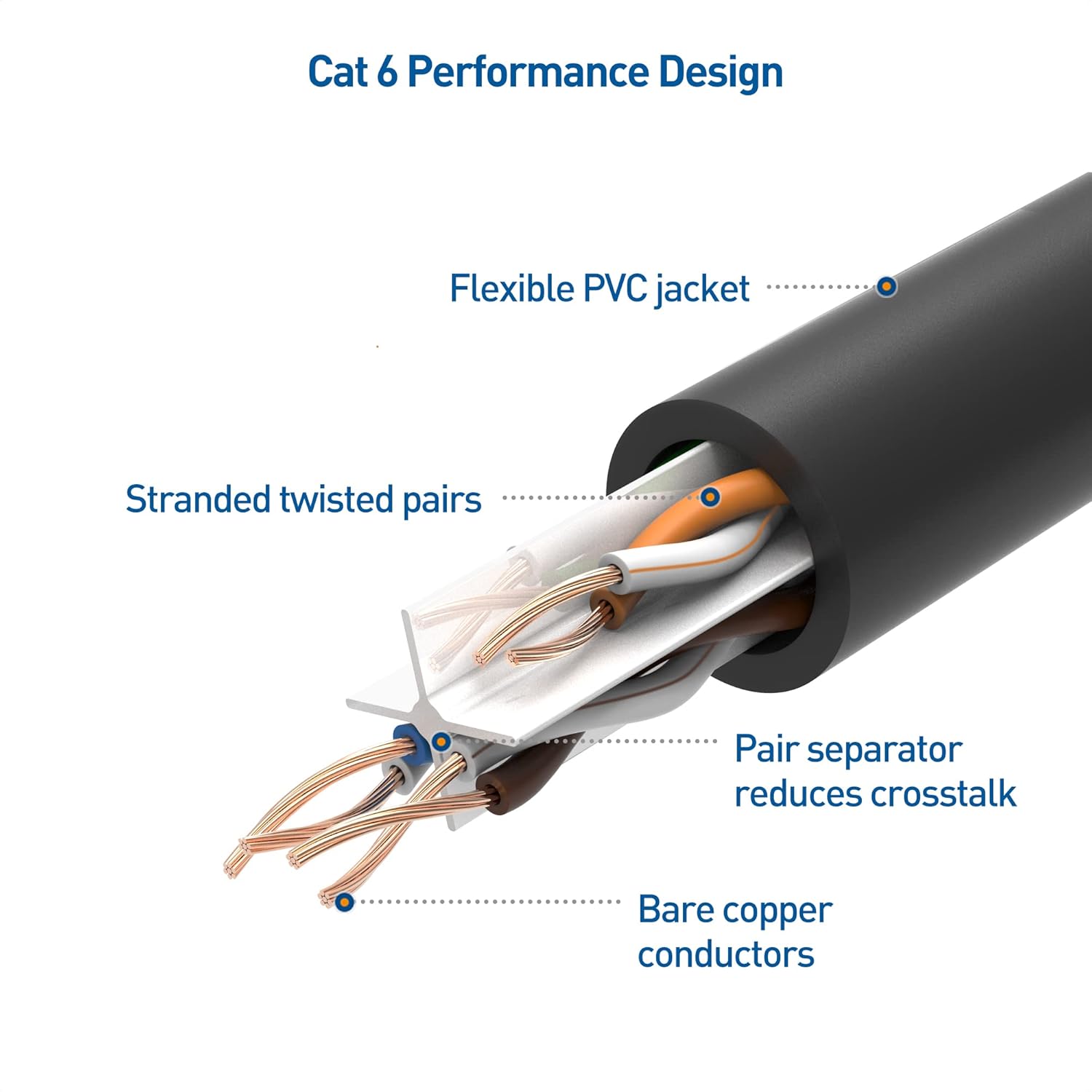
Category 6 cabling was introduced in the early 2000s as an improvement over Cat5e, designed to reliably support 1-Gigabit Ethernet (1GbE) speeds. It operates at a frequency of 250 MHz, which provides greater bandwidth and a better signal-to-noise ratio than its predecessors. For years, Cat6 has been the go-to standard for new commercial and residential installations, comfortably handling everyday tasks like high-speed internet browsing, HD video streaming, and standard office data traffic over distances up to 100 meters (328 feet).
The key limitation of Cat6 emerges when discussing 10-Gigabit Ethernet. While it can technically achieve 10GbE speeds, it can only do so over a significantly reduced distance—typically between 37 to 55 meters (121 to 180 feet), depending on the level of alien crosstalk in the environment. This makes it unsuitable for providing a complete 10GbE backbone in most commercial buildings where cable runs often exceed this length.
Introducing Category 6 Augmented (Cat6A)
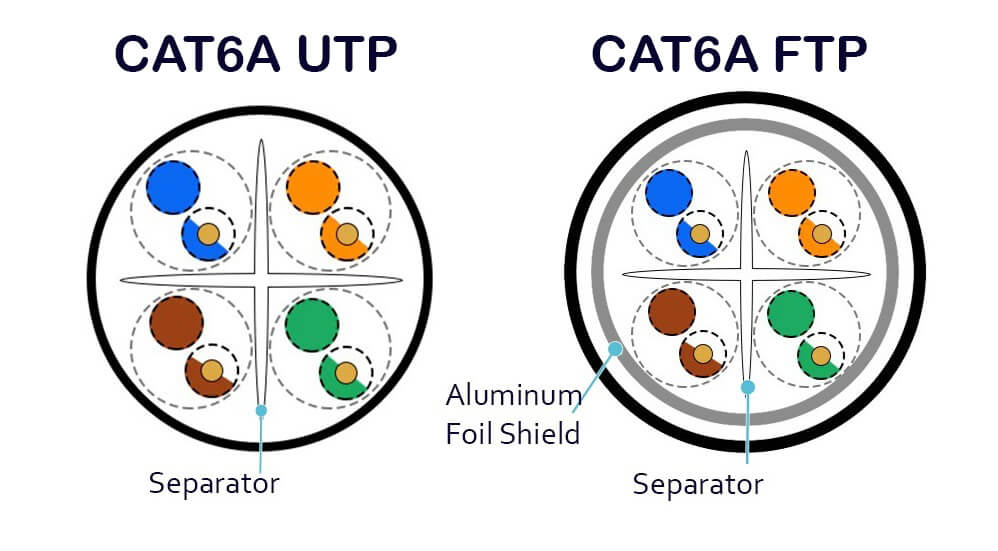
As the demand for faster networks grew, Category 6 Augmented (Cat6A) was standardized in 2008 specifically to address the shortcomings of Cat6. The ‘A’ for Augmented signifies its enhanced capabilities. Cat6A is designed and certified to reliably deliver 10GbE performance over the full 100-meter (328-foot) channel. It achieves this by operating at a much higher frequency of 500 MHz, double that of Cat6.
This increased frequency is made possible by significant improvements in cable construction. Cat6A cables have more tightly twisted pairs, larger copper conductors, and enhanced shielding or internal spacing to combat a critical issue known as Alien Crosstalk (ANEXT)—the electronic noise interference between adjacent cables. This robust design is what makes Cat6A the official industry standard (TIA-568-C.2) for 10GBASE-T deployments.
Head-to-Head Comparison: Cat6 vs. Cat6A in Detail
Choosing the right cable becomes easier when you see the specifications laid out side-by-side. This table highlights the fundamental differences in performance, design, and cost that define the choice between Cat6 and Cat6A.
| Feature | Category 6 (Cat6) | Category 6 Augmented (Cat6A) |
|---|---|---|
| Max Speed | 1Gbps (10Gbps under 55m) | 10Gbps |
| Max Distance for 10GbE | ~37-55 meters (121-180 ft) | 100 meters (328 ft) |
| Bandwidth/Frequency | 250 MHz | 500 MHz |
| Alien Crosstalk (ANEXT) | Susceptible at higher frequencies | Highly Resistant by design |
| Cable Diameter | Thinner (~0.25 inches) | Thicker (~0.35 inches), up to 40% larger |
| Power over Ethernet (PoE) | Good for PoE/PoE+ | Excellent for all PoE types, including high-power PoE++ (Type 3 & 4) |
| Cost (Cable & Components) | Lower | Higher (20-35% more) |
| Installation | Easier, more flexible bend radius | More challenging due to thickness and stiffness |
The 10GbE Question: Can Cat6 Really Handle 10-Gigabit Speeds?
The answer to this question is a nuanced “yes, but…” that carries significant implications for network design. Technically, Cat6 cabling can transmit data at 10 Gbps. However, this capability is severely constrained by distance and environmental factors. The primary culprit is Alien Crosstalk (ANEXT), which is interference that “leaks” from one cable to another when they are run in close proximity, such as in a bundle or conduit. At the higher frequencies required for 10GbE, Cat6 cables are not designed to sufficiently mitigate this interference, leading to data errors and packet loss over longer distances.
This is why the TIA standard only supports 10GbE on Cat6 for runs up to 55 meters, and even that distance can be reduced in “noisy” environments with many parallel cables. In a real-world building infrastructure, where cable runs from a patch panel to a wall outlet can easily exceed this limit, relying on Cat6 for a 10GbE network is a risky gamble. Cat6A, by contrast, was engineered from the ground up to solve this problem. Its superior insulation, tighter twists, and often an internal spline or overall shield effectively nullify alien crosstalk, guaranteeing robust 10Gbps performance across the full 100-meter channel. Therefore, if 10GbE is a firm requirement, Cat6A is the only choice that ensures standards-compliant performance and reliability.
Why Does Future-Proofing Matter in Cabling Infrastructure?
When discussing building infrastructure, the concept of future-proofing is not just a buzzword; it’s a critical financial and operational strategy. The physical cabling in your walls and ceilings is the most difficult and expensive component of your network to replace. While active hardware like switches and routers are replaced every 3-7 years, a building’s structured cabling is expected to have a lifespan of 15-20 years or more. The cost of a cabling installation is heavily weighted towards labor—pulling, terminating, and testing cables—rather than the material itself.
Choosing Cat6 today might save you 20-30% on material costs, but if your bandwidth needs surpass 1Gbps in five or ten years, you will face a “rip and replace” scenario. This involves not only the high cost of new cabling and installation labor but also significant disruption to your business operations. By investing in Cat6A now, you are installing a network backbone capable of supporting not just 10GbE, but also the next generation of high-bandwidth technologies. This includes next-gen Wi-Fi standards (Wi-Fi 6E/7), which require multi-gigabit backhaul, an explosion of Internet of Things (IoT) devices, high-resolution AV-over-IP systems, and advanced building automation—all of which will strain a 1Gbps network.
Beyond Speed: Other Critical Factors to Consider
While the 1Gbps vs. 10Gbps debate is central, other performance factors can make Cat6A the superior choice even if you don’t plan on a full 10GbE upgrade immediately. Power over Ethernet and installation logistics are two major considerations.
Power over Ethernet (PoE) Performance
Power over Ethernet (PoE) technology, which delivers both data and electrical power over a single Ethernet cable, is becoming ubiquitous. It powers everything from VoIP phones and security cameras to wireless access points and smart lighting. The latest PoE standards, PoE+ (802.3at) and PoE++ (802.3bt), deliver significantly more power (up to 60W and 90-100W, respectively) to support more demanding devices.
When delivering this much power, cables generate heat. Cat6A has a distinct advantage here due to its construction. Its larger gauge conductors offer less electrical resistance, and its overall thicker diameter allows for better heat dissipation compared to Cat6. This is crucial for cables run in large, tight bundles, where heat buildup can degrade data performance and even pose a safety concern. For any building planning to deploy high-power PoE++ devices like pan-tilt-zoom (PTZ) cameras, advanced Wi-Fi 6 access points, or digital signage, Cat6A is the recommended and often required choice for ensuring stable performance and safety.
Installation and Physical Constraints
The robust design of Cat6A comes with physical trade-offs. Cat6A cables are noticeably thicker and heavier than their Cat6 counterparts. This has practical implications for installation. The larger diameter means that fewer Cat6A cables can fit into a given size of conduit or cable tray. This requires careful planning of your cable pathways and may necessitate larger conduits, increasing initial material costs.
Furthermore, Cat6A cables are stiffer and have a larger minimum bend radius, meaning they cannot be bent as sharply as Cat6 cables without risking damage or performance degradation. This demands more space in wall boxes, behind patch panels, and around corners. It also requires installers to be more skilled and meticulous. While Cat6 is more forgiving and faster to install, the stringent requirements for a certified Cat6A installation ensure a higher quality, more reliable final product.
Making the Right Choice: Which Cable is for You?
The optimal choice between Cat6 and Cat6A depends entirely on your specific use case, budget, and long-term vision for the space. There is no single “best” answer, only the “right” answer for your project.
Scenarios Where Cat6 is Still a Viable Choice
Despite the advantages of Cat6A, Cat6 remains a perfectly practical and cost-effective option in several scenarios:
- Standard Home Networks: For the vast majority of homes, a 1Gbps network is more than sufficient for streaming 4K video, online gaming, and general internet use. Most consumer-grade modems and routers only have 1Gbps ports, making Cat6 the logical and budget-friendly choice.
- Small Businesses with Basic Needs: A small office with fewer than 20 employees primarily using cloud-based applications, email, and moderate file sharing will operate flawlessly on a 1Gbps Cat6 network. If the budget is tight and 10GbE is not on the horizon, Cat6 delivers excellent value.
- Short-Term or Temporary Installations: For office leases or installations where the expected lifespan is less than 5-7 years, the added cost of Cat6A may not provide a worthwhile return on investment.
When is Upgrading to Cat6A a Non-Negotiable?
For a growing number of applications, the upfront investment in Cat6A is not just an upgrade but a necessity for ensuring long-term viability and performance:
- New Commercial Construction & Major Renovations: The “install it once, install it right” principle applies here. For any new build or gut renovation, the marginal cost of Cat6A is a small price to pay for a 15-20 year future-proof infrastructure.
- Data Centers: In data centers, 10GbE is often the minimum speed for server-to-switch and switch-to-switch links. Cat6A is the default copper cabling standard in these environments.
- Healthcare, Education, and Hospitality: These sectors have rapidly escalating bandwidth demands due to medical imaging (PACS), e-learning platforms, high-density Wi-Fi deployments, and media streaming. Cat6A provides the necessary headroom for growth.
- Installations Requiring High-Power PoE++: As mentioned, if you plan to deploy the latest generation of power-hungry devices, Cat6A is essential for safe and reliable operation.
- Any Network with a 10GbE Roadmap: If your organization’s IT strategy includes upgrading your core network to 10Gbps within the next 5 years, installing Cat6A cabling from the start is the only logical and cost-effective path.
Conclusion: Investing in Your Network’s Future
The decision between Cat6 and Cat6A boils down to a classic conflict: balancing today’s budget against tomorrow’s needs. Cat6 is the reliable workhorse of the 1-Gigabit era, offering solid performance at an attractive price point for applications with clearly defined and limited demands. It is the practical choice for many homes and small businesses where cost is a primary driver.
However, Cat6A represents a strategic investment in the future of your building’s connectivity. It is the definitive standard for 10-Gigabit Ethernet over copper and provides the robust foundation required to support the next wave of wireless, IoT, and high-power PoE technologies. For any new construction, major renovation, or forward-thinking organization, the slightly higher upfront cost of Cat6A is an insurance policy against the far greater expense and disruption of a premature network overhaul. By choosing Cat6A, you aren’t just installing cables; you are building a high-performance digital foundation that will serve your needs for decades to come.