


Cat8 Ethernet cables significantly reduce crosstalk through a combination of superior shielding and tighter twisted-pair construction. Specifically, Cat8 cables utilize an S/FTP (Screened/Foiled Twisted Pair) design, where each individual pair of copper wires is wrapped in a foil shield, and then all four pairs are encased in an overall braided screen. This dual-layer shielding acts as a robust barrier, effectively blocking electromagnetic interference (EMI) from both internal sources (crosstalk) and external sources, ensuring pristine signal integrity for high-frequency data transmission up to 2000 MHz.
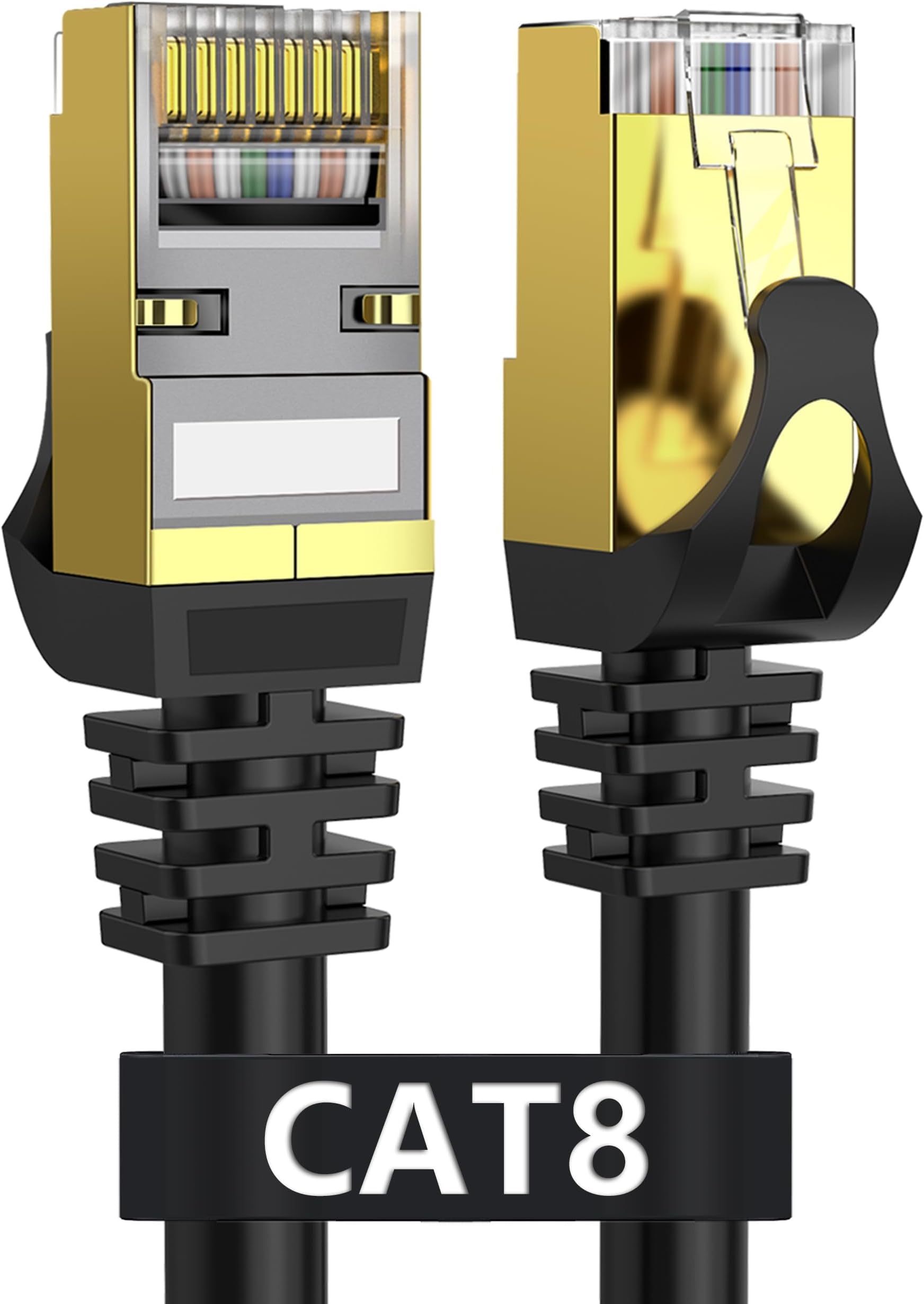
Table of Contents
What is Crosstalk in Ethernet Cabling? A Deep Dive
Before understanding how Cat8 cables solve the problem, it’s crucial to define what we’re fighting against. In networking, crosstalk is the unintentional and undesirable transfer of an electrical signal from one wire to a nearby parallel wire. Imagine having a quiet conversation in a library, but someone next to you starts talking loudly; their voice “bleeds” into your conversation, making it hard to hear. In an Ethernet cable, data is transmitted as electrical pulses. When these pulses on one wire pair induce a similar, weaker signal on an adjacent pair, it corrupts the data, leading to errors, packet loss, and reduced network performance. This phenomenon is a form of electromagnetic interference (EMI), but it’s generated internally within the same cable or from adjacent cables.
Understanding Near-End Crosstalk (NEXT)
Near-End Crosstalk (NEXT) is the interference measured at the same end of the cable as the transmitting source. The signal on a transmitting pair induces a signal back onto an adjacent receiving pair. Because the transmitted signal is strongest at its source, NEXT is often the most powerful and disruptive form of crosstalk. It’s like shouting into a microphone and hearing your own echo immediately in your earpiece. The measurement compares the strength of the transmitted signal to the strength of the induced crosstalk signal at the transmitting end. A higher NEXT value (measured in decibels) is better, as it indicates a larger difference between the intended signal and the noise, signifying less interference.
Understanding Far-End Crosstalk (FEXT)
Conversely, Far-End Crosstalk (FEXT) is the interference measured at the opposite end of the cable from the transmitter. The signal travels down a wire pair and, as it does, induces crosstalk onto an adjacent pair, which is then measured at the receiving end. The original signal weakens or attenuates as it travels the length of the cable. Consequently, the FEXT measurement is generally lower than NEXT. While less potent than NEXT, FEXT is still a significant factor in signal degradation, especially over longer cable runs where the intended signal has weakened considerably, making it more vulnerable to even slight interference.
The Challenge of Alien Crosstalk (AXT)
Alien Crosstalk (AXT) is a particularly troublesome form of interference that occurs between adjacent cables in a bundle, rather than between pairs within a single cable. As network speeds and frequencies increase, the electromagnetic fields generated by each cable become stronger and can more easily “jump” to neighboring cables. This is especially problematic in data centers, server rooms, and patch panels where dozens or hundreds of cables are bundled tightly together. Unshielded cables (UTP) are highly susceptible to AXT. For high-speed applications like 25GBASE-T and 40GBASE-T, which Cat8 is designed for, mitigating Alien Crosstalk is not just beneficial—it’s mandatory for reliable performance.
How Does Cat8’s Design Conquer Crosstalk?
The Category 8 standard was engineered from the ground up to support extremely high frequencies (up to 2000 MHz) and data rates (up to 40 Gbps). Achieving this level of performance required a radical approach to crosstalk mitigation, focusing on two primary engineering principles: superior shielding and tighter pair twists. This robust construction is the key to its noise-canceling prowess.
The First Line of Defense: Individual Pair Shielding
The most significant feature of a Cat8 cable is its mandatory S/FTP (Screened/Foiled Twisted Pair) construction. The first layer of this shielding involves wrapping each individual twisted pair of wires in a metallic foil. This is often referred to as PiMF (Pairs in Metal Foil). This foil shield acts as a Faraday cage for each pair, effectively containing its electromagnetic field and preventing it from bleeding over to adjacent pairs. This directly and aggressively combats internal crosstalk like NEXT and FEXT. By isolating each signal path, the integrity of the data transmitted on each pair is preserved, which is fundamental for achieving the high-fidelity transmission required for 40 Gbps speeds.
The Second Line of Defense: Overall Braided Shielding
After each pair is individually shielded, Cat8’s S/FTP design incorporates a second, outer shield. This is typically a tinned copper braid that encases all four of the foil-wrapped pairs. This overall screen provides two critical benefits. First, it offers an additional layer of protection against any residual internal crosstalk that might escape the individual foil shields. Second, and more importantly, it provides a robust defense against external noise, specifically Alien Crosstalk (AXT). When multiple Cat8 cables are bundled together, this outer braid on each cable prevents the electromagnetic fields from one cable from interfering with its neighbors. This makes Cat8 the ideal choice for high-density data center environments.
Enhanced Signal Cancellation with Tighter Twists
Twisted-pair technology has been the foundation of Ethernet cabling for decades. By twisting two wires together, the electromagnetic fields they generate largely cancel each other out. Cat8 cabling takes this principle to an extreme. To manage the massive 2000 MHz frequency, the wire pairs in a Cat8 cable are twisted much more tightly and with greater precision than in any previous category, such as Cat6a or Cat7. These tighter twists result in more effective cancellation of noise, further reducing crosstalk between the wires within a pair. When combined with the dual-layer shielding, this creates a signal channel that is exceptionally resilient to all forms of electromagnetic interference, ensuring clean and error-free data transmission.
Cat8 vs. Other Categories: A Crosstalk Comparison
To truly appreciate Cat8’s advancements, it’s helpful to compare its crosstalk mitigation features with its predecessors. Each category represents a step-change in performance, largely driven by improvements in handling interference. The move from unshielded to shielded and the increasing complexity of that shielding is a clear trend as frequencies rise.
| Category | Typical Shielding | Frequency | Crosstalk Resistance |
|---|---|---|---|
| Cat5e | UTP (Unshielded Twisted Pair) | 100 MHz | Low. Relies solely on pair twisting. Susceptible to NEXT and AXT. |
| Cat6 | UTP (often with a spline) | 250 MHz | Moderate. Tighter twists and a central spline physically separate pairs, reducing NEXT. Still vulnerable to AXT. |
| Cat6a | UTP or F/UTP (Foiled/Unshielded Twisted Pair) | 500 MHz | High. Shielded versions (F/UTP) offer good AXT resistance. UTP versions use special construction to mitigate AXT. |
| Cat7 | S/FTP (Screened/Foiled Twisted Pair) | 600 MHz | Very High. Standardized shielding on each pair and an overall screen provides excellent NEXT, FEXT, and AXT mitigation. |
| Cat8 | S/FTP (mandatory and more robust) | 2000 MHz | Exceptional. The most advanced S/FTP design, coupled with extreme twist rates, is built to handle the immense crosstalk challenges at 2 GHz. |
Why Does Crosstalk Mitigation Matter for Cat8?
The need for extreme crosstalk mitigation in Cat8 is directly tied to its operating frequency of 2000 MHz (2 GHz). This is four times the frequency of Cat6a and more than three times that of Cat7. A fundamental principle of physics dictates that the higher the frequency of an electrical signal, the stronger the electromagnetic field it radiates. This means that at 2000 MHz, the potential for both internal and alien crosstalk is exponentially greater than at lower frequencies. Without the advanced shielding and construction of Cat8, the signals would be so thoroughly corrupted by noise that 25GBASE-T and 40GBASE-T data transmission would be impossible, even over very short distances. Cat8’s design isn’t just an improvement; it’s a necessity to make these next-generation speeds viable over twisted-pair copper cabling.
Practical Implications for Cat8 Implementation
The robust construction of Cat8 has practical consequences. The extensive shielding makes the cables thicker, stiffer, and less flexible than their lower-category counterparts. This requires a larger bend radius and more careful handling during installation to avoid damaging the shields or disrupting the precise pair twists. Furthermore, to maintain the integrity of the shielding system, Cat8 cables must be terminated with compatible shielded connectors (like GG45 or TERA) and grounded properly. An improper termination or a break in the grounding can render the entire shielding system ineffective, exposing the cable to the very interference it was designed to prevent. Therefore, while Cat8 offers unparalleled performance in crosstalk reduction, it demands a higher level of skill and attention to detail during installation and termination.
Frequently Asked Questions
Is Cat8 overkill for a home network?
Yes, for most current home network applications, Cat8 is overkill. Home networks typically run at 1 Gbps or 10 Gbps, speeds for which Cat6 or Cat6a cables are more than sufficient and much more cost-effective and flexible. Cat8 is designed for short-distance (up to 30 meters) connections in high-bandwidth data centers.
Do you need special connectors for Cat8?
Yes. To fully benefit from Cat8’s shielding, you must use shielded connectors that are rated for Cat8 performance. The RJ45 connector is compatible, but it must be a shielded, Cat8-rated version. For full performance, connectors like GG45 or TERA are often recommended. Using an unshielded or lower-category connector will compromise the cable’s ability to reduce crosstalk.
Does Cat8 completely eliminate all crosstalk?
No technology can completely eliminate 100% of all electromagnetic interference. However, the design of Cat8 reduces crosstalk to such a low level that it no longer interferes with the data signal, allowing for error-free transmission at its specified speed and frequency. It meets the stringent requirements of the ANSI/TIA-568-C.2-1 standard for this purpose.