


Yes, a CAT6 cable can support 10 Gbps, but only for distances up to 55 meters (180 feet) under ideal conditions. For longer runs, CAT6A is the standard.
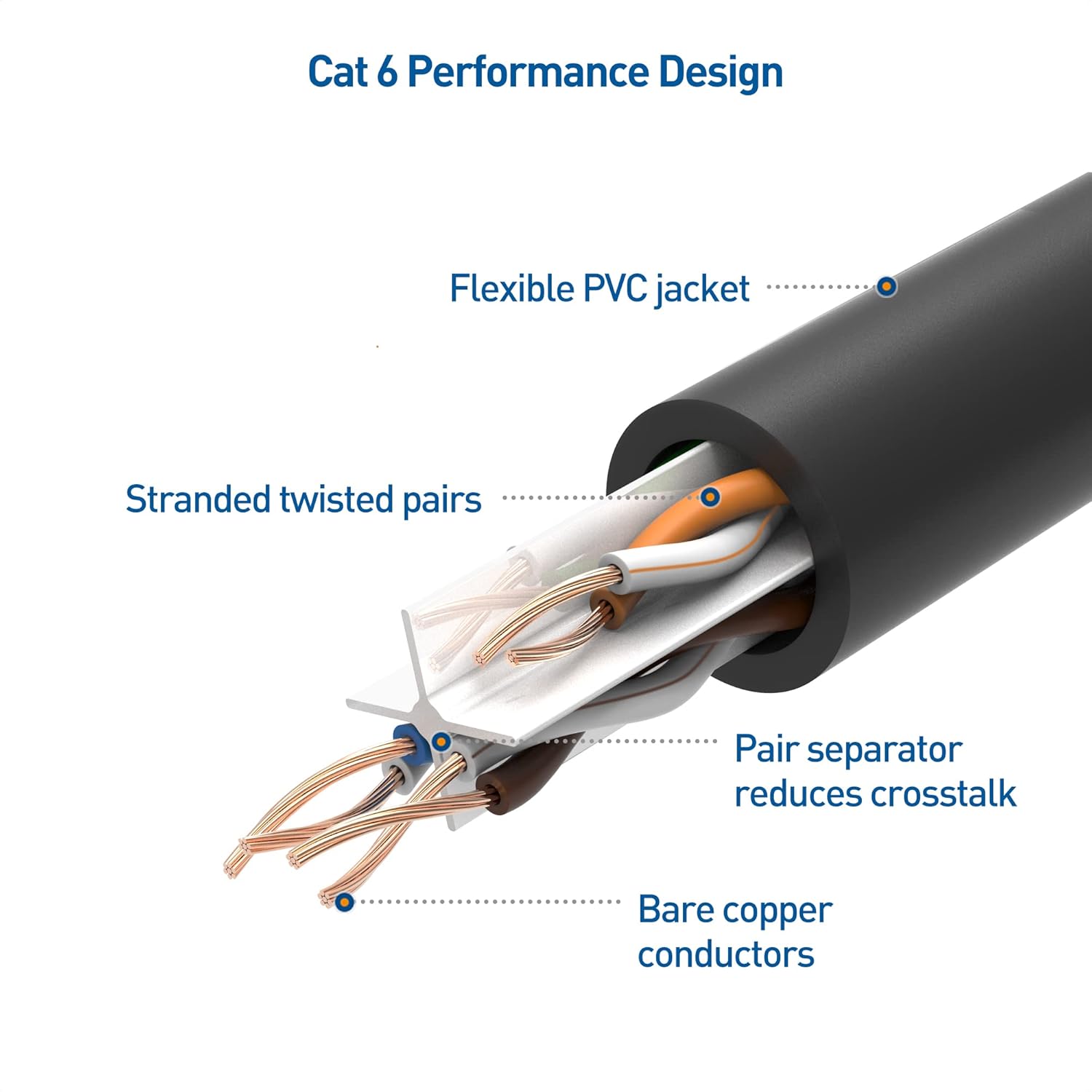
Understanding What Dictates 10 Gbps Capability in a CAT6 Cable
The ability of a Category 6 (CAT6) cable to handle 10 Gigabit Ethernet speeds is not determined by the cable alone. It’s a complex interplay between industry standards, the physical properties of the cable, and the environment in which it is installed. Two primary factors govern this performance: the 10GBASE-T standard and a phenomenon known as Alien Crosstalk.
The Role of the 10GBASE-T Standard
The IEEE 802.3an standard, commercially known as 10GBASE-T, is the technology that defines the requirements for transmitting 10 Gbps data streams over twisted-pair copper cabling. This standard was engineered to work with the superior CAT6A specification but also established performance parameters for existing CAT6 infrastructure. It pushes the frequency required for data transmission far beyond CAT6’s native 250 MHz design, which introduces significant performance challenges that must be managed.
Critical Factors: Distance and Alien Crosstalk (ANEXT)
The single greatest obstacle for 10GBASE-T over CAT6 is Alien Crosstalk (ANEXT). While standard crosstalk refers to signal interference between pairs within a single cable, ANEXT is the interference imposed on a cable by other nearby, “alien” cables. At the high frequencies required for 10 Gbps, signals are much more susceptible to this external noise. As the length of the cable run increases, the cumulative effect of ANEXT can corrupt the data signal, leading to transmission errors and a failure to maintain a stable 10 Gbps link. This is the fundamental reason why distance becomes the critical limiting factor.
The Official Verdict on CAT6 Speed and Distance Limitations
The Telecommunications Industry Association (TIA) and other standards bodies provide clear guidance on the performance expectations for CAT6 cabling in a 10GBASE-T environment. The answer isn’t a simple yes or no but is instead qualified by a strict distance limitation that network installers and IT professionals must respect to guarantee performance.
Up to 55 Meters: The Qualified “Yes”
According to the TIA/EIA-568 standard, a CAT6 cable can reliably support a 10 Gbps data rate up to a maximum distance of 55 meters (approximately 180 feet). Within this range, and especially in environments with low ANEXT, CAT6 is considered capable of handling 10GBASE-T traffic. This makes it a viable solution for smaller-scale deployments where cable runs between switches, servers, and endpoints are relatively short. However, this performance is contingent on using high-quality, standards-compliant cabling and proper installation.
Beyond 55 Meters: Why Performance Declines
Once a CAT6 cable run exceeds 55 meters, its ability to support a 10 Gbps link becomes unreliable and is not standards-compliant. The primary reason for this sharp decline is the combination of signal attenuation (the weakening of the signal over distance) and the aforementioned Alien Crosstalk. At higher frequencies, the signal degrades more quickly. Over a longer distance, the cable is exposed to more potential sources of ANEXT from adjacent power or data lines, eventually overpowering the data signal and making it impossible for the networking equipment to distinguish between valid data and noise.
Comparing CAT6 vs. CAT6A: Which is Right for 10 Gigabit Ethernet?
When planning for a 10 Gbps network, the choice often comes down to CAT6 and its successor, Category 6 Augmented (CAT6A). While CAT6 offers a conditional path to 10G speeds, CAT6A was specifically engineered from the ground up to handle the demands of 10GBASE-T over the full standard distance, making it the superior and recommended choice for all new installations.
Frequency and Bandwidth Differences
The most significant technical difference lies in their bandwidth capabilities. CAT6 is rated for a frequency of 250 MHz, which is sufficient for 1 Gbps networking over 100 meters. In contrast, CAT6A is rated for 500 MHz. This doubling of the frequency provides a much larger and more robust data pipeline, allowing it to handle the demanding signaling of 10GBASE-T with significantly more headroom and less susceptibility to errors over long distances.
Construction and Shielding Insights
To achieve its superior performance and mitigate Alien Crosstalk, CAT6A cables are constructed more robustly. They typically feature tighter-twisted pairs, a larger overall diameter, and enhanced shielding. Many CAT6A cables, such as those available from a specialized supplier like DLAyCABLE, incorporate foil shielding around individual pairs (U/FTP) or an overall foil shield around all pairs (F/UTP). This shielding acts as a barrier against external electromagnetic interference and, most importantly, isolates the cable from the ANEXT generated by its neighbors—the very factor that limits CAT6 performance.
A Head-to-Head Comparison Table
This table provides a clear summary of the key differences between CAT6 and CAT6A for 10 Gbps applications.
| Feature | CAT6 | CAT6A |
|---|---|---|
| 10 Gbps Max Distance | Up to 55 meters (180 ft) | Up to 100 meters (328 ft) |
| Standard Frequency | 250 MHz | 500 MHz |
| Alien Crosstalk (ANEXT) | Susceptible, especially in bundles | Engineered to mitigate ANEXT |
| Construction | Thinner, often unshielded (UTP) | Thicker, often includes a spline and/or shielding (F/UTP, U/FTP) |
| Primary Use Case for 10G | Short-run data center links, existing infrastructure upgrades | All new 10G installations, future-proofing, PoE applications |
In What Scenarios is Using CAT6 for 10G a Practical Choice?
Despite its limitations, there are specific situations where leveraging CAT6 for 10 Gbps networking is a perfectly reasonable and cost-effective decision. The choice depends entirely on the physical constraints of the environment and the performance requirements of the network link.
Short-Distance Connections (Data Centers, Home Labs)
The most common and appropriate use for CAT6 in a 10G network is for short interconnects. This is ideal within a server rack for connecting servers to a top-of-rack switch, or for linking network hardware within the same room or communications closet. In these controlled environments, cable runs are typically well under the 55-meter threshold, and high-quality patch cords can deliver flawless 10 Gbps performance.
Existing Infrastructure Upgrades
For buildings already wired with a CAT6 infrastructure, performing a complete re-cabling with CAT6A can be prohibitively expensive. In these cases, a company may choose to selectively upgrade specific, mission-critical links to 10 Gbps. As long as those targeted cable runs have been verified to be under 55 meters and are properly tested for performance, it can serve as a viable bridge solution to higher speeds without a complete overhaul.
How to Maximize Your Chances of Achieving 10 Gbps on CAT6 Cabling
If you plan to run 10GBASE-T over existing or new CAT6 cabling, adhering to a strict set of best practices is essential. These steps will help mitigate the inherent limitations of the cable and increase the likelihood of establishing a stable, high-performance link.
Prioritize High-Quality, Certified Cables
Not all CAT6 cables are created equal. To maximize performance, it is crucial to use cables from a reputable supplier that meet or exceed TIA/EIA-568 certification standards. Premium CAT6 cables from providers like DLAyCABLE are manufactured with high-purity copper conductors and superior insulation, ensuring they can consistently perform at the upper limits of the specification. Avoid unverified, low-cost alternatives, as they often fail to meet the required performance tolerances for 10G.
Adhere to Proper Installation Techniques
Flawless installation is non-negotiable. During installation, installers must respect the cable’s minimum bend radius to avoid damaging the internal twisted pairs. Terminations onto patch panels and keystone jacks must be performed meticulously according to T568A or T568B wiring schemes. Furthermore, when bundling cables, avoid using overly tight zip ties, which can deform the cable jacket and alter the geometry of the twisted pairs, increasing crosstalk.
Testing and Verification for Performance Assurance
You cannot assume a CAT6 link will support 10 Gbps, even if it is shorter than 55 meters. The only way to be certain is to test and certify the link using a professional-grade network cable analyzer. These tools can run a 10GBASE-T certification test that measures all relevant parameters, including insertion loss, return loss, and, most importantly, Alien Crosstalk. A successful test provides documented proof that the link meets the standard’s requirements and will reliably support 10 Gbps traffic.