


In today’s hyper-connected world, a fast and stable internet connection is no longer a luxury—it’s a necessity. But the speed you pay for from your internet service provider is only part of the equation. The unsung hero of your network is the Ethernet cable, the physical link that carries data between your devices. Choosing the right one can be the difference between a seamless digital experience and a frustratingly slow one.
As a leading manufacturer of high-performance cabling solutions, we at D-Lay Cable understand the critical role these components play. Two of the most common cables you’ll encounter are Cat5e and Cat6. While they may look similar, their internal construction and performance capabilities are vastly different. dlaycable will break down those differences to help you make an informed decision for your home or business.
A Quick Comparison: Cat5e vs. Cat6 at a Glance
Before we dive into the technical details, here’s a straightforward comparison. Note that we are comparing Cat5e (Enhanced Category 5) with Cat6, as the original Cat5 standard is now largely obsolete and not recommended for new installations.
| Feature | Cat5e Cable | Cat6 Cable |
|---|---|---|
| Max Speed | 1 Gbps (1,000 Mbps) | 10 Gbps (up to 55 meters) |
| Bandwidth | 100 MHz | 250 MHz |
| Crosstalk Reduction | Basic | Superior (Tighter twists, spline) |
| Best For | Basic home networking, small offices, budget-sensitive applications. | Future-proofing, business networks, gaming, 4K streaming, high-performance needs. |
Diving Deeper: The Key Differences Explained
Now, let’s explore what those specifications mean in the real world.
Performance: Speed and Bandwidth
This is the most significant difference. Speed (measured in Gigabits per second, Gbps) is how fast data can be transferred, while Bandwidth (measured in Megahertz, MHz) is the capacity of the connection to handle that data.
- Cat5e: Supports speeds up to 1 Gbps at 100 MHz bandwidth. For many years, this has been the standard for home and office use, perfectly capable of handling HD streaming, online browsing, and most gaming.
- Cat6: Takes a major leap forward, supporting speeds up to 10 Gbps over shorter distances (up to 55 meters or 180 feet) and a standard 1 Gbps over longer distances. It operates at 250 MHz bandwidth, more than double that of Cat5e.
Think of it like a highway: Cat5e is a two-lane highway, while Cat6 is a five-lane superhighway. Both can have the same speed limit (1 Gbps over long distances), but the Cat6 superhighway can handle far more traffic at once without congestion, enabling higher potential speeds over shorter distances.
Construction and Crosstalk Reduction
The performance boost in Cat6 isn’t magic; it comes from superior engineering and construction. A key factor is the reduction of “crosstalk.”
Crosstalk (XT) is the signal interference that occurs when cables run alongside each other. It can corrupt data packets, reduce speed, and create an unstable connection. Cat6 is specifically designed to combat this:
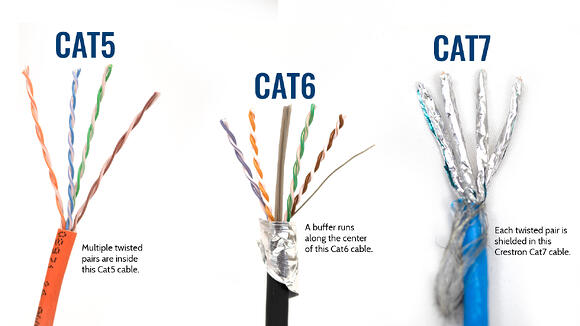
- Tighter Twists: The pairs of copper wires inside a Cat6 cable are twisted more tightly than in a Cat5e cable. This helps to nullify interference from adjacent wire pairs.
- Spline (Separator): Many Cat6 cables include a plastic spine, or “spline,” that runs down the center, physically separating the four twisted pairs. This provides a significant barrier against crosstalk, ensuring a cleaner signal.
- Thicker Sheath: Cat6 cables often have a thicker outer jacket, further protecting the internal wires from external interference.
This robust construction is why Cat6 provides a more reliable and stable connection, especially in environments with a lot of electronic noise or many bundled cables.
Cost vs. Long-Term Investment
Due to its more complex construction and higher-grade materials, a Cat6 cable is typically 20-30% more expensive than a comparable length of Cat5e cable. While Cat5e might be tempting for its lower upfront cost, it’s essential to view this decision as an investment.
For any new installation or major upgrade, we strongly recommend Cat6. The modest increase in cost is a small price to pay for a network that is future-proof. As internet speeds increase and devices like 4K/8K TVs, network-attached storage (NAS), and high-end gaming rigs demand more bandwidth, a Cat6 infrastructure ensures you won’t have a bottleneck in your local network.
Backward Compatibility and Installation
The good news is that both Cat5e and Cat6 cables use the same standard RJ45 connector. This means Cat6 is fully backward compatible. You can plug a Cat6 cable into a device designed for Cat5e and it will work perfectly (though it will be limited to Cat5e speeds).
However, the physical differences in Cat6 cables—their thicker gauge and internal spline—make them slightly more rigid and less flexible than Cat5e cables. This can make installation in tight corners or conduits a bit more challenging, but it’s a minor consideration for the significant performance gains.
So, Which Cable Should You Choose?
Your choice ultimately depends on your specific needs and budget.
Choose Cat5e if:
- You are on a tight budget.
- Your internet plan is 1 Gbps or less and you have no plans to upgrade soon.
- You are simply replacing a single, short cable in an existing home setup.
– Your primary activities are web browsing, email, and standard HD video streaming.
Choose Cat6 if:
- You are building a new home or office or doing a major renovation. This is the time to future-proof.
- You are a serious gamer or a content creator who needs low latency and high-speed data transfer.
- Your network includes high-performance devices like a NAS, a media server, or multiple 4K streaming devices.
- You want the most reliable, stable, and interference-free connection possible for your business or home office.
The D-Lay Cable Difference: Why Quality Matters
It’s important to remember that not all cables are created equal. The “Cat” rating is a standard, but achieving that standard requires precision manufacturing, quality control, and premium materials. A poorly made cable, regardless of its rating, will fail to deliver its promised performance.
At D-Lay Cable, we leverage our expertise as a direct manufacturer to ensure every cable we produce, from Cat5e to Cat6a and beyond, meets and exceeds industry specifications. We use 100% pure copper conductors—not inferior copper-clad aluminum (CCA)—and adhere to strict UL, ETL, and RoHS certifications. This commitment to quality means our cables deliver the speed, reliability, and longevity you invest in, protecting your network’s performance for years to come.
Conclusion: Building a Foundation for a Faster Future
In summary, while Cat5e remains a capable standard for basic needs, Cat6 is the clear winner for performance, reliability, and future-proofing. It offers a more robust foundation for the ever-increasing demands of modern technology. By choosing the right cable, you’re not just connecting a device; you’re investing in the speed and stability of your entire digital life. For a network built to last, choose quality, and choose Cat6.