


In our increasingly connected world, the speed and reliability of your internet connection are paramount. While Wi-Fi technology dominates our perception of connectivity, the unsung hero behind a stable, high-performance network is often a physical wire: the Ethernet cable. But as you look to set up or upgrade your network, you’ll face a critical choice: Cat5e or Cat6?
As a leading manufacturer of high-performance network cables, we at DlayCable understand that choosing the right infrastructure is the foundation of a powerful network. dlaycable will demystify the differences between these two popular standards, helping you make an informed decision for your home or business.
Article Contents
- A Quick Primer: What is a “Category” Cable?
- Demystifying Cat5e: The Reliable Standard
- Introducing Cat6: The Performance Upgrade
- Head-to-Head: Cat5e vs. Cat6 Key Differences
- How to Physically Identify Your Cable
- Which Cable is Right for Your Needs?
- The DlayCable Commitment to Quality
- Conclusion: Future-Proofing Your Network for Tomorrow
A Quick Primer: What is a “Category” Cable?
“Cat” is short for “Category.” The number that follows indicates the specification version supported by the cable. In simple terms, a higher number generally means a more technologically advanced cable, capable of supporting faster speeds and higher frequencies. These cables consist of twisted pairs of copper wires, a design that is crucial for preventing signal interference.
Demystifying Cat5e: The Reliable Standard
Category 5e (the ‘e’ stands for ‘enhanced’) has been the workhorse of networking for years. It was an improvement upon the now-obsolete Cat5 standard, designed to better support Gigabit Ethernet speeds. For many standard applications, Cat5e remains a viable and cost-effective solution.
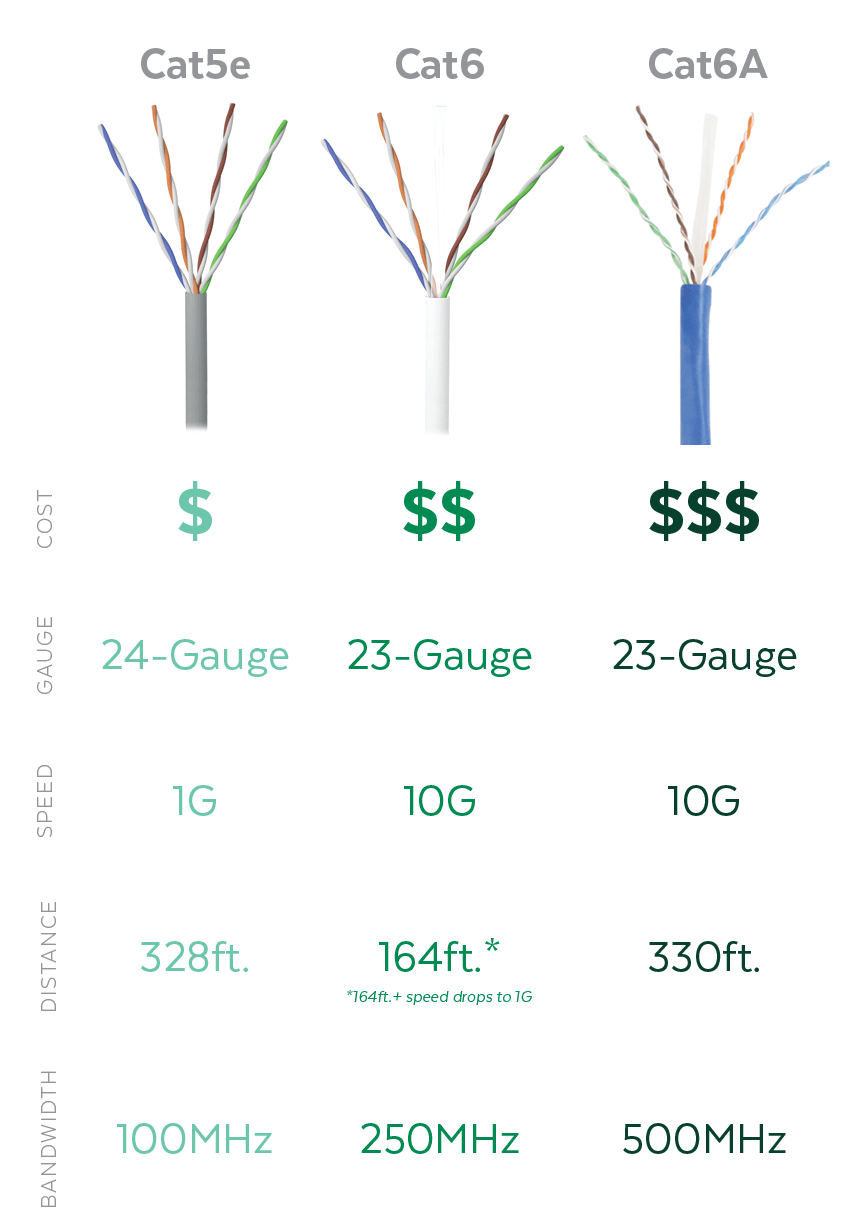
- Performance: Supports speeds up to 1 Gigabit per second (Gbps).
- Bandwidth: Operates at a frequency of 100 MHz.
- Best For: Basic home networking, office VoIP phones, and standard data traffic where budget is a primary concern.
Introducing Cat6: The Performance Upgrade
Category 6 represents a significant step up in performance. It’s designed with stricter specifications to provide more reliable Gigabit and even 10-Gigabit performance over shorter distances. This is achieved through improved construction, such as tighter-wound wire pairs and, often, a plastic spine called a “spline” that separates the pairs to reduce interference.
- Performance: Reliably supports 1 Gbps and can achieve up to 10 Gbps over shorter distances (up to 55 meters or 180 feet).
- Bandwidth: Operates at a higher frequency of 250 MHz, allowing more data to be transmitted simultaneously.
- Best For: High-demand home networks (4K streaming, online gaming), modern offices, data centers, and any new installation where future-proofing is a priority.
Head-to-Head: Cat5e vs. Cat6 Key Differences
Let’s break down the most important distinctions in a clear, side-by-side comparison.
| Feature | Cat5e Cable | Cat6 Cable |
|---|---|---|
| Max Speed (at 100m) | 1 Gbps | 1 Gbps |
| Max Speed (at <55m) | 1 Gbps | 10 Gbps |
| Bandwidth / Frequency | 100 MHz | 250 MHz |
| Crosstalk Reduction | Standard twisted pairs | Stricter standards, tighter twists, often includes a spline |
| Cost | Lower | Slightly Higher (10-20% more) |
Bandwidth vs. Speed
Think of bandwidth (MHz) as the number of lanes on a highway and speed (Gbps) as the speed limit. A Cat6 cable’s 250 MHz bandwidth provides a wider highway than Cat5e’s 100 MHz. This means more data can travel at the same time, reducing congestion and leading to a more stable and consistent performance, especially in data-heavy environments.
Crosstalk
Crosstalk is the unwanted interference between adjacent wire pairs. Cat6 cables are built to much stricter specifications to minimize this interference. This results in fewer data packet errors, higher signal integrity, and a more reliable connection, which is especially critical for applications like competitive online gaming and high-definition video conferencing.
How to Physically Identify Your Cable
The easiest way to tell the difference is to simply look at the text printed on the cable’s outer jacket. Manufacturers are required to print the category type directly on the wire. You will see text like “CAT.5e” or “CATEGORY 6” printed along its length.
Which Cable is Right for Your Needs?
Your choice ultimately depends on your specific application and budget.
For Most Home Users and Budget-Conscious Setups:
If your internet plan is 1 Gbps or less and your primary activities are web browsing, email, and streaming HD video, a high-quality Cat5e cable will perform perfectly well. It’s a reliable and economical choice for existing networks.
For Gamers, Streamers, and Future-Proofing:
Cat6 is the recommended choice. The small additional cost is a worthwhile investment. The higher bandwidth and reduced crosstalk provide a more stable connection with lower latency, which is crucial for online gaming. Furthermore, as internet speeds increase and more devices (IoT, 8K TVs) are added to your network, Cat6 provides the headroom to handle future demands.
For New Business Installations and Data Centers:
For any new construction or major network overhaul, Cat6 or even Cat6a should be the minimum standard. The labor cost of installing cables often far outweighs the material cost, so installing a more capable cable from the start saves significant money and effort on future upgrades.
The DlayCable Commitment to Quality
Whether you determine Cat5e is sufficient for your current needs or you wisely choose to invest in Cat6 for the future, the quality of the cable itself matters. At DlayCable, we manufacture a full range of both Cat5e and Cat6 LAN cables, all built to exceed industry standards. Our products are rigorously tested and certified (UL, ETL, CE, RoHS) to ensure they deliver the performance and reliability you expect. By controlling the manufacturing process from start to finish, we guarantee every cable that leaves our facility is ready to form the backbone of your network.
Conclusion: Future-Proofing Your Network for Tomorrow
While Cat5e is still a capable standard, Cat6 offers superior performance, greater reliability, and essential future-proofing for a minimal increase in cost. Its ability to handle higher bandwidth and resist interference makes it the clear winner for anyone seeking the best performance from their network, especially for new installations.
Investing in the right cable infrastructure is an investment in a seamless digital experience. By choosing a high-quality Cat6 cable, you’re not just building a network for today; you’re building a robust foundation for the connected technologies of tomorrow.