


In today’s hyper-connected world, the stability and speed of your network are paramount. Whether you’re setting up a home office, wiring a new commercial building, or upgrading a data center, the choice of Ethernet cable is a foundational decision that impacts performance for years to come. As a leading global manufacturer with over 15 years of experience in producing high-quality network cables, we at Dlaycable often get asked: “What is the real difference between Cat5e and Cat6?”
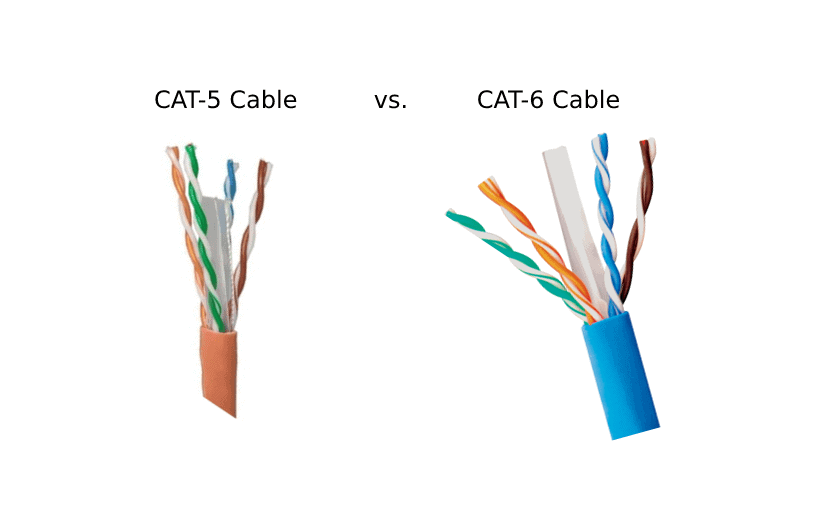
While they may look similar, these two cables are engineered for different levels of performance. dlaycable will break down the key distinctions to help you make an informed decision for your specific needs, ensuring your network infrastructure is both reliable and future-proof.
Article Contents
Cat5e vs. Cat6: At a Glance
For a quick overview, here is a direct comparison of the most important specifications for Cat5e and Cat6 cables.
| Feature | Category 5e (Cat5e) | Category 6 (Cat6) |
|---|---|---|
| Max Speed | 1 Gbps at 100 meters | 10 Gbps up to 55 meters; 1 Gbps at 100 meters |
| Bandwidth (Frequency) | Up to 100 MHz | Up to 250 MHz |
| Crosstalk Performance | Standard | Significantly Improved (Lower Crosstalk) |
| Internal Construction | Tighter twist-per-inch than Cat5 | Even tighter twists, often includes a spline (separator) |
| Cost | More economical | Higher initial cost (10-20% more) |
Understanding Cat5e: The Reliable Standard
Category 5e (the ‘e’ stands for “enhanced”) has been the workhorse of network installations for years. It was designed to reliably support Gigabit Ethernet (1 Gbps) speeds over a distance of up to 100 meters (328 feet). It improved upon the original Cat5 standard by tightening the specifications for crosstalk—the unwanted signal interference between adjacent wire pairs.
For most standard home and small office applications, such as web browsing, streaming HD video, and online meetings, Cat5e provides more than enough bandwidth and is a highly cost-effective solution.
Understanding Cat6: The Performance Upgrade
Category 6 represents a significant step up in performance. It supports the same 1 Gbps speed at 100 meters but can also handle much higher speeds of 10 Gbps over shorter distances (up to 55 meters). The key to this capability lies in its superior construction and higher bandwidth of 250 MHz.
From a manufacturing perspective, Cat6 cables are built to more stringent standards:
- Tighter Twists: The copper wire pairs inside a Cat6 cable are twisted more tightly than in Cat5e. This design naturally reduces signal interference.
- Spline (Separator): Many Cat6 cables include a plastic separator, known as a spline, that runs down the center of the cable. This spline isolates each of the four wire pairs, drastically reducing crosstalk and allowing for cleaner, faster data transmission.
- Thicker Conductors: Cat6 cables often use a slightly thicker copper conductor (e.g., 23 AWG vs. 24 AWG in Cat5e), which improves signal strength.
This robust construction makes Cat6 the preferred choice for environments with high electromagnetic interference (EMI) and for applications that demand higher performance.
The 4 Core Differences Explained
Let’s break down the main factors that differentiate these two cables and how they impact your network.
1. Performance: Speed and Bandwidth
This is the most critical difference. While both can handle 1 Gbps, Cat6’s bandwidth is 2.5 times that of Cat5e (250 MHz vs. 100 MHz). Think of bandwidth as a highway: Cat5e is a two-lane highway, while Cat6 is a five-lane superhighway. More lanes mean more data can travel simultaneously without congestion, resulting in better performance for demanding tasks and multiple users.
2. Crosstalk and Interference
Crosstalk is the “noise” or signal bleeding that occurs between wire pairs inside a cable. Too much crosstalk leads to data errors and slower network speeds. Due to its tighter twists and the inclusion of a spline, Cat6 offers far superior protection against both near-end crosstalk (NEXT) and alien crosstalk (AXT). This means a more stable and reliable signal, which is critical in busy network environments like offices or data centers.
3. Cost and Installation
There’s no denying that Cat5e is the more budget-friendly option. The raw cable and its associated components (like jacks and patch panels) are less expensive. Cat6 cables are typically 10-20% more expensive due to their more complex manufacturing and higher-grade materials. Additionally, the thicker gauge and internal spline can make Cat6 slightly more rigid and difficult to terminate, potentially increasing installation time.
4. Future-Proofing
Investing in network infrastructure is a long-term decision. Installing Cat5e today might save you money, but it may not be sufficient for the internet speeds and local network demands of tomorrow. With the rise of multi-gigabit internet plans, Wi-Fi 6/7, and data-intensive applications, installing Cat6 provides a crucial layer of future-proofing. It ensures your physical wiring won’t be the bottleneck as your technology needs evolve.
How to Choose: Which Cable is Right for You?
Your choice ultimately depends on your specific use case, budget, and future plans.
Choose Cat5e If:
- You are a home user with an internet plan of 1 Gbps or less.
- Your primary activities are web browsing, HD streaming, and general office work.
- Budget is the primary concern for a residential or small office installation.
- You are simply replacing an existing cable in a 1 Gbps network.
Choose Cat6 If:
- You are undertaking a new installation in a commercial building or modern home.
- You need to future-proof your network for speeds beyond 1 Gbps.
- You are a gamer, content creator, or business that transfers large files across the local network.
- The installation environment has high potential for EMI (e.g., near power lines, fluorescent lights, or motors).
- You are deploying high-performance devices like Wi-Fi 6/6E access points or network-attached storage (NAS).
The Dlaycable Advantage: Sourcing with Confidence
Regardless of your choice, the quality of the cable itself is non-negotiable. A poorly manufactured cable will fail to meet its category specifications, leading to network instability and packet loss. At Dlaycable, we leverage our 20,000 sqm factory and advanced production lines to ensure every cable meets and exceeds industry standards.
When you partner with us, you benefit from:
- Strict Quality Control: Our products are certified by UL, ETL, CPR, RoHS, and REACH, guaranteeing safety and performance.
- Premium Materials: We use high-purity oxygen-free copper and quality insulation to deliver superior signal integrity.
- OEM/ODM Expertise: We provide one-stop custom solutions, allowing you to specify everything from jacket color and printing to performance characteristics for your unique project.
- Global Trust: With products exported to over 100 countries, we are a trusted partner for businesses worldwide.
Whether your project demands cost-effective Cat5e UTP or high-performance, shielded Cat6A cable, our professional team is ready to provide a solution that fits your needs and budget.
Contact Dlaycable today to discuss your specific cabling requirements and receive a competitive quote for your next project. Build your network on a foundation of quality and expertise.