


The primary difference is performance: CAT7 cables support 600 MHz bandwidth for 10 Gbps speeds, while CAT6 supports 250 MHz for 1 Gbps, with limited 10 Gbps support.
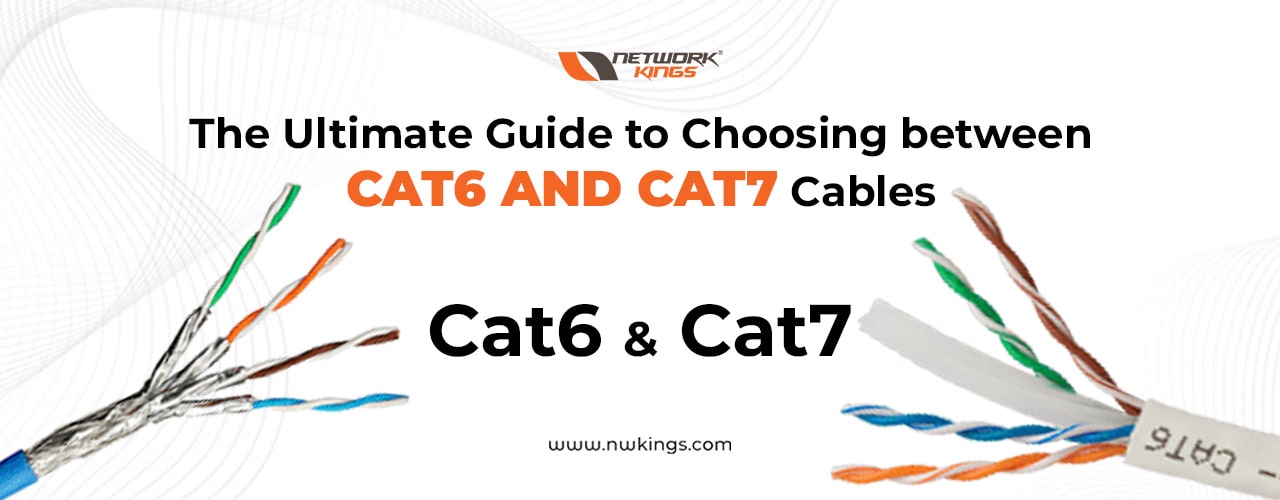
Table of Contents
- At a Glance: Key Differences Between CAT6 and CAT7
- Performance Deep Dive: Speed and Bandwidth
- Construction and Shielding: How They Differ
- Connectors and Compatibility Concerns
- The Standards Divide: TIA vs. ISO
- A Practical Alternative: Where Does CAT6A Fit In?
- Making the Right Choice for Your Application
- Cost and Future-Proofing Analysis
Choosing the correct network cable is fundamental to building a reliable and high-performing network. As data demands increase, understanding the distinctions between different Ethernet cable categories, such as CAT6 and CAT7, becomes crucial. Both are designed to transmit data, but they differ significantly in terms of speed, bandwidth, construction, and industry standardization. This breakdown will clarify these differences to help you select the appropriate cabling for your specific needs, whether for a home office, a corporate environment, or a high-density data center.
At a Glance: Key Differences Between CAT6 and CAT7
Before diving into the technical specifics, a direct comparison can quickly highlight the primary distinctions between these two cable types. The most notable differences lie in their performance ceilings and physical construction, which directly impact their ideal use cases and cost.
| Feature | CAT6 Cable | CAT7 Cable |
|---|---|---|
| Max Speed | 1 Gbps at 100 meters / 10 Gbps at 55 meters | 10 Gbps at 100 meters |
| Max Bandwidth | 250 MHz | 600 MHz |
| Shielding | Optional (UTP or STP) | Required (S/FTP or F/FTP) |
| Standard Connector | RJ45 | GG45, TERA (RJ45 compatible) |
| TIA/EIA Standard | Yes (ANSI/TIA-568-C.2) | No |
| ISO/IEC Standard | Class E | Class F |
| Common Application | Home networks, small to medium businesses | Data centers, high-frequency applications |
Performance Deep Dive: Speed and Bandwidth
The core function of an Ethernet cable is data transmission, and its performance is measured by speed (in Gigabits per second, or Gbps) and bandwidth (in Megahertz, or MHz). Bandwidth refers to the range of frequencies a cable can carry, which determines its data-carrying capacity. A higher bandwidth allows more data to be transmitted simultaneously, much like a wider highway allows more cars to travel at the same time.
CAT6 Performance Capabilities
Category 6 (CAT6) cable is a standardized twisted pair cable for Ethernet that is backward compatible with CAT5/5e and CAT3 cable standards. It is defined by the Telecommunications Industry Association (TIA) and Electronic Industries Alliance (EIA). CAT6 must meet more stringent specifications for crosstalk and system noise than previous generations.
Its performance standard is 250 MHz, which enables it to support data transfer speeds of up to 1 Gbps over a distance of 100 meters (328 feet). For shorter distances—up to 55 meters (180 feet)—CAT6 can support higher speeds of 10 Gbps, though performance can be susceptible to alien crosstalk in dense cabling environments.
CAT7 Performance Capabilities
Category 7 (CAT7) cable was developed as a Class F standard by the International Organization for Standardization (ISO). It operates at a much higher frequency, with a performance standard of 600 MHz. This increased bandwidth allows CAT7 to reliably support 10 Gbps speeds over the full 100-meter distance. In some cases, it can even support future standards of 40 Gbps at 50 meters and 100 Gbps at 15 meters.
The significant jump in bandwidth from 250 MHz to 600 MHz not only ensures a stable 10 Gbps connection but also provides more headroom for handling multiple data-intensive applications at once. This makes it a theoretical choice for environments demanding extremely high performance and minimal latency.
Construction and Shielding: How They Differ
The physical construction of a network cable, particularly its shielding, is a critical factor in its performance. Shielding protects the data-carrying wires from electromagnetic interference (EMI) and crosstalk from adjacent cables, ensuring signal integrity. This is where CAT6 and CAT7 have one of their most significant structural differences.
CAT6 Shielding (UTP vs. STP)
CAT6 cables are available in two main forms: Unshielded Twisted Pair (UTP) and Shielded Twisted Pair (STP). UTP CAT6 is more common, especially in home and office environments, due to its lower cost and greater flexibility. It relies on the tight twisting of its internal wire pairs to cancel out interference. STP CAT6 includes a layer of foil or braided shielding around the twisted pairs, offering better protection against EMI in environments with significant electronic noise, such as manufacturing floors or areas with heavy machinery.
CAT7 Shielding (S/FTP)
Unlike CAT6, the CAT7 standard requires robust shielding. The most common construction for CAT7 is Screened/Foiled Twisted Pair (S/FTP). In this design, each of the four individual wire pairs is wrapped in its own foil shield, and then all four pairs are encased together in an outer braided screen. This dual-layer shielding provides exceptional protection against both internal crosstalk and external EMI.
This comprehensive shielding is what enables CAT7 to achieve its higher bandwidth and maintain signal stability over long distances. For mission-critical applications where data integrity is paramount, the superior shielding of cables like Dlaycable’s pure copper S/FTP CAT7 cables ensures a stable and noise-free connection, protecting against data corruption and network downtime.
Connectors and Compatibility Concerns
The connector is the physical interface between the cable and a network device. While it may seem like a minor detail, connector type and compatibility have major implications for a cable’s usability and performance.
The Ubiquitous RJ45 for CAT6
CAT6 cables use the standard RJ45 connector. This is the same connector used for CAT5 and CAT5e cables, making it universally compatible with nearly all consumer and enterprise networking equipment, from laptops and routers to switches and patch panels. Its widespread adoption means components are inexpensive and readily available.
The CAT7 Connector Dilemma (GG45/TERA vs. RJ45)
The official standard for CAT7 specifies a modified GigaGate45 (GG45) or TERA connector to achieve its full 600 MHz performance. These connectors are designed to be backward compatible with RJ45 ports but include additional contacts to access the higher frequencies. However, these connectors have not seen widespread adoption in the market.
As a result, most commercially available “CAT7” cables are terminated with standard RJ45 connectors. While this makes them physically compatible with existing equipment, it’s important to understand that an RJ45 connector is only rated for CAT6A frequencies (500 MHz). Using an RJ45 connector on a CAT7 cable effectively limits its performance, making it function more like a CAT6A cable. This discrepancy is a primary source of confusion and debate surrounding CAT7’s practical value.
The Standards Divide: TIA vs. ISO
Industry standards ensure that networking components from different manufacturers can work together seamlessly. A key point of divergence between CAT6 and CAT7 is which standards body recognizes them. The TIA, which sets networking standards primarily used in North America, has officially standardized CAT6. However, the TIA does not recognize the CAT7 standard.
Instead, CAT7 is an ISO/IEC (International Organization for Standardization/International Electrotechnical Commission) Class F standard, which is more commonly followed in Europe. This lack of TIA recognition means that for commercial installations in the United States that must adhere to TIA-568 specifications, CAT7 is not an approved option. This is a critical consideration for professional network installers and system designers.
A Practical Alternative: Where Does CAT6A Fit In?
Given the issues with CAT7’s non-standard connectors and lack of TIA recognition, another category often enters the discussion: CAT6A (Augmented Category 6). CAT6A is the TIA-approved standard for achieving 10 Gbps speeds over the full 100-meter distance. It operates at a bandwidth of 500 MHz—double that of CAT6—and uses the standard RJ45 connector.
For most applications requiring 10 Gbps networking, CAT6A presents a more practical, standardized, and cost-effective solution than CAT7. It delivers the same 10 Gbps speed over the same distance but within a TIA-recognized framework that ensures interoperability. When you need reliable 10 Gbps performance, exploring high-quality options like Dlaycable’s range of certified CAT6A patch cables and bulk wire is often the most sensible path forward.
Making the Right Choice for Your Application
Your final decision should be based on your network’s current requirements, future goals, and budget. Both cable types have their place, but their ideal applications are distinct.
When to Choose CAT6
CAT6 remains an excellent and highly capable choice for a wide range of applications. It is the ideal solution for:
- Home Networks: Perfect for streaming 4K video, online gaming, and everyday internet use, as most home internet connections are 1 Gbps or less.
- Small to Medium Businesses: Fully supports typical office activities, including VoIP phones, file sharing, and connecting workstations to the network.
- Cost-Sensitive Installations: CAT6 cables and their associated components (keystone jacks, patch panels) are more affordable and easier to install than higher-category cables.
When to Consider CAT7 (or CAT6A)
Situations that demand higher performance and future-proofing may warrant considering a step up. However, in most of these cases, CAT6A is the more appropriate choice. These applications include:
- Data Centers: Connecting servers, switches, and storage area networks where 10 Gbps is the standard.
- High-Performance Computing: For workstations involved in video editing, 3D rendering, or large-scale data analysis that require a high-speed connection to a server or network-attached storage.
- Future-Proofing New Installations: If you are running cable through walls for a new build and want to ensure your infrastructure can handle potential future speeds beyond 10 Gbps, the superior shielding of CAT7 might offer some theoretical advantages, though CAT6A provides a more practical path to 10 Gbps.
Cost and Future-Proofing Analysis
There is a noticeable price difference between the categories. CAT7 cables are generally more expensive than CAT6 due to their more complex construction and mandatory, heavy-duty shielding. The required shielding also makes CAT7 thicker and less flexible, which can complicate installation in tight spaces like conduits or behind walls.
When considering “future-proofing,” it’s essential to balance ambition with practicality. While CAT7 offers higher theoretical performance, the widely adopted and TIA-standardized CAT6A provides a clear and reliable upgrade path to 10 Gbps. For the vast majority of users, CAT6 provides more than enough performance for current needs, while CAT6A stands as the logical next step for those who require 10 Gbps performance now or in the near future.