


When choosing an Ethernet cable for your network, the debate between Cat6a and Cat7 is a common point of confusion. For the vast majority of users, including home, gaming, and standard office environments, Cat6a is the better and more practical choice. Cat6a (Category 6a) is a TIA/EIA recognized standard that delivers a robust 10 Gigabits per second (Gbps) speed over 100 meters, uses the universal RJ45 connector, and offers a perfect balance of performance, cost, and future-proofing. In contrast, Cat7 (Category 7) is an ISO standard not recognized by the Telecommunications Industry Association (TIA) in North America, and while it boasts higher theoretical bandwidth, it requires proprietary connectors (GG45 or TERA) to achieve its full potential, creating significant compatibility and practicality issues.
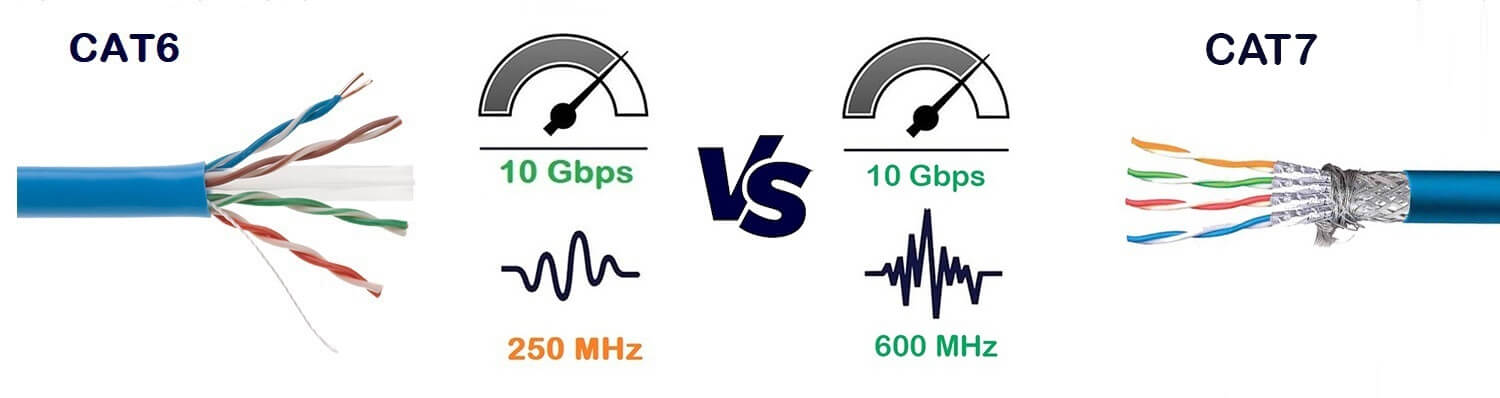
Quick Comparison: Cat6a vs. Cat7 at a Glance
Before we dive into the technical details, this table provides a high-level overview of the primary differences between Cat6a and Cat7 cables. It highlights the specifications that matter most when making a purchasing decision.
| Feature | Cat6a (Category 6a) | Cat7 (Category 7) |
|---|---|---|
| Max Speed | 10 Gbps | 10 Gbps |
| Max Bandwidth | 500 MHz | 600 MHz |
| Max Length for Max Speed | 100 meters (328 feet) | 100 meters (328 feet) |
| Shielding | Often UTP (Unshielded), but also available as F/UTP (Shielded) | Always S/FTP (Shielded and Foiled Twisted Pair) |
| Standard Connector | RJ45 | GG45 or TERA (RJ45 compatible, but not fully utilized) |
| TIA/EIA Standard? | Yes (TIA/EIA-568-C.2) | No (It is an ISO/IEC 11801 Class F standard) |
| Best For | Home, gaming, office, and most data center applications. | Niche industrial or AV applications where proprietary connectors are used. |
What is Cat6a Cable? A Deep Dive
Cat6a (the ‘a’ stands for augmented) is an enhanced version of the Cat6 standard, designed specifically to provide reliable 10GBASE-T (10 Gigabit Ethernet) performance over the full 100-meter distance of a standard channel. It was officially defined by the TIA/EIA in 2008 and has since become the gold standard for new structured cabling installations in commercial and high-end residential settings.
Performance and Specifications
The defining feature of Cat6a is its ability to support data rates of 10 Gbps up to 100 meters. To achieve this, it operates at a bandwidth frequency of 500 MHz, double that of its predecessor, Cat6. This increased bandwidth provides more headroom and significantly reduces the risk of alien crosstalk, which is interference from adjacent cables, a major limiting factor for 10G Ethernet on older cabling. Cat6a is fully backward compatible with all previous Ethernet standards, including Cat6, Cat5e, and Cat5.
Shielding and Construction
Cat6a cables come in two primary forms: Unshielded Twisted Pair (UTP) and Shielded (often F/UTP – Foiled/Unshielded Twisted Pair). While UTP Cat6a is available, its larger diameter and construction make it more susceptible to alien crosstalk. For this reason, shielded Cat6a (F/UTP) is far more common and recommended. The foil shield wrapped around the four twisted pairs provides excellent protection against external electromagnetic interference (EMI) and virtually eliminates alien crosstalk, ensuring stable 10 Gbps performance even in noisy environments with bundled cables.
Connectors and Compatibility
A crucial advantage of Cat6a is its use of the standard RJ45 connector. This is the same ubiquitous connector used on virtually every piece of networking equipment worldwide, from routers and switches to PCs and game consoles. This guarantees 100% compatibility with your existing and future devices without the need for special adapters or considerations, making installation and maintenance straightforward and cost-effective.
Pros and Cons of Cat6a
- Pros:
- Recognized and standardized by TIA/EIA for guaranteed performance.
- Delivers full 10 Gbps speed over 100 meters.
- Uses the universal RJ45 connector for maximum compatibility.
- Excellent cost-to-performance ratio.
- Widely available from numerous reputable manufacturers.
- Cons:
- Thicker and less flexible than Cat6 cables.
- Shielded versions require proper grounding for the shield to be effective.
What is Cat7 Cable? Understanding the Controversy
Cat7 is a networking cable standard that often appears in marketing as a step above Cat6a. On paper, its specifications look impressive. However, its real-world application is fraught with issues, primarily stemming from its lack of recognition by the TIA/EIA, the dominant standards body in North America, and its use of non-standard connectors.
Performance and Specifications
Cat7 is specified by ISO/IEC 11801 as a Class F cable. It is designed to support a bandwidth of up to 600 MHz. Like Cat6a, it is also rated for 10 Gbps speeds up to 100 meters. While the higher bandwidth might suggest superior performance, for 10GBASE-T applications, the extra 100 MHz provides no practical benefit over Cat6a’s 500 MHz, as both are more than sufficient for the 10 Gbps signal.
Superior Shielding as a Standard
One area where Cat7 excels is shielding. Every Cat7 cable is an S/FTP (Screened/Foiled Twisted Pair) cable. This means that not only is there an overall braided screen around all four pairs, but each individual pair is also wrapped in its own foil shield. This dual-shielding design provides exceptional protection against EMI and virtually eliminates all forms of crosstalk. This robust construction is why it’s sometimes favored in extremely high-interference environments like industrial plants or medical facilities.
The Connector Problem: GG45 and TERA
Herein lies the biggest problem with Cat7. To leverage its full 600 MHz bandwidth and shielding properties, the ISO standard specifies a proprietary connector, either the GG45 (GigaGate 45) or the TERA connector. These are not RJ45 connectors. While a GG45 connector is backward compatible and can accept a standard RJ45 plug, you are then limited to the performance class of the RJ45, effectively turning your Cat7 cable into an expensive Cat6a cable. If you buy a Cat7 cable that comes pre-terminated with RJ45 ends, it is not a true, standards-compliant Cat7 cable. It is, at best, a hybrid cable that cannot deliver the full promise of the Cat7 specification.
The Standards Issue: ISO vs. TIA/EIA
The Telecommunications Industry Association (TIA) and Electronic Industries Alliance (EIA) set the standards for network cabling in the United States and much of the world. The TIA/EIA has never recognized or ratified the Cat7 standard. Instead, after Cat6a, they moved directly to developing Cat8 for 25/40 Gbps applications in data centers. Because Cat7 is not a TIA standard, there is no official certification or guarantee of performance for cables marketed as “Cat7” in North America, especially those sold with RJ45 connectors. This has led to many manufacturers selling what are essentially well-shielded Cat6a cables under the “Cat7” name for a premium price.
Pros and Cons of Cat7
- Pros:
- Extremely robust S/FTP shielding is standard on all cables.
- Slightly higher theoretical bandwidth (600 MHz vs. 500 MHz).
- Cons:
- Not a recognized TIA/EIA standard.
- Requires proprietary GG45 or TERA connectors for full performance.
- Cables sold with RJ45 ends are not true Cat7 and offer no benefit over Cat6a.
- More expensive and much less flexible than Cat6a.
- Lack of standardization leads to inconsistent quality and marketing claims.
Key Differences Analyzed: Cat6a vs. Cat7
When you break it down, the decision between Cat6a and Cat7 comes down to a few critical, practical differences. Why choose a standardized, universally compatible option over a non-standardized one with proprietary parts?
Speed and Bandwidth: Is There a Real-World Difference?
For any network running at or below 10 Gbps, there is no real-world speed difference between a properly installed Cat6a cable and a Cat7 cable. Both are specified to handle 10 Gbps over 100 meters. The extra 100 MHz of bandwidth in Cat7 provides no tangible benefit for a 10GBASE-T network, which requires approximately 400 MHz to operate. Cat6a’s 500 MHz provides more than enough headroom.
Shielding and Crosstalk Protection
Cat7’s mandatory S/FTP shielding is technically superior to the F/UTP shielding on most Cat6a cables. However, a well-made shielded Cat6a cable is more than capable of mitigating all crosstalk and interference in 99% of environments, including dense cable trays in office buildings. The extreme shielding of Cat7 is overkill for all but the most severe industrial EMI environments.
Connectors and Compatibility
This is the most significant differentiator and the primary reason to choose Cat6a. Cat6a uses the standard RJ45 connector, ensuring seamless compatibility with all your network devices. Cat7 requires proprietary connectors to meet its specification. Any Cat7 cable you buy with RJ45 ends is, by definition, a non-standard, compromised product that won’t perform any better than Cat6a.
Cost and Availability
Due to its widespread adoption and standardization, Cat6a cable is more affordable and readily available from countless trusted brands. Cat7 is more expensive due to its more complex shielding construction and the lower volume of production. You are paying a premium for features that you likely cannot use and that are not officially recognized by key industry bodies.
Official Standards and Recognition
This point cannot be overstated. Cat6a is a globally recognized standard under TIA/EIA-568. This ensures that any cable labeled Cat6a from a reputable manufacturer meets a specific, verifiable set of performance criteria. Cat7 lacks this TIA recognition, making the “Cat7” label on many consumer products little more than a marketing term with no guarantee of quality or adherence to a meaningful standard for North American markets.
Which Cable Should You Choose? Practical Scenarios
To make it simple, here is a breakdown of which cable to choose based on your specific needs.
For Home Networking and Gaming?
The clear winner is Cat6a. Most home internet connections are 1 Gbps or less, where even Cat5e would suffice. However, for a new installation or to connect a high-speed local network (like a NAS to a PC), Cat6a provides excellent future-proofing for the eventual arrival of 2.5, 5, or 10 Gbps home internet and devices. It offers all the performance you could possibly need for decades at a reasonable price. There is absolutely no reason to consider Cat7 for home use.
For Office and Business Environments?
Choose Cat6a. It is the TIA-specified standard for 10GBASE-T deployments in commercial buildings. IT professionals and network installers rely on the standardization of Cat6a for predictable performance, compatibility, and ease of certification. Using a non-standard cable like Cat7 would be unprofessional and could lead to connectivity issues and an inability to certify the network infrastructure.
For Data Centers and High-Performance Computing?
Here, the conversation shifts. While Cat6a is widely used in data centers for server-to-switch connections up to 10 Gbps, the true upgrade path is not Cat7. For higher speeds like 25 Gbps or 40 Gbps over copper, the industry has standardized on Cat8 cable. Cat8 is a TIA-recognized standard designed specifically for these high-speed, short-distance (up to 30 meters) links within a data center. Cat7 has no place in a modern data center strategy.
What About “Future-Proofing”?
The idea of “future-proofing” with Cat7 is a fallacy. You cannot future-proof your network with a non-standard, proprietary system. True future-proofing involves using the current, recognized standard that provides headroom for growth. For today’s networks, that standard is Cat6a. It fully supports 10 Gbps, which will remain the top-end speed for consumer and most business applications for many years to come. By the time speeds beyond 10 Gbps become mainstream over copper, the industry will have adopted a new TIA standard like Cat8 or beyond, not the dead-end Cat7.
A Note on Cat6 and Cat8
It’s helpful to understand where Cat6a and Cat7 sit relative to other categories:
- Cat6: Supports 10 Gbps, but only up to 55 meters and is more susceptible to crosstalk. It is fine for shorter runs and 1 Gbps networks, but Cat6a is superior for 10 Gbps.
- Cat8: The official TIA successor to Cat6a. It’s designed for 25/40 Gbps speeds over a maximum of 30 meters. It is strictly intended for switch-to-server connections inside data centers and is complete overkill for any other use.
Conclusion: The Clear Winner for Most Users
The verdict in the Cat6a vs. Cat7 debate is overwhelmingly clear. Cat6a is the superior choice for virtually all networking needs. It is an officially recognized TIA standard that guarantees 10 Gbps performance, uses the universal RJ45 connector, and provides the perfect balance of performance, cost, and practicality. It is the cable trusted by IT professionals and recommended for any new installation, from a home gaming setup to a full corporate office backbone.
Cat7, on the other hand, exists in a confusing gray area. It is a non-TIA standard with proprietary connector requirements that render most “Cat7” cables on the market as nothing more than overpriced, non-compliant Cat6a equivalents. By choosing Cat6a, you are investing in a proven, standardized technology that will serve you reliably for years to come, without the compatibility headaches and questionable marketing claims associated with Cat7.