


CAT8 shielded cables provide the 40Gbps speed and robust EMI protection essential for medical robotics, ensuring low-noise data transmission for precise control.
| Table of Contents |
The Critical Role of CAT8 Shielded Cables in Advancing Medical Robotics
The field of medical robotics is transforming healthcare, from intricate surgical procedures performed with microscopic precision to automated laboratory diagnostics that deliver results faster than ever. At the heart of these sophisticated systems lies a fundamental requirement: flawless, instantaneous communication. The intricate dance of robotic arms, sensors, and high-definition cameras depends on a data stream that is not only fast but also impeccably clean. In the high-stakes, electrically noisy environment of a hospital or clinic, standard network cabling falls short. This is where Category 8 (CAT8) shielded cables emerge as the definitive solution, engineered to deliver the performance, reliability, and noise immunity that medical robotics demand.
What Are the Unique Cabling Demands of Medical Robotics?
Medical robotic systems operate under conditions where there is zero tolerance for error. A dropped data packet or a moment of signal interference could have profound consequences. The cabling infrastructure for these devices must therefore be designed to meet a set of extreme challenges unique to the healthcare environment.
The Imperative for High-Fidelity Data Transmission
A surgical robot is a complex network of components, all communicating simultaneously. High-resolution 4K video from endoscopic cameras, positional data from encoders on each joint, and feedback from tactile sensors all generate immense volumes of data. This information must be transmitted without corruption or loss. High-fidelity data transmission means that the signal received by the control console or processing unit is an exact replica of the signal that was sent. This integrity is the bedrock of patient safety and is essential for surgeons to make critical, real-time decisions based on what they see and feel through the robotic interface.
Navigating Electrically Saturated Environments
Hospitals and surgical suites are among the most challenging environments for electronic communication due to high levels of Electromagnetic Interference (EMI) and Radio-Frequency Interference (RFI). Powerful equipment such as MRI machines, X-ray C-arms, electrosurgical units, and countless other monitoring devices all emit electromagnetic radiation. This “noise” can easily corrupt data traveling through unshielded or poorly shielded cables, leading to command delays, inaccurate sensor readings, or video artifacts. A cable’s ability to maintain a high signal-to-noise ratio (SNR) by rejecting this external interference is not a luxury; it is a fundamental safety requirement.
The Requirement for Real-Time, Low-Latency Control
Latency—the delay between a command being issued and the action being executed—is the enemy of precision robotics. In robotic surgery, a surgeon’s hand movements must translate to the robotic instruments instantly and fluidly. Any perceptible lag can disrupt the procedure and compromise accuracy. Medical robotic applications demand near-zero latency to ensure that the system is perfectly responsive. The network infrastructure must support deterministic, real-time data transfer, where communication delays are minimized and, more importantly, are consistent and predictable.
Why is CAT8 the Superior Choice for Medical Robotic Systems?
While other cabling categories exist, CAT8 offers a combination of speed, bandwidth, and shielding that makes it uniquely suited for the rigorous demands of modern and future medical robotics. It represents a significant leap in performance, establishing a new baseline for mission-critical applications.
Unmatched Bandwidth and Speed: The 40Gbps Advantage
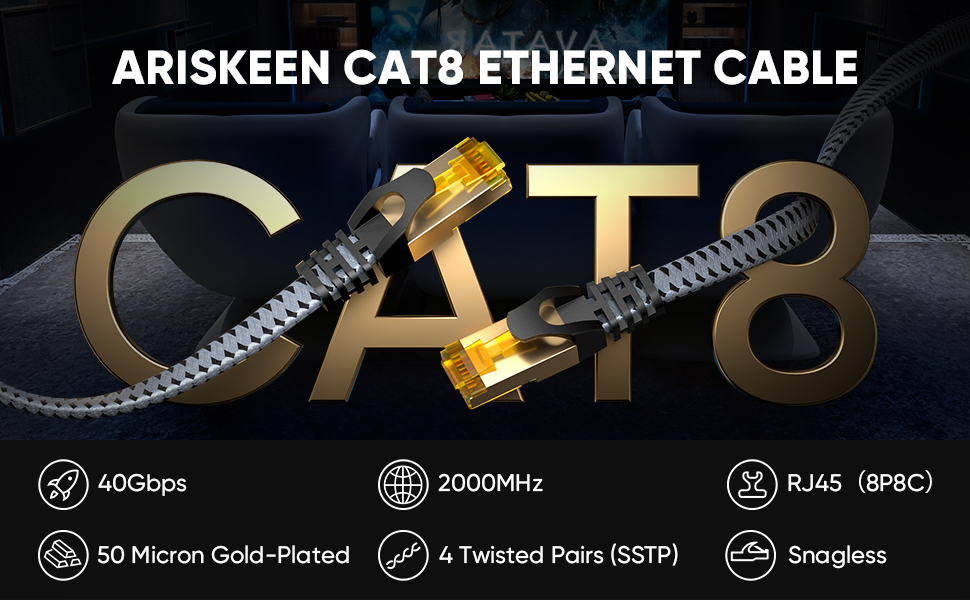
CAT8 cable is specified for data rates of up to 40 Gigabits per second (Gbps) over a bandwidth of 2000 MHz. This massive data-handling capacity is essential for supporting the combined data streams of next-generation medical robots. It ensures that high-resolution video feeds, complex control algorithms, and large sensor data packets can all be transmitted simultaneously without creating a bottleneck. This performance headroom is crucial for accommodating future advancements, such as the integration of AI-driven analytics and augmented reality overlays in the surgical field.
| Feature | Category 6A (CAT6A) | Category 7 (CAT7) | Category 8 (CAT8) |
|---|---|---|---|
| Max Data Rate | 10 Gbps | 10 Gbps | 40 Gbps |
| Max Bandwidth | 500 MHz | 600 MHz | 2000 MHz |
| Primary Shielding Type | U/FTP or F/UTP | S/FTP | S/FTP |
| Best Suited For | General Enterprise Networks | High-Performance Networks | Data Centers & Mission-Critical Systems (e.g., Medical Robotics) |
The Gold Standard in Shielding: How S/FTP Conquers Noise
CAT8’s most critical feature for the medical field is its standard construction: S/FTP (Screened/Foiled Twisted Pair). This robust design incorporates two layers of protection against noise. First, each of the four twisted pairs of conductors is individually wrapped in a metallic foil shield. This completely isolates each pair, eliminating internal interference known as crosstalk. Second, all four shielded pairs are wrapped in an overall high-coverage metallic braid screen. This outer braid acts as a formidable barrier against external EMI and RFI from surrounding medical equipment.
This dual-shielding methodology ensures the cleanest possible signal, preserving data integrity even in the most electromagnetically hostile environments. Dlaycable’s CAT8 S/FTP cables are engineered with premium-grade shielding materials, ensuring maximum noise immunity for mission-critical medical applications. Our meticulous manufacturing process guarantees consistent, reliable protection along the entire length of the cable.
Future-Proofing Medical Infrastructure
Investing in a CAT8 cabling infrastructure is a strategic decision that prepares medical facilities for the future. As robotic systems become more advanced—incorporating artificial intelligence, machine learning, and higher-resolution imaging—their data requirements will only grow. Deploying CAT8 today ensures that the physical network layer will be able to support the technological advancements of tomorrow without requiring a costly and disruptive overhaul.
How Does CAT8 Shielding Directly Translate to Precision and Safety?
The technical specifications of CAT8 cable are impressive, but their true value lies in how they translate to tangible benefits in a clinical setting. Superior shielding and bandwidth directly enhance the precision, responsiveness, and ultimate safety of medical robotic systems.
Eliminating Jitter for Smoother Robotic Movements
Signal jitter refers to tiny, inconsistent variations in the timing of data packet arrival. EMI is a primary cause of jitter. For a robotic arm, jitter in the control signal can manifest as microscopic, erratic movements or vibrations, undermining the smoothness and predictability of its motion. By providing a pristine, noise-free signal path, CAT8’s S/FTP shielding effectively eliminates jitter. This results in exceptionally fluid and precise mechanical movements, allowing surgeons to perform delicate tasks with greater confidence and accuracy.
Ensuring Uncorrupted Feedback Loops
Robotic control is a two-way street. Commands are sent to the robot, and sensor data is sent back to the controller or surgeon. This feedback loop—which can include haptic feedback simulating the sense of touch, force measurements, and precise location data—is just as important as the initial command. CAT8’s robust shielding protects this return data from corruption. An uncorrupted feedback loop ensures that the surgeon’s perception of the surgical environment is accurate, allowing for immediate and correct adjustments, which is fundamental to safe and effective procedures.
Enhancing Diagnostic Accuracy
Beyond surgery, robotics are essential in diagnostics and laboratory automation. Robotic microscopes, sample handlers, and imaging systems all rely on the precise transmission of data. A noise-free signal path, guaranteed by a well-shielded CAT8 cable, ensures that digital images are free of artifacts and that data from sensors is recorded without error. This leads to higher diagnostic accuracy, more reliable test results, and ultimately, better patient outcomes.
Key Considerations When Selecting CAT8 Cables for Medical Applications
Specifying CAT8 is the first step. To realize its full potential, engineers and procurement managers must pay close attention to the quality of the cable and its associated components.
Construction and Material Quality
The performance of a cable is dictated by its materials. It is critical to select CAT8 cables made with 100% solid bare copper conductors. Copper has superior conductivity compared to Copper Clad Aluminum (CCA), ensuring lower signal loss and better overall performance, especially when carrying Power over Ethernet (PoE). The cable jacket material is also a key safety consideration. In many healthcare environments, a Low Smoke Zero Halogen (LSZH) jacket is required, as it emits minimal smoke and no toxic halogen compounds when exposed to fire. At Dlaycable, we use only 100% solid bare copper conductors and offer a range of jacket options, including LSZH, to meet stringent medical safety standards.
Connector and Termination Integrity
A high-performance cable is only as good as its connection points. To maintain the integrity of the shielding, it is essential to use high-quality, fully shielded connectors and to ensure they are terminated properly. The shield must be continuous from the cable, through the connector, and to the grounded equipment. Improper termination can create a gap in the EMI protection, rendering the cable’s advanced shielding ineffective. The entire channel, from the robotic device to the control unit, must be treated as a single high-performance system.
Compliance and Certification
Always source cables from a reputable manufacturer that adheres to international standards, such as those set by the TIA and ISO/IEC. Reputable suppliers provide detailed specification sheets and test reports that certify the cable’s performance characteristics, including bandwidth, data rate, and shielding effectiveness. This documentation provides the assurance that the cable will perform as expected in a demanding and critical medical environment.