


For the vast majority of home and office applications, Cat6 or its enhanced sibling, Cat6A, offers the best combination of performance and value. Cat8 cable, while technically superior with staggering speed capabilities, is a highly specialized solution designed almost exclusively for high-bandwidth, short-distance connections within data centers. For most users, upgrading to CAT8 is generally not worth the significant extra cost, as its benefits cannot be realized without a supporting infrastructure of 40Gbps network devices.
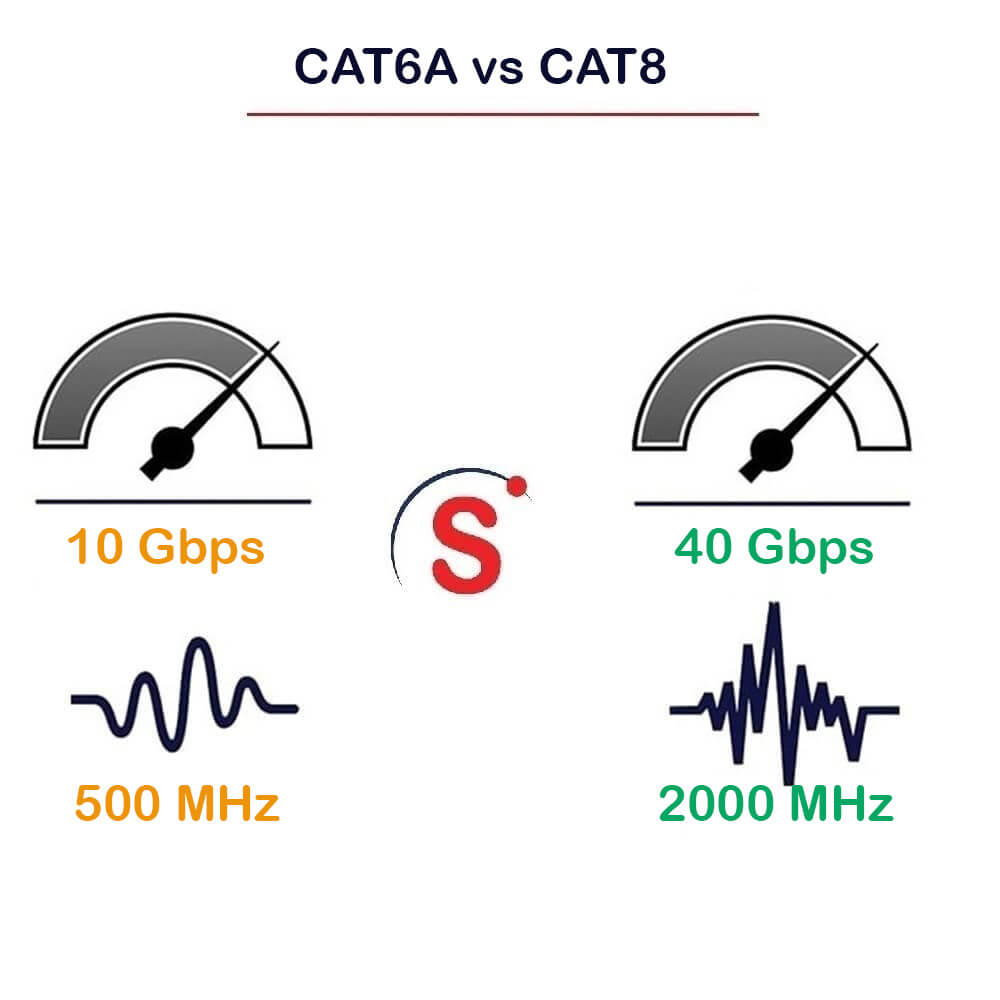
Navigating the world of Ethernet cables can feel like alphabet soup—CAT5e, CAT6, CAT6A, CAT7, CAT8—each promising better performance than the last. As experts in network connectivity at D-Lay Cable, we understand that choosing the right cable is fundamental to building a reliable and efficient network. The wrong choice can mean overspending on performance you’ll never use, or worse, creating a bottleneck that throttles your entire system. This comprehensive guide will break down the real-world differences between CAT6 and CAT8, demystify the specs, and help you determine which cable is the right investment for your specific needs.
Table of Contents
- Understanding the Basics: What Are CAT6 and CAT8 Cables?
- Head-to-Head Comparison: CAT6 vs. CAT8 at a Glance
- The Critical Factor: Which Cable for Which Application?
- What About the “In-Between” Option? Don’t Forget CAT6A
- Debunking Common Myths: Is CAT8 Worth It for…?
- Making the Right Choice: The D-Lay Cable Verdict
- Frequently Asked Questions (FAQ)
Understanding the Basics: What Are CAT6 and CAT8 Cables?
Before we can declare a winner, it’s essential to understand what each category brings to the table. Both are “twisted pair” copper cables, but their internal construction and capabilities are worlds apart, designed for entirely different eras of networking.
A Look at CAT6: The Current Gold Standard
Category 6 (CAT6) cable is the workhorse of modern networking. It was introduced as a significant improvement over CAT5e, offering more robust performance and higher bandwidth. It features tighter-wound wire pairs and often includes a “spline”—a plastic divider that separates the pairs to reduce crosstalk and interference. This construction allows it to comfortably support 1 Gigabit per second (Gbps) speeds over distances up to 100 meters (328 feet). For shorter runs, typically under 55 meters (180 feet), CAT6 can even handle blazing-fast 10Gbps speeds, making it more than capable for nearly all current home and small business internet plans and local network tasks.
Introducing CAT8: The Data Center Powerhouse
Category 8 (CAT8) is the latest and most powerful Ethernet standard recognized by the Telecommunications Industry Association (TIA). It represents a quantum leap in performance, designed specifically for the heart of the internet: data centers. CAT8 supports phenomenal speeds of 25Gbps or even 40Gbps, but only over a maximum distance of 30 meters (98 feet). To achieve this, it operates at a massive frequency of 2000 MHz and requires mandatory, heavy-duty shielding (S/FTP – Screened/Foiled Twisted Pair) to protect against electromagnetic interference in electrically noisy environments. Think of CAT8 not as a general-purpose cable, but as a specialized, short-range link between servers and switches in a professional setting.
Head-to-Head Comparison: CAT6 vs. CAT8 at a Glance
Seeing the specifications side-by-side provides the clearest picture of the vast difference between these two standards. The right choice often becomes obvious when you match your requirements to the capabilities in this table.
| Feature | CAT6 Cable | CAT8 Cable |
|---|---|---|
| Max Speed (Data Rate) | 1 Gbps at 100m / 10 Gbps at <55m | 25 Gbps / 40 Gbps at 30m |
| Max Frequency (Bandwidth) | 250 MHz | 2000 MHz |
| Max Distance | 100 meters (328 ft) | 30 meters (98 ft) |
| Shielding | Optional (UTP is common) | Mandatory (S/FTP or F/FTP) |
| Cost | Moderate | High to Very High |
| Best Application | Home networks, office LANs, general use | Data centers, server rooms (short switch-to-server links) |
The Critical Factor: Which Cable for Which Application?
Technical specifications are only part of the story. The most important question is: “Where are you going to use it?” The environment and purpose of the connection are the ultimate deciding factors.
When Is CAT6 the Smart Choice? (Hint: Most of the Time)
For the overwhelming majority of scenarios, CAT6 is the most logical and cost-effective solution. Its ability to handle 1Gbps over the full 100-meter standard distance covers virtually every consumer-grade internet connection available today and for the foreseeable future. Even with multi-gig internet plans (2.5Gbps or 5Gbps) becoming more common, CAT6 cabling can often support these speeds over typical in-home distances. It is the perfect choice for:
- Home Networking: Connecting your router, computer, smart TV, and gaming consoles for streaming 4K video, online gaming, and remote work.
- Small to Medium Business (SMB) Offices: Building a reliable Local Area Network (LAN) for workstations, printers, and VoIP phones.
- General Purpose Connections: Any standard network drop where reliability and good performance are needed without breaking the budget. You can find our high-quality CAT6 patch cables perfect for these tasks.
When Does CAT8 Make Sense? The Niche Application
CAT8 cable’s immense power comes with strict limitations, primarily its short-distance channel length. This makes it impractical for wiring a house or office, but perfectly suited for its intended environment. You should only consider CAT8 for:
- Data Centers: Primarily for “top-of-rack” or “end-of-row” architectures, connecting high-speed servers directly to network switches within the same rack or an adjacent one.
- Enterprise Core Network Links: In situations where two high-performance switches need to be linked over a short distance with 25G or 40G speeds.
- Extreme-Performance Environments: Scientific or financial institutions requiring the absolute highest data throughput between specific, co-located machines. For these critical applications, D-Lay Cable offers certified CAT8 cable solutions.
What About the “In-Between” Option? Don’t Forget CAT6A
Often lost in the CAT6 vs. CAT8 debate is the true champion of future-proofing for demanding users: Category 6A (CAT6A). The ‘A’ stands for “Augmented,” and it improves upon CAT6 by guaranteeing 10Gbps performance over the full 100-meter distance. It features improved shielding and tighter twists than standard CAT6, making it the ideal choice for new installations in modern offices or for home networking enthusiasts who want to build a network that will last a decade or more. If you’re running cables through walls or considering a multi-gigabit home network, choosing CAT6A provides a significant performance ceiling over CAT6 without the extreme cost and limitations of CAT8. It is the perfect balance of performance, distance, and cost for future-ready installations.
Debunking Common Myths: Is CAT8 Worth It for…?
Marketing hype can often create confusion. Let’s address two of the most common questions we hear from customers to provide a clear, expert answer.
Is CAT8 better for Gaming?
The short answer is no. While it sounds impressive, a CAT8 cable will not lower your ping or reduce lag in online gaming compared to a quality CAT6 or CAT6A cable. Gaming requires very little bandwidth (typically under 20 Mbps). The critical factor for gaming is latency (ping), which is determined by your internet service provider’s routing and the distance to the game server, not the category of the Ethernet cable in your home. Your internet connection speed is the bottleneck, not the cable. A stable, wired connection with a CAT6 cable is all you need for a competitive gaming edge.
Will CAT8 “Future-Proof” My Home?
This is a tempting idea, but it’s impractical. “Future-proofing” with CAT8 is a misstep for residential settings. The standard is designed for 30-meter links, which is often not long enough for typical home wiring runs from a central patch panel to various rooms. Furthermore, home networking equipment (routers, switches, motherboards) that supports the 25G/40G speeds of CAT8 is currently non-existent or prohibitively expensive for consumers. By the time such technology becomes mainstream and affordable, a new, better, and more cost-effective cabling standard will likely have emerged. For genuine future-proofing at home, CAT6A is the far more sensible and economical choice.
Making the Right Choice: The D-Lay Cable Verdict
Choosing between CAT6 and CAT8 isn’t about which is “better,” but which is “right” for the job. The decision boils down to a simple assessment of your needs and environment.
- For 99% of users, including homeowners, gamers, remote workers, and most businesses, CAT6 or CAT6A is the definitive choice. CAT6 handles all current internet speeds with ease, while our recommended CAT6A cables provide a robust and intelligent path for future 10Gbps networks.
- For data center professionals and enterprise network architects building high-speed, short-distance infrastructure, CAT8 is the necessary and powerful tool for enabling 25G/40G backbone connections.
At D-Lay Cable, our commitment is to provide you with the right solution that maximizes your network’s performance and your budget’s efficiency. We encourage you to invest wisely in the technology that fits your application, ensuring a stable, fast, and reliable connection for years to come.
Frequently Asked Questions (FAQ)
- Can I plug a CAT8 cable into a CAT6 port or router?
- Yes, absolutely. Ethernet ports are backward-compatible. You can use a CAT8 cable with any device that has a standard RJ45 Ethernet port. However, the connection will only run at the speed of the slowest component. Plugging a CAT8 cable into a 1Gbps port will result in a 1Gbps connection.
- Will a CAT8 cable make my internet faster?
- No. Your internet speed is determined by the plan you purchase from your Internet Service Provider (ISP). An Ethernet cable cannot make your internet faster than what you pay for. It can only ensure you are getting the full speed of your plan to your device without a local bottleneck.
- What is the difference between CAT8.1 and CAT8.2?
- The main difference lies in the connector type they are designed for. CAT8.1 uses the traditional RJ45 connector and is backward-compatible. CAT8.2 is designed for non-RJ45 style connectors (like TERA or GG45) and is primarily found in data center channels. For most purposes, if you are looking at CAT8, it will be the CAT8.1 standard with RJ45 ends.