


Yes, for most common, short-distance applications, high-quality flat Ethernet cables perform just as well as their round counterparts, delivering the same certified speeds and bandwidth for their category (e.g., Cat6, Cat6a). The primary differences are not in their speed potential but in their physical construction, which influences their susceptibility to electronic interference (crosstalk), long-distance signal degradation, and overall durability. Therefore, while a flat cable is an excellent solution for tidying up a home office or a short server rack run, a traditional round cable remains the superior choice for more demanding, long-distance, or high-interference environments.
Understanding the Core Differences: Flat vs. Round Cable Construction
At first glance, the most obvious difference between these two cables is their shape. However, this external geometry is a direct result of their internal architecture. Understanding this construction is the key to knowing how and where each cable will perform best. The design choices made for each type create a distinct set of advantages and disadvantages.
What is a Flat Ethernet Cable?
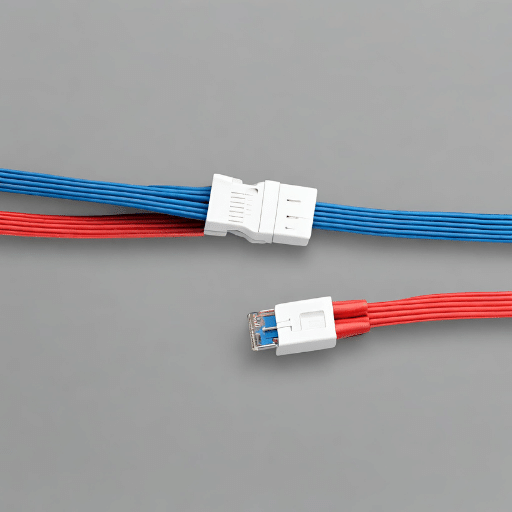
A flat Ethernet cable resembles a ribbon. Inside, its eight copper conductor wires are arranged side-by-side in parallel lanes, rather than being twisted together. This design makes the cable incredibly thin and flexible, which is its main selling point. However, this parallel arrangement is also its primary technical weakness. Most flat cables are unshielded (UTP) to maintain their slim profile, which means there is no additional metallic foil or braid to protect the conductors from external electromagnetic interference (EMI).
How are Round Ethernet Cables Constructed?
Round Ethernet cables, the industry standard for decades, have a more complex internal structure. Their eight conductors are grouped into four twisted pairs. This twisting is not for show; it is a critical engineering feature designed to cancel out electromagnetic interference from adjacent pairs and external sources—a phenomenon known as crosstalk. Furthermore, many round cables incorporate a plastic spine (or “spline”) to physically separate the pairs, further reducing interference. They are also available in shielded varieties (STP/FTP) with foil or braid shielding for maximum protection in electrically noisy environments.
Performance Showdown: Where Does Each Cable Shine?
When you’re deciding between flat and round cables, a direct comparison of their key attributes can simplify the choice. The “winner” in each category often depends entirely on the specific needs of your network installation.
| Feature | Flat Ethernet Cable | Round Ethernet Cable | Winner & Context |
|---|---|---|---|
| Installation & Aesthetics | Highly flexible, easy to hide under carpets, along baseboards, or behind furniture. Excellent for clean, discreet setups. | Bulkier and less flexible. More difficult to run discreetly without clips or conduits. | Flat – For convenience and low-visibility installs. |
| Crosstalk & Interference (EMI) Resistance | More susceptible due to parallel, untwisted wires. Not ideal for running alongside power cables or in electrically noisy areas. | Superior resistance due to twisted pairs and optional shielding. The standard for reliable performance. | Round – For reliability in any environment. |
| Long-Distance Performance | Signal degradation (attenuation) is more pronounced over longer distances. Generally not recommended for runs exceeding 50 feet (15 meters). | Engineered to maintain signal integrity up to the maximum standard length of 328 feet (100 meters). | Round – The only choice for long runs. |
| Durability & Bend Radius | Thinner wires can be more prone to breaking from sharp bends or repeated flexing. Less protection from being crushed. | Thicker outer jacket and internal structure provide greater physical protection and durability against stress. | Round – For durability and permanent installations. |
| Power over Ethernet (PoE) | Generally not recommended. The thinner conductors have higher resistance and dissipate heat less effectively, which can be a problem for high-power PoE devices. | The standard and preferred choice. Better heat dissipation and lower resistance make it reliable for powering devices like IP cameras and access points. | Round – For any PoE application. |
| Data Center & Rack Use | Excellent for short patch connections within a rack due to less bulk and better airflow. | Can create cable clutter in high-density racks, potentially impeding airflow. | Flat – For short, high-density patching. |
The Pros of Flat Ethernet Cables: Why Choose Them?
Despite their technical trade-offs, flat network cables excel in several scenarios where convenience and aesthetics are the top priority. Their unique form factor makes them a problem-solver for many common networking challenges, particularly in homes and offices.
Unmatched Convenience and Aesthetics
The number one reason people choose flat cables is their low profile. They can be run under rugs and carpets, pressed into the crevice between a wall and a baseboard, or routed behind furniture with virtually no visible bulk. This makes them the perfect choice for connecting a gaming console in the living room or a desktop computer across a room without creating an unsightly trip hazard.
Flexibility for Tricky Installations
Flat Ethernet cables are incredibly pliable. They can make sharp, 90-degree turns around door frames or corners with ease, a task that can be difficult for stiffer, round cables. This flexibility simplifies routing through tight spaces, such as behind wall-mounted TVs or through crowded entertainment centers, making installations faster and cleaner.
Ideal for High-Density Racking (Short Runs)
In a professional setting like a data center or network closet, flat patch cords can be a major advantage. When connecting switches to patch panels over short distances (e.g., 1-3 feet), their reduced bulk saves significant space. This not only makes the rack look neater and easier to manage but can also improve airflow between active components, which is crucial for thermal management.
The Cons of Flat Ethernet Cables: What are the Trade-offs?
The convenience of the flat design comes at a cost to technical performance and resilience. It’s crucial to understand these limitations to avoid creating network bottlenecks or points of failure.
The Critical Issue: Crosstalk and Attenuation
The lack of twisted pairs is the most significant technical drawback. As mentioned, twisting the wires is a fundamental technique for preventing crosstalk—when the signal from one wire interferes with the signal on an adjacent wire. In flat cables, the parallel wires are highly prone to this interference, which can lead to data errors and retransmissions, effectively slowing down your connection. This problem is magnified over longer distances, where signal strength naturally weakens (a process called attenuation). The combination of crosstalk and attenuation makes flat cables unsuitable for long runs.
Durability and Bend Radius Concerns
While flexible, the thin nature of flat cables makes them less robust. The internal conductors are finer and have less protective insulation and sheathing than their round counterparts. This makes them more susceptible to damage from being pinched, crushed by furniture, or repeatedly bent in the same spot. A traditional round cable, with its thick outer jacket and internal fillers, is simply built to withstand more physical abuse, making it the better choice for permanent installations inside walls or in high-traffic areas.
Limitations with Power over Ethernet (PoE)
Power over Ethernet (PoE) is a technology that transmits both data and electrical power over a single Ethernet cable, commonly used for VoIP phones, security cameras, and wireless access points. This process generates heat. Round cables, with their thicker conductors and greater surface area, dissipate this heat more effectively. Flat cables, with their thin, tightly packed conductors, can struggle with heat dissipation, potentially leading to performance issues or even a fire hazard in high-power PoE applications (PoE+, PoE++). For any PoE-powered device, a round cable is the safer and more reliable choice.
Choosing the Right Cable for Your Application
The debate isn’t about which cable is universally “better,” but which is *right for the job*. Your specific use case should be the ultimate deciding factor.
When is a Flat Ethernet Cable the Perfect Choice?
- Home & Office Setups: Connecting a computer, printer, or gaming console that is relatively close to the router.
- Under Carpets & Along Baseboards: Any application where hiding the cable for aesthetic reasons is paramount.
- Short-Distance Patching: Connecting devices within a single server rack or on a desktop.
- Travel & Temporary Setups: Their light weight and flexibility make them great for a laptop bag to ensure a stable connection in a hotel or at a conference.
When Should You Always Use a Round Ethernet Cable?
- Long-Distance Runs: Any cable run over 50 feet (15 meters), and especially those approaching the 328-foot (100-meter) limit.
- High-Interference Environments: Installations near power lines, fluorescent lights, motors, or other sources of EMI.
- Permanent & In-Wall Installations: Where durability and long-term signal integrity are critical.
- All Power over Ethernet (PoE) Applications: For powering devices like IP security cameras, wireless access points, and VoIP phones.
- Mission-Critical Infrastructure: For backbone connections between switches, routers, and servers where 100% reliability is non-negotiable.
The Verdict: Does Shape Matter More Than Quality?
Ultimately, the quality of manufacturing is the most critical factor. A well-made, certified Cat6a flat Ethernet cable from a reputable supplier will always outperform a cheap, uncertified Cat5e round cable. Standards matter. When choosing any cable, flat or round, look for clear markings of its category (Cat6, Cat6a, Cat8) and ensure it meets TIA/EIA industry standards. High-quality copper, proper connectors, and robust construction will have a greater impact on your daily performance than shape alone.
The shape simply defines the best-use scenario. Think of it as choosing between a sports car and a pickup truck. Both are excellent vehicles, but you wouldn’t use a Ferrari to haul lumber. Similarly, use flat cables for their flexibility and aesthetics in short, low-interference runs, and rely on the robust, time-tested engineering of round cables for everything else.
Frequently Asked Questions (FAQ)
Are flat ethernet cables good for gaming?
Yes, flat Ethernet cables are perfectly fine for gaming, provided the distance between your console or PC and your router is short (under 50 feet). Gaming relies on low latency (ping), and for short distances, a quality flat cable will provide a stable, low-latency connection identical to a round one.
Can flat ethernet cables be used for long distances?
It is strongly advised not to use flat Ethernet cables for long distances. Due to their increased susceptibility to crosstalk and attenuation, their performance degrades significantly on runs longer than 50 feet (15 meters). For any long run, always choose a standard round cable.
Do flat ethernet cables support PoE?
While some may technically work with low-power PoE devices, it is not recommended. Round cables offer superior heat dissipation, which is crucial for the safety and performance of PoE-powered devices. Always use a round, preferably shielded, cable for PoE applications.
Are flat ethernet cables less durable?
Yes, they are generally less durable than round cables. Their thin sheathing and finer internal wires offer less protection against being crushed, torn, or damaged by repeated sharp bends. Round cables are built for greater physical resilience.
Conclusion: Making the Informed Choice for Your Network
Flat Ethernet cables absolutely have their place and can work just as well as round cables under the right conditions. They are an innovative solution for applications where aesthetics, flexibility, and ease of installation are the primary concerns. For short, simple connections in a home or office, they are an excellent and practical choice.
However, for the backbone of your network—long runs, connections in noisy environments, permanent installations, or any PoE application—the superior engineering of the traditional round cable is undeniable. Its twisted-pair design, enhanced durability, and ability to reject interference make it the professional standard for a reason. By understanding the fundamental differences and matching the cable type to your specific application, you ensure a fast, stable, and reliable network for years to come.
As a leading provider of high-quality networking solutions, DlayCable offers a comprehensive range of both flat and round Ethernet cables, all certified to meet rigorous industry standards. Whether you need a discreet flat cable for your home office or a robust, shielded round cable for your data center, we have the right product to guarantee optimal performance.