


As leaders in high-performance network cabling, we at D-Lay Cable often field questions about mixing and matching Ethernet standards. One of the most common queries we receive is: “Can I plug a new Cat8 cable into my existing Cat6 network?” It’s a great question, especially as home and business users look to get the best possible performance from their infrastructure.
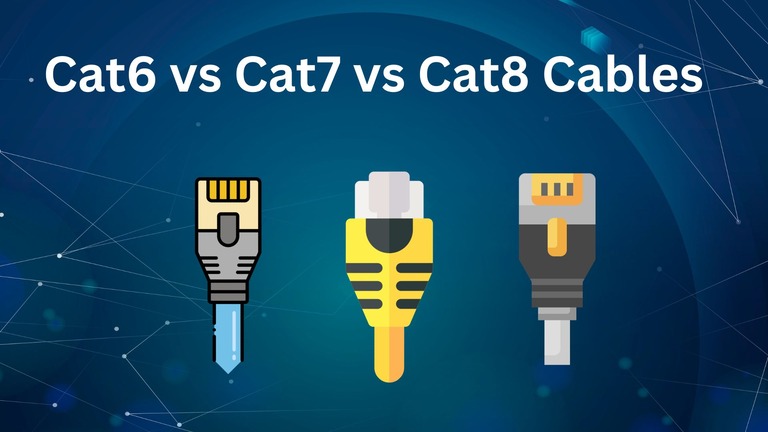
This comprehensive guide will not only answer that question but also provide the expert context you need to make the right choice for your network, ensuring you get the performance you pay for without creating unnecessary bottlenecks.
The Quick Answer: Yes, But With a Catch
The short answer is a resounding yes. You can plug a Cat8 cable into a device with a Cat6 port, or connect a Cat6 cable to a Cat8 patch panel. They are physically and electrically compatible.
However—and this is the crucial part—your connection will not magically upgrade to Cat8 speeds. The entire link will automatically downgrade to the performance level of the lowest category component in the chain. Essentially, you’ll have a very expensive, over-specified Cat6 cable.
The “How”: Understanding Physical and Backward Compatibility
The reason Cat8 and Cat6 cables can connect to each other is thanks to two key principles of network engineering:
- The RJ45 Connector: Both Cat6 and Cat8 cables, along with Cat5e and Cat6a, use the same standard RJ45 modular connector. This is the familiar plastic plug you see on the end of any standard Ethernet cable. It’s designed to be a universal interface, so the physical plug will always fit the port.
- Backward Compatibility: The standards set by the Institute of Electrical and Electronics Engineers (IEEE) are designed to be backward compatible. This ensures that new technology can be gradually introduced into older networks without causing a total system failure. A Cat8 cable is designed to meet or exceed all the performance requirements of previous categories, including Cat6 and Cat6a.
The “Why”: Your Network is Only as Fast as Its Weakest Link
Think of your network connection as a highway. Your Cat6 components (wall jacks, patch panel, and the device’s network card) are a highway designed for speeds up to 10 Gbps under specific conditions. A Cat8 cable is like a futuristic Formula 1 racetrack capable of 40 Gbps.
When you connect that F1 racetrack (Cat8) to your existing highway (Cat6), traffic can’t suddenly travel at 40 Gbps. The cars still have to slow down to match the speed limit of the highway. Your data packets are the cars, and the slowest part of the network sets the speed limit for the entire journey.
Using a Cat8 cable in a Cat6 setup means you’re simply not using the advanced features you’ve paid for, like its massive 2000 MHz bandwidth and superior shielding. The network devices will negotiate a connection speed that both ends can support, which in this case will be the Cat6 standard.
Head-to-Head: Cat6 vs. Cat8 Specification Showdown
To truly understand the difference, it helps to see the specifications side-by-side. As a company dedicated to quality, we believe in transparency. Here’s how our certified cables stack up.
| Feature | Category 6 (Cat6) | Category 8 (Cat8) |
|---|---|---|
| Max Speed | 1 Gbps up to 100 meters (328 ft) 10 Gbps up to 55 meters (180 ft) |
25 Gbps or 40 Gbps up to 30 meters (100 ft) |
| Bandwidth (Frequency) | 250 MHz | 2000 MHz (8x more than Cat6) |
| Shielding | Commonly UTP (Unshielded Twisted Pair) or F/UTP (Foiled) | Always S/FTP (Screened/Foiled Twisted Pair). Each pair is shielded, and there’s an overall braid shield. |
| Construction | More flexible, thinner gauge wire. | Thicker, more rigid due to heavy shielding and larger copper conductors. |
| Best Application | Home networks, SMB offices, and general-purpose enterprise desktop connections. | Data centers, server rooms, and very short, high-bandwidth switch-to-switch or server-to-switch links. |
| Relative Cost | Cost-effective and affordable. | Significantly more expensive due to complex construction and materials. |
Practical Scenarios: Which Cable is Right for You?
At D-Lay Cable, our goal is to provide the right solution, not just the most powerful one. Here’s our expert advice for common situations:
Scenario 1: Upgrading Your Home or Office Network
For nearly all home, home office, and standard business applications, Cat6 or Cat6a is the ideal choice. Our premium Cat6a cables support 10 Gbps speeds over the full 100 meters, providing more than enough bandwidth for streaming 4K video, online gaming, and heavy file transfers for years to come. It hits the sweet spot of performance and cost-effectiveness.
Scenario 2: “Future-Proofing” Your Installation
We often hear customers mention “future-proofing” as a reason to consider Cat8. While the impulse is understandable, true future-proofing means matching the cable to a realistic upgrade path. For residential and commercial buildings, Cat6a is the practical future-proof standard. Internet service speeds and local device capabilities are unlikely to exceed 10 Gbps in the mainstream for the foreseeable future. Investing in Cat8 for a desktop run is like building a private airport for a helicopter that hasn’t been invented yet.
Scenario 3: Building or Managing a Data Center
This is where Cat8 truly shines. It was specifically designed for “Top-of-Rack” or “End-of-Row” data center architectures where high-speed servers and switches are located in close proximity. In these environments, the 30-meter distance limit is not a drawback, and the 25/40 Gbps speed is a necessity for handling immense data loads. Its robust S/FTP shielding is also critical for mitigating crosstalk in dense, high-frequency environments.
The D-Lay Cable Promise: Performance Through Quality
So, does Cat8 work with Cat6? Yes. Should you use it that way? Probably not.
Choosing the right cable is about building a balanced, high-performing system. At D-Lay Cable, we stand behind this philosophy. Whether you need a reliable Cat6 patch cord for your office or a fully-certified Cat8 solution for a demanding data center, our commitment is the same:
- Pure Bare Copper Conductors: We never use inferior Copper Clad Aluminum (CCA). Our cables guarantee signal integrity and safety.
- Rigorous Testing: Every cable is tested to meet and exceed TIA/EIA standards, ensuring you get the performance advertised.
- Expert Support: We don’t just sell cables; we provide solutions. Our team is here to help you design a network that’s both powerful and practical.
Don’t let your network be defined by its weakest link. Explore our full range of professionally-graded Ethernet cables and build a network you can rely on, today and tomorrow.