


As a leading manufacturer of network infrastructure solutions, we at DLAY Cable get this question frequently. The quick answer is: not always, but it is highly recommended and often necessary for optimal performance. The choice between shielded and unshielded Cat6A cable is one of the most critical decisions you can make when designing a robust, future-proof network.
Simply choosing Cat6A isn’t enough to guarantee 10 Gigabit Ethernet (10GBASE-T) speeds. Understanding the role of shielding is key to unlocking the full potential of your investment. dlaycable will walk you through everything you need to know.
- The Quick Answer vs. The Complete Picture
- Understanding Shielding: STP vs. UTP
- Why Does Cat6A Often Require Shielding?
- Decoding the Types of Cat6A Cabling
- A Practical Checklist: When to Choose Shielded Cat6A
- The Non-Negotiable Rule: Proper Installation is Everything
- The DLAY Cable Recommendation: Invest in Reliability
- Conclusion: Shielding is an Assurance
The Quick Answer vs. The Complete Picture
While unshielded Cat6A (UTP) cable exists, the standard’s higher frequency performance makes it extremely susceptible to interference. To reliably achieve 10Gbps speeds, especially over longer distances or in dense environments, a shielded solution is the industry’s best practice. The shield acts as a protective barrier, ensuring data integrity and consistent performance.
Understanding the Core Technology: Shielded (STP) vs. Unshielded (UTP)
To grasp the “why,” we first need to understand the fundamental difference in cable construction.
What is Unshielded Twisted Pair (UTP)?
UTP cable, as the name implies, consists of twisted pairs of copper wires enclosed in a simple plastic jacket. It relies solely on the twisting of the pairs to cancel out a minimal amount of interference. This design is sufficient for lower-frequency standards like Cat5e and most Cat6 applications in low-interference environments.
What is Shielded Twisted Pair (STP)?
STP cable adds a crucial layer of protection: a metallic shield, typically made of aluminum foil or a braided metal mesh. This shield is wrapped around the twisted pairs, creating a barrier that intercepts and grounds external electromagnetic interference (EMI) and radio frequency interference (RFI).
The Critical Question: Why Does Cat6A Often Require Shielding?
The primary reason comes down to two factors: frequency and Alien Crosstalk.
- Higher Frequency: Cat6A operates at frequencies up to 500 MHz, more than double that of Cat6 (250 MHz). Higher frequencies are more sensitive and prone to corruption from external noise.
- The Enemy of Speed: Alien Crosstalk (AXT): This is the most significant performance killer for 10GBASE-T networks. AXT is interference that “leaks” from one cable to an adjacent cable in a bundle. In a data center or a crowded conduit, dozens of cables run side-by-side. The cumulative AXT can devastate network performance.
A shield is the most effective defense against Alien Crosstalk. By grounding the interference picked up by the shield, it prevents the noise from affecting the data signals within the core wires. This is why for any serious Cat6A installation, a shielded cable is the professional standard.
Decoding the Alphabet Soup: Types of Cat6A Cabling
You’ll encounter various acronyms when shopping for Cat6A cable. At DLAY Cable, we manufacture the highest quality versions to meet specific needs.
Cat6A UTP (Unshielded)
This cable attempts to mitigate AXT through design innovations like larger wire gauges, tighter twists, and internal spacers. However, it remains vulnerable in many real-world scenarios and is not recommended for mission-critical or high-density applications.
Cat6A F/UTP (Foiled/Unshielded Twisted Pair) – The Popular Choice
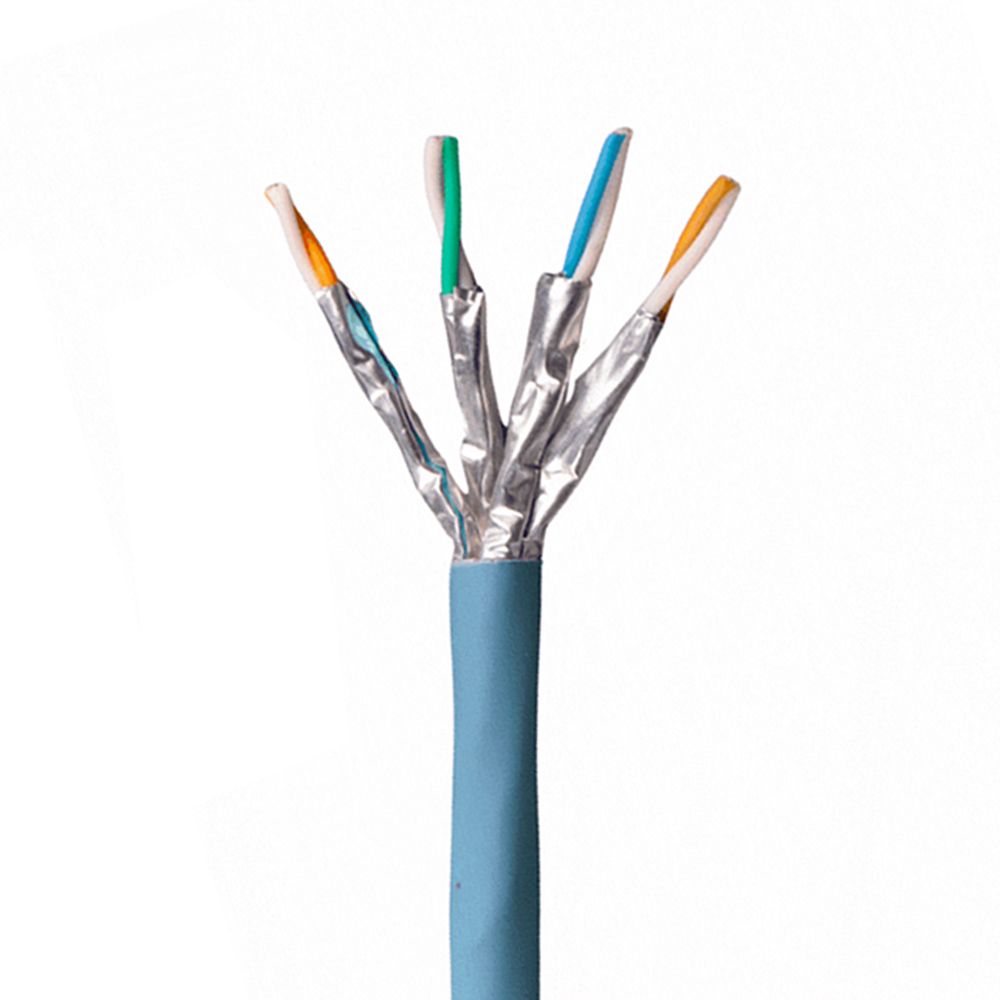
This is the most common and effective type of shielded Cat6A cable. It features an overall foil shield that encases all four twisted pairs. This single shield provides excellent protection against AXT and external EMI, making it the go-to choice for the vast majority of 10GbE installations. Our DLAY Cable Cat6A F/UTP cables, built with 100% pure copper, are Fluke-tested to guarantee performance.
Cat6A S/FTP (Shielded/Foiled Twisted Pair) – The Ultimate Protection
This is the premium solution for the most demanding environments. Each individual twisted pair is wrapped in its own foil shield, and then an overall braided shield encases the entire bundle. This dual-shielding design provides maximum protection against both AXT (from the individual foils) and external EMI/RFI (from the overall braid). It’s ideal for industrial settings, hospitals, and high-density data centers.
A Practical Checklist: When to Choose Shielded Cat6A
Choose a shielded Cat6A solution if your installation involves any of the following:
- ✅ Data Centers: High cable density makes AXT a certainty. Shielding is mandatory.
- ✅ Healthcare Facilities: Sensitive diagnostic equipment requires a network free from EMI.
- ✅ Industrial/Manufacturing Floors: Heavy machinery and power systems create significant electrical noise.
- ✅ Running Near Power Lines: Cables run parallel to electrical conduits must be shielded.
- ✅ Mission-Critical Applications: Any environment where network downtime is not an option.
- ✅ Future-Proofing: Shielding provides the headroom and reliability for future technologies beyond 10Gbps.
The Non-Negotiable Rule: Proper Installation is Everything
A shielded cable is only as good as its installation. An improperly installed shielded system can perform worse than an unshielded one. Here are the golden rules:
Grounding: The Make-or-Break Step
The shield must be properly grounded at a patch panel. This gives the collected interference a path to dissipate safely. An ungrounded shield can act like an antenna, attracting noise and inducing it into the data-carrying wires.
System Integrity: Use Shielded Components
Your entire channel must be shielded. This means using shielded Cat6A cable, shielded Cat6A keystone jacks, and shielded Cat6A patch panels. Using an unshielded jack with a shielded cable breaks the continuity of the shield, rendering it useless. That’s why we at DLAY Cable provide a complete, end-to-end shielded solution to ensure system integrity.
The DLAY Cable Recommendation: Invest in Reliability
For any new network designed for long-term, high-speed performance, we unequivocally recommend using a shielded Cat6A solution like F/UTP or S/FTP.
The marginal extra cost of shielded cable is a small price to pay for the immense gain in performance, reliability, and peace of mind. Choosing unshielded Cat6A is a gamble on your network’s environment, while choosing shielded Cat6A is an investment in guaranteed performance. Our high-quality, pure copper cables are engineered to not just meet but exceed TIA standards, ensuring your network is stable, fast, and ready for the future.
Conclusion: Shielding Isn’t Just a Feature, It’s an Assurance
So, is Cat6A shielded? The answer is that it should be. Shielding is the critical component that elevates Cat6A from a theoretical 10Gbps standard to a reliably performing 10Gbps reality. By protecting your data signals from Alien Crosstalk and EMI, a properly installed shielded system from a quality manufacturer like DLAY Cable provides the robust foundation your high-performance network deserves.