


Yes, Cat7 (Category 7) Ethernet cables exist, but they are not an officially recognized standard by the Telecommunications Industry Association (TIA), the primary standards body for cabling in North America. While Cat7 is a legitimate standard under the International Organization for Standardization (ISO/IEC 11801), its lack of TIA approval and specific connector requirements create significant confusion and practical issues. This often leads to consumers purchasing cables labeled “Cat7” that don’t deliver the promised performance or compatibility, making standardized alternatives like Cat6A or Cat8 a more reliable choice for most applications.
At D-Lay Cable, we specialize in high-performance network infrastructure, and one of the most frequent questions we encounter revolves around the mysterious Cat7 cable. You’ve likely seen it advertised online, promising superior speeds and future-proofing for your network. But what’s the real story? Is it the ultimate upgrade for your home or office, or just clever marketing? This comprehensive guide will break down the facts, debunk the myths, and help you understand why this
particular category is often skipped by industry professionals.
Table of Contents
- What is a Cat7 Ethernet Cable?
- The Core Confusion: Why Isn’t Cat7 a TIA Standard?
- How Does Cat7 Compare to Other Ethernet Cables?
- So, Should You Buy a Cat7 Ethernet Cable?
- The Final Verdict from D-Lay Cable Experts
What is a Cat7 Ethernet Cable?
To understand the controversy, we first need to define what a Cat7 cable is according to its official specification. It’s not a fictional product; it’s a cabling standard with very specific
and demanding technical requirements. Its primary goal was to provide a robust solution for 10 Gigabit Ethernet over long distances with superior protection against interference.
The Official Standard: ISO/IEC 11801
Category 7 is defined by the ISO/IEC 11801 Class F standard. This international specification outlines a cable capable of:
- Transmitting data at frequencies up to 600 MHz.
- Supporting network speeds of 10 Gbps at distances up to 100 meters (328 feet).
On paper, these numbers look impressive, representing a significant jump in bandwidth over its predecessor, Cat6 (250 MHz). This higher frequency rating allows for more data to be transmitted simultaneously, which is why it was designed for the then-emerging 10 Gigabit Ethernet (10GBASE-T) standard.
Key Feature: Enhanced Shielding (S/FTP)
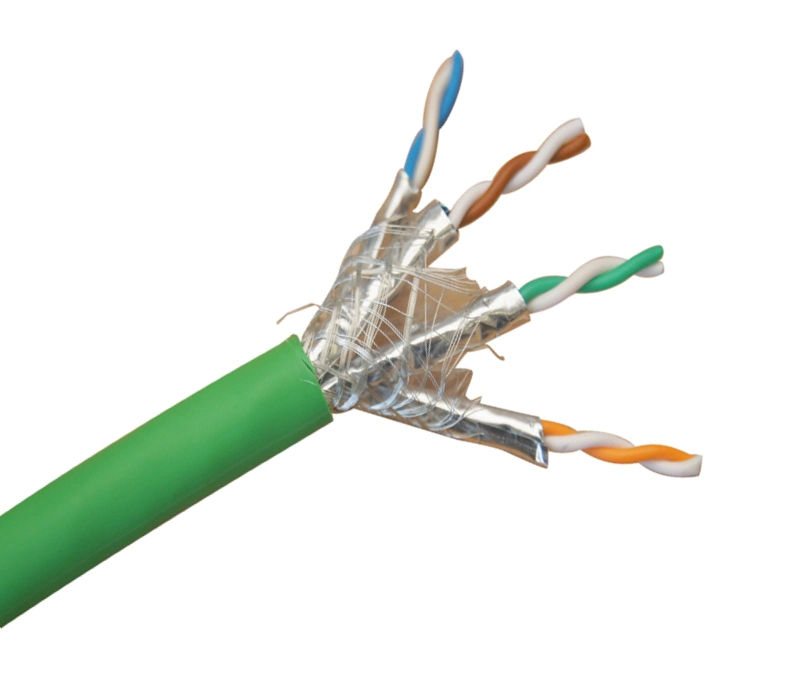
A defining characteristic of a true Cat7 cable is its extensive shielding. The standard mandates Screened/Shielded Twisted Pair (S/FTP) construction. This means each of the four individual twisted pairs is wrapped in a foil shield, and then a larger, overall braided shield encases the entire group of four pairs. This dual-layer of protection makes Cat7 highly resilient to both internal crosstalk (interference between the pairs) and external electromagnetic interference (EMI) from power lines, fluorescent lights, and other electrical noise. This robust shielding is what enables its high-frequency performance over long cable runs.
The Core Confusion: Why Isn’t Cat7 a TIA Standard?
Herein lies the problem. While the ISO defined Cat7, the Telecommunications Industry Association (TIA)—the body that sets the networking standards used predominantly in North America and influences global practices—never ratified it. If you look at the official TIA progression, it jumps from Cat6A directly to Cat8. There was a conscious decision to skip Cat7, and the reasons are crucial for any potential buyer to understand.
The TIA/EIA vs. ISO/IEC Divide
The world of cabling has two major standards organizations: the ISO/IEC and the TIA/EIA. While they often collaborate and their standards align, they sometimes diverge. The TIA’s primary focus is ensuring backward compatibility and practical, widespread adoption within the existing ecosystem. This focus on practicality is precisely why Cat7 hit a wall.
The Connector Conundrum: RJ45 vs. GG45/TERA
The single biggest reason the TIA rejected Cat7 was the connector. The familiar RJ45 connector, used on everything from Cat5e to Cat6A and even Cat8, could not technically meet the stringent 600 MHz requirements of the original Cat7 specification. To be fully compliant, a true Cat7 installation requires one of two proprietary connectors:
- GG45 (GigaGate 45): A connector that is backward-compatible with RJ45 but includes extra contacts to achieve higher frequencies.
- TERA: A robust, fully shielded connector that looks nothing like an RJ45 and is primarily used in industrial and data center environments.
This was a deal-breaker. The TIA knew that forcing the industry to abandon the ubiquitous RJ45 connector for a proprietary one would create massive compatibility issues and hinder adoption. Imagine needing different patch panels, wall plates, and network switches just to use a new cable. It was an impractical and costly proposition.
The Rise of Cat6A: The Practical 10Gbps Solution
While the ISO was finalizing Cat7, the TIA was developing its own solution for 10 Gigabit Ethernet: Category 6A (Cat6A). Ratified as ANSI/TIA-568-C.2, Cat6A achieves the exact same goal—10 Gbps speed over 100 meters—but does so at a lower frequency of 500 MHz and, most importantly, uses the standard RJ45 connector. By delivering the necessary performance without requiring a disruptive change in hardware, Cat6A became the TIA’s official, recommended standard for 10GBASE-T deployments, effectively making Cat7 redundant in their eyes.
How Does Cat7 Compare to Other Ethernet Cables?
To put Cat7 in perspective, it’s helpful to see where it stands against the TIA-approved standards that are widely used today. This comparison makes it clear why Cat6A and Cat8 are the preferred choices for new installations.
| Category | Max Speed (at 100m) | Bandwidth | Shielding | TIA Standard | Recommended Connector |
|---|---|---|---|---|---|
| Cat5e | 1 Gbps | 100 MHz | UTP | Yes | RJ45 |
| Cat6 | 1 Gbps (10 Gbps < 55m) | 250 MHz | UTP/STP | Yes | RJ45 |
| Cat6A | 10 Gbps | 500 MHz | UTP/F/UTP | Yes | RJ45 |
| Cat7 | 10 Gbps | 600 MHz | S/FTP | No | GG45 / TERA |
| Cat8 | 25/40 Gbps (< 30m) | 2000 MHz | S/FTP | Yes | RJ45 |
Cat7 vs. Cat6A: The Practical Choice
When you compare them side-by-side, the choice becomes clear for most users. Both Cat7 and Cat6A deliver 10 Gbps speeds over 100 meters. However, Cat6A is a TIA-recognized standard that uses the universal RJ45 connector. This ensures full compatibility with your existing router, switches, computers, and other networked devices. It is the cost-effective, reliable, and industry-approved solution for high-performance home networks, office environments, and gaming setups that demand low latency and high throughput.
Cat7 vs. Cat8: A Glimpse into the Future
If Cat6A is for today, Cat8 is for tomorrow’s data center. Cat8 is the true successor in the TIA-standardized lineage. It offers a massive leap in performance with a bandwidth of 2000 MHz, supporting speeds of 25 Gbps or even 40 Gbps over shorter distances (up to 30 meters). Crucially, the TIA designed Cat8 to use the standard RJ45 connector, making it the clear upgrade path for high-speed, short-distance links between servers and switches. Cat8 positions Cat7 as an evolutionary dead-end—it’s outmatched in future performance by Cat8 and outmatched in current practicality by Cat6A.
So, Should You Buy a Cat7 Ethernet Cable?
Based on the technical facts and industry standards, the answer for the vast majority of users is no. While you can easily find cables marketed as “Cat7,” they often create more problems than they solve and rarely provide a tangible benefit over the proper, standardized alternative.
When Cat6A is the Better Option
For almost any home or office application, Cat6A is the superior choice. Choose Cat6A if you are:
- Upgrading your home network for multi-gigabit internet.
- Setting up a high-performance gaming rig where low latency is key.
- Wiring an office for 10GBASE-T connectivity.
- Looking for a reliable, future-proof cable that is guaranteed to work with all your standard equipment.
When Cat8 is the Right Investment
Cat8 is designed for a very specific use case: high-speed interconnects within a single room, like a data center. Choose Cat8 for:
- Connecting servers to switches in a data center or server rack.
- Future-proofing for 25GBASE-T or 40GBASE-T network standards.
- Applications requiring extreme bandwidth and the highest level of shielding over short distances.
Beware the “Cat7” Marketing Trap
The biggest issue with Cat7 is the marketplace itself. Most “Cat7” cables sold to consumers come terminated with standard RJ45 connectors. By definition, this is not a compliant Cat7 cable. It cannot leverage the full 600 MHz specification without the proper GG45 or TERA connector. In reality, these cables are often just well-built, heavily shielded Cat6A cables that have been relabeled as “Cat7” to attract buyers looking for “the best.” You may be paying a premium for a non-standard product that offers no real-world performance gain over a properly certified Cat6A cable.
The Final Verdict from D-Lay Cable Experts
While Cat7 Ethernet cable is a real ISO standard, its lack of TIA recognition, proprietary connector requirements, and redundancy in the face of Cat6A and Cat8 make it an impractical and often misleading choice for consumers and network installers. It exists in a “no man’s land” of cabling standards—not practical enough for today’s 10 Gbps needs and not powerful enough for the 40 Gbps future.
For reliable, high-performance networking that guarantees compatibility and meets industry-accepted benchmarks, your decision should be between TIA-standardized cables. Choose Cat6A for excellent 10 Gbps performance in any home or office, and invest in Cat8 for professional-grade, future-proof data center applications. By sticking to these standards, you ensure that your network infrastructure is built on a foundation of proven technology, a principle we stand by at D-Lay Cable.