


No, Cat8 cable is not good for long-distance runs. It is a highly specialized cable engineered for extremely high-speed data transmission over very short distances. The maximum supported channel length for a Cat8 cable is strictly limited to 30 meters (or 98 feet). While it offers unparalleled performance with bandwidth up to 2000 MHz and speeds of 25GBASE-T or 40GBASE-T, that power is confined to a short range. For any network installation exceeding this 30-meter limit, other cables like Cat6a or fiber optics are the appropriate and industry-standard solutions.
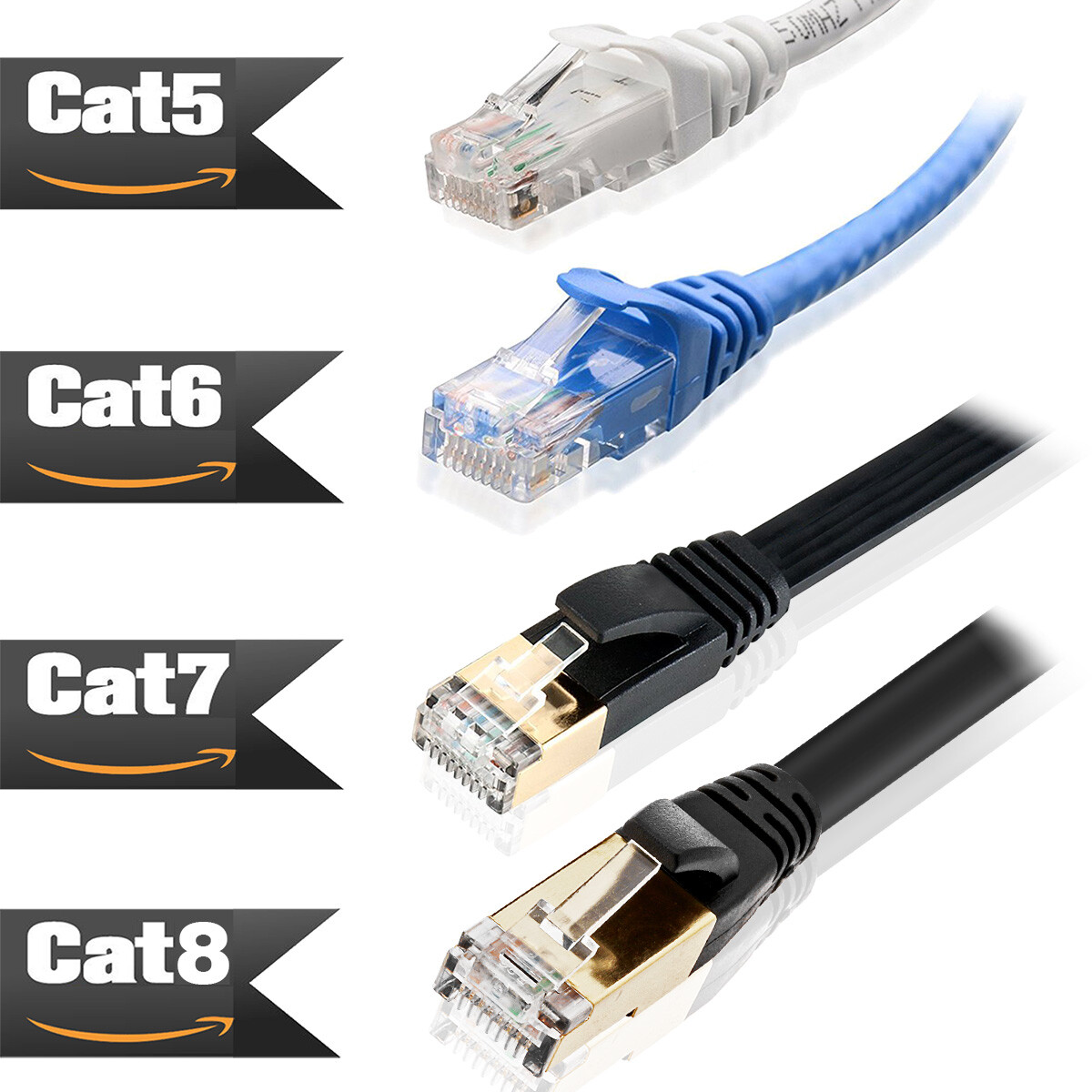
Table of Contents
- What Exactly is Cat8 Cable?
- The Critical Question: What is Cat8’s Maximum Length?
- So, Why Isn’t Cat8 Ideal for Long Distance Runs?
- Which Ethernet Cable is Best for Long Distances?
- When Should You Actually Use Cat8 Cable?
- What About Runs Longer Than 100 Meters?
- Conclusion: Choosing the Right Cable for Your Distance
What Exactly is Cat8 Cable?
Category 8, or Cat8, represents the latest generation of twisted-pair copper Ethernet cabling recognized by the ANSI/TIA-568 standard. It is a monumental leap in performance, designed specifically for the demanding environments of modern data centers. Unlike its predecessors, which were created for general-purpose office and home networking, Cat8 was developed with a singular focus: to support 25GBASE-T and 40GBASE-T applications. This requires a robust construction, typically featuring superior shielding for each pair of conductors (S/FTP) to virtually eliminate crosstalk and interference, allowing it to handle incredibly high frequencies.
Key Specifications: Speed and Frequency
The performance figures for Cat8 are truly impressive. It is specified to support a frequency of up to 2000 MHz, which is four times the bandwidth of Cat6a (500 MHz) and double that of Cat7a (1000 MHz). This massive bandwidth is what enables it to carry data at speeds of 25 Gbps or even 40 Gbps. These speeds are essential in data center architectures, particularly for “top-of-rack” or “end-of-row” configurations where servers need ultra-fast connections to the primary network switches. However, as we will explore, these incredible speeds are only achievable over a very limited distance.
The Target Environment: Why Data Centers Love Cat8
Data centers are the native habitat of Cat8 cabling. In these facilities, servers, storage arrays, and network switches are often housed in close proximity within the same or adjacent racks. The connections between these components are typically very short, usually less than 10 meters. Cat8 provides a cost-effective copper-based solution for these high-throughput, short-reach links, offering an alternative to more expensive fiber optic transceivers. Its use of the familiar RJ45 connector also simplifies installation and maintenance for network technicians. It is a future-proofing investment for data centers preparing for next-generation network speeds.
The Critical Question: What is Cat8’s Maximum Length?
The single most important limitation to understand about Cat8 is its distance constraint. According to the ANSI/TIA-568-C.2-1 standard, a Cat8 channel is specified for a maximum length of 30 meters (98 feet). This 30-meter channel is composed of up to 24 meters of solid horizontal cable and a total of 6 meters of patch cords. Attempting to use Cat8 for a network run longer than this will result in significant signal degradation, packet loss, and a failure to achieve the target speeds of 25/40 Gbps. In practice, the performance will likely drop off dramatically, making it a poor and unreliable choice for any long-distance application.
The 30-Meter Rule Explained
The “30-Meter Rule” is not an arbitrary suggestion; it is a hard limit defined by the physics of signal transmission and the standards that govern the cable’s performance. The channel length of 30 meters is the maximum distance over which the cable is guaranteed to meet its performance specifications for 40GBASE-T. This includes the main “backbone” cable run and any patch cables at either end. For system designers and installers, this is a critical parameter. It means Cat8 is suited for connecting devices within a single room or rack, but not for connecting different floors of a building or running cable across a large office space.
Why the Short Distance? The Physics of High Frequencies
The short distance limitation of Cat8 is a direct result of a fundamental principle in electrical engineering: signal attenuation. All electrical signals lose strength as they travel along a copper cable. This loss, or attenuation, becomes more severe as the frequency of the signal increases. Because Cat8 operates at an extremely high frequency of 2000 MHz to achieve its speeds, the signal degrades much more rapidly than it would in lower-frequency cables like Cat6 or Cat6a. The heavy shielding in Cat8 helps combat external noise (crosstalk), but it cannot prevent the inherent energy loss over distance. Thus, the 30-meter limit is the point at which the signal becomes too weak to be reliably interpreted by the receiving equipment.
So, Why Isn’t Cat8 Ideal for Long Distance Runs?
Beyond the hard technical limit of 30 meters, there are other practical reasons why Cat8 is the wrong tool for any job requiring a long-distance cable run. The primary factors are the inherent trade-off between speed and distance, and the significant cost difference when compared to more suitable alternatives.
The Trade-off: Speed vs. Distance
Ethernet cabling always involves a trade-off. Cat8 is engineered to maximize speed at the expense of distance. Conversely, cables like Cat6a are designed to provide a very robust 10 Gbps signal across a much longer distance—the full 100 meters (328 feet) allowed by TIA standards. Using a Cat8 cable for a 50-meter or 100-meter run is not just unsupported; it’s a fundamental misuse of the technology. You would be paying a premium for a high-speed capability that the cable cannot deliver at that length, when a Cat6a cable would perform the task reliably and within its specified standards.
Cost-Inefficiency for Longer Installations
Cat8 cable is significantly more expensive than Cat6a. This is due to its more complex construction, including thicker copper conductors and extensive S/FTP (Screened/Foiled Twisted Pair) shielding. While this cost is justifiable for short, mission-critical links within a data center, it becomes prohibitively expensive and inefficient when considered for standard “horizontal” runs in an office or home. You would be paying more for a cable that not only fails to provide a benefit over that distance but will actively underperform compared to the cheaper, purpose-built alternative.
Which Ethernet Cable is Best for Long Distances?
Since Cat8 is out of the question for runs over 30 meters, what should you use? The answer depends on your performance requirements, but for modern networks, Cat6a is typically the best choice for achieving high speeds over the full distance allowance.
The Champion for Long Runs: Cat6a
For any long-distance run up to 100 meters (328 feet), Category 6a (Cat6a) is the king. It is designed and guaranteed to support 10GBASE-T speeds over the entire 100-meter channel. Operating at a frequency of 500 MHz, it offers a perfect balance of high performance, long reach, and cost-effectiveness. It is the recommended standard for new installations in offices, hospitals, and advanced smart homes that require a future-proof infrastructure capable of handling high-speed data, PoE (Power over Ethernet) devices, and streaming high-definition video without compromise. At D-Lay Cable, our high-quality Cat6a cables are engineered to meet and exceed these standards for maximum reliability.
The Reliable Workhorse: Cat6
Category 6 (Cat6) is another excellent and highly popular option. It supports speeds up to 10 Gbps, but only for distances up to 55 meters (180 feet). For the full 100-meter distance, Cat6 is reliably rated for 1GBASE-T (1 Gbps) speeds. This makes it a fantastic and budget-friendly choice for many home and small office networks where gigabit speeds are more than sufficient for everyday tasks like web browsing, streaming, and online gaming. It is a reliable workhorse that meets the needs of a vast majority of current network applications.
Quick Comparison Table: Cat6 vs. Cat6a vs. Cat8
| Feature | Cat6 | Cat6a | Cat8 |
|---|---|---|---|
| Max Speed | 1 Gbps (10 Gbps up to 55m) | 10 Gbps | 40 Gbps |
| Max Distance | 100 meters (328 ft) | 100 meters (328 ft) | 30 meters (98 ft) |
| Bandwidth (Frequency) | 250 MHz | 500 MHz | 2000 MHz |
| Best Use Case | Home and Small Office (1 Gbps) | Commercial Buildings, Data Centers (10 Gbps) | Short-range Data Center Links (40 Gbps) |
When Should You Actually Use Cat8 Cable?
If Cat8 isn’t for long-distance runs, what is its proper application? Cat8 shines in a very specific, high-tech niche where its unique capabilities are not just beneficial, but necessary for next-generation networking.
Future-Proofing Data Centers
The primary use case for Cat8 is in data centers to “future-proof” the physical network layer. As network hardware evolves to 25GBASE-T and 40GBASE-T standards, having a copper cabling infrastructure that can support these speeds is vital. Installing Cat8 now for new server-to-switch links ensures that the physical cabling will not need to be replaced when faster switches and network interface cards (NICs) are deployed. It’s an investment in the longevity and scalability of the data center’s core infrastructure.
High-Bandwidth Switch-to-Server Connections
Specifically, Cat8 is used for connections at the “edge” of the data center network—the links connecting individual servers to the main network switch in the same or an adjacent rack. These connections, often called direct-attach or point-to-point links, are almost always under the 30-meter limit. Using Cat8 here allows data centers to leverage the cost-effectiveness and ease of use of RJ45-based copper cabling, rather than migrating entirely to more expensive short-range fiber optic solutions for these connections.
What About Runs Longer Than 100 Meters?
The 100-meter limit for copper Ethernet (Cat6, Cat6a, etc.) is another hard boundary set by TIA standards. If your networking needs require a connection that exceeds this distance, you must move beyond copper cabling altogether.
Stepping into the World of Fiber Optic Cable
When you need to cover distances greater than 100 meters, fiber optic cable is the only solution. Fiber optics transmit data using light pulses instead of electrical signals, which makes them completely immune to electromagnetic interference (EMI) and allows for incredibly high speeds over vast distances—from a few hundred meters to many kilometers, depending on the type of fiber and transceivers used. It is the standard for connecting buildings across a campus, linking network closets on different floors of a high-rise, or for any long-haul network backbone application.
Conclusion: Choosing the Right Cable for Your Distance
To circle back to our original question: is Cat8 good for long distance? The answer is a definitive no. Cat8 is a short-range specialist, built for record-breaking speed within the confined space of a data center rack. Its 30-meter distance limitation makes it unsuitable for the vast majority of horizontal cabling runs in homes and offices.
The key to a successful network installation is selecting the right cable for the job.
- For runs under 30 meters requiring future-proof 25/40 Gbps speeds (data center environments), Cat8 is the correct choice.
- For runs up to 100 meters requiring robust 10 Gbps speeds, Cat6a is the industry-standard and best all-around option.
- For runs up to 100 meters where 1 Gbps is sufficient, Cat6 is a reliable and cost-effective solution.
- For any runs over 100 meters, you must use fiber optic cable.
Understanding these distinctions ensures you build a network that is both high-performing and cost-efficient. Whether your project demands the short-range power of our certified Cat8 cables or the long-distance reliability of our Cat6a and fiber optic solutions, D-Lay Cable provides the standards-compliant infrastructure you can trust.