


Building a reliable, high-speed network is the backbone of any modern home or business. While many focus on routers and switches, the true foundation of your network’s performance and stability lies in its cabling. When it comes to Cat6, the industry standard for gigabit speeds, a critical decision arises: should you use Shielded Twisted Pair (STP) or Unshielded Twisted Pair (UTP) cables?
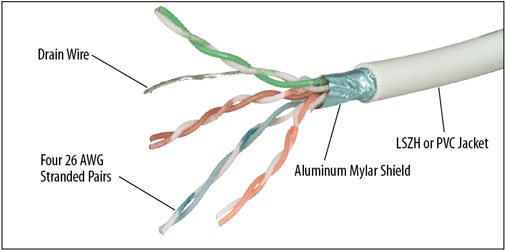
As a leading manufacturer with over 26 years of experience in structured cabling solutions, we at D-Lay Cable understand that this choice can be confusing. The right answer isn’t about which cable is “better,” but which is right for your specific environment. dlaycable will demystify the differences and empower you to make the perfect choice for a flawless network.
Unshielded Twisted Pair (UTP) Cat6: The Everyday Champion
Unshielded Twisted Pair (UTP) Cat6 cable is the most common type of network cable used today, and for good reason. Its design consists of four pairs of copper wires twisted together. This twisting is the cable’s primary defense against most common forms of interference and crosstalk from other cables.

Advantages of UTP Cat6:
- Cost-Effective: Without the extra shielding materials and manufacturing processes, UTP cables are significantly more affordable, making them ideal for large-scale deployments on a budget.
- Flexibility and Size: UTP cables are thinner and more flexible than their shielded counterparts. This makes them much easier to pull through conduits, walls, and tight spaces.
- Simple Installation: Termination of UTP cables is faster and requires standard, widely available tools and connectors. There’s no need for special grounding procedures.
Best Use Cases for UTP Cat6:
UTP is the perfect solution for standard residential and commercial office environments where the risk of significant electromagnetic interference (EMI) is low. Think typical home networks, office cubicles, schools, and retail stores.
Shielded Twisted Pair (STP) Cat6: The Guardian Against Interference
Shielded Twisted Pair (STP) Cat6 cable adds a critical layer of protection. In addition to the twisted pairs, STP cables include a conductive shield—typically a foil wrap (F/UTP) or a braided screen (S/UTP), or both (SF/UTP)—around the wires. This shield acts as a barrier, blocking external electromagnetic interference (EMI) from corrupting the data signals traveling through the cable.

Advantages of STP Cat6:
- Superior EMI Protection: This is the primary reason to choose STP. It protects data integrity in environments with high levels of electronic “noise” from motors, power lines, fluorescent lighting, and heavy machinery.
- Reduced Crosstalk: The shield further prevents signal bleed between adjacent cables, ensuring cleaner transmission in dense cabling setups.
- Robust and Durable: The additional layers make STP cables physically tougher and more resilient.
A Critical Note on Grounding:
The effectiveness of an STP cable is entirely dependent on it being properly grounded. If the shield is not connected to ground, it can act like an antenna, attracting EMI and actually degrading performance. This requires compatible shielded connectors, jacks, and patch panels, as well as a skilled installer who understands grounding principles.
Best Use Cases for STP Cat6:
STP is essential in environments with high EMI. This includes factories, hospitals with sensitive medical equipment, data centers with densely packed server racks, airports, and any installation where cables must run parallel to high-voltage power lines.
Head-to-Head Comparison: A Quick Breakdown
To simplify your decision, here’s a direct comparison of the key attributes:
| Feature | UTP (Unshielded) Cat6 | STP (Shielded) Cat6 |
|---|---|---|
| EMI Protection | Relies on twisted pairs; vulnerable in high-EMI zones. | Excellent protection via foil or braid shield. |
| Cost | Lower per foot/meter. | Higher due to extra materials and manufacturing. |
| Installation | Simpler, faster, and does not require grounding. | More complex; requires proper grounding to be effective. |
| Cable Size & Flexibility | Thinner, lighter, and more flexible. | Thicker, heavier, and stiffer. |
| Ideal Environment | Homes, offices, schools, retail. | Data centers, factories, hospitals, near power lines. |
The Deciding Factor: How to Choose for Your Needs
Still unsure? Ask yourself these three simple questions:
- What is my installation environment like?
This is the most important question. Is the cable running near heavy machinery, elevators, generators, large fluorescent light banks, or bundles of power cables? If yes, STP is your best bet. If it’s a standard office or home environment, UTP is the practical and economical choice. - What is my budget and what are my installation resources?
If budget is a primary concern and you’re working with standard installation practices, UTP will deliver the performance you need without the extra cost and complexity. If performance and data integrity are non-negotiable in a noisy environment, the extra investment in STP cable and professional installation is well worth it. - Am I future-proofing for higher-interference applications?
If you’re installing cabling in a new building and anticipate that certain areas might house more electronically-sensitive or “noisy” equipment in the future, it might be wise to run STP now to avoid costly retrofitting later.
The D-Lay Cable Advantage: Quality You Can Trust
Choosing the right type of cable is only half the battle. The quality of the cable itself is paramount. At D-Lay Cable, we don’t just sell cables; we manufacture networking solutions built on decades of expertise.
Here’s why customers worldwide trust us for their network infrastructure:
- Uncompromising Quality: With 26+ years of manufacturing experience, our processes are refined to perfection. Our products, including both UTP and STP Cat6 cables, are certified by UL, ETL, CPR, CE, and RoHS, guaranteeing they meet the highest global standards for safety and performance.
- A Complete Solution: We are your one-stop shop. Whether you need UTP for a commercial office build-out or specialized STP for an industrial facility, we have the high-performance cable for the job. We also provide all the necessary components, like keystone jacks, patch panels, and patch cords, to ensure your entire system is optimized.
- Expert Guidance: Our team doesn’t just take orders; we provide solutions. If you’re still unsure which cable is right for you, our experts can analyze your project’s requirements and recommend the ideal product to ensure your network is fast, stable, and reliable.
Don’t let the wrong cable be the weak link in your network. Build your foundation on quality and expertise.
Ready to build a better network? Contact the D-Lay Cable experts today to discuss your project or browse our extensive catalog of certified Cat6 solutions.