


CAT8 Ethernet cables support a maximum transmission speed of 40Gbps over a 30-meter distance, operating at a frequency of up to 2000 MHz for high-bandwidth applications.
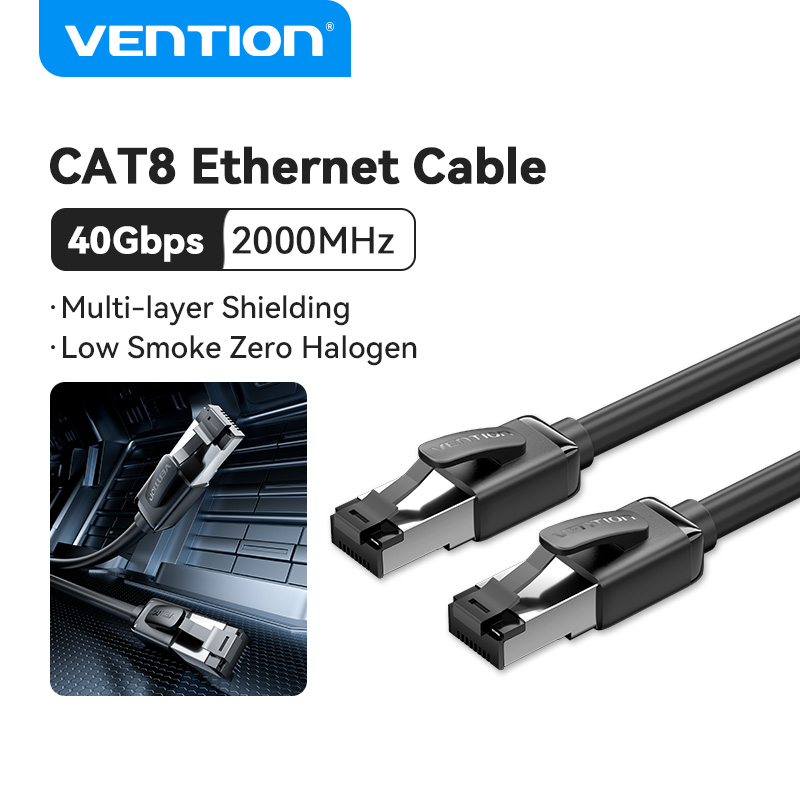
Understanding CAT8 Cable Specifications
Category 8, or CAT8, represents the pinnacle of twisted-pair copper cabling technology. It was specifically developed to support 25GBASE-T and 40GBASE-T applications, primarily within data centers. Understanding its core specifications is crucial to appreciating its power and its specific use cases.
Defining CAT8: The Next Generation of Ethernet
Standardized by the ANSI/TIA-568-C.2-1, CAT8 cable is a significant advancement over its predecessors. It is the only twisted-pair standard that supports a frequency of up to 2000 MHz (or 2 GHz), which is four times the bandwidth of CAT6a. This massive increase in bandwidth is what enables its phenomenal data transfer rates.
There are two recognized variants of CAT8 cable: CAT8.1 and CAT8.2. CAT8.1 is compatible with standard RJ45 connectors, making it more common for general data center use. CAT8.2 utilizes TERA or GG45 connectors, typically found in more specialized environments. Both are designed to meet the stringent requirements for 40Gbps networking.
The Core Metrics: Speed and Frequency
The headline feature of CAT8 is its maximum transmission speed of 40 Gigabits per second (Gbps). This rate allows for the transfer of massive amounts of data almost instantaneously, making it ideal for high-traffic server-to-switch connections. To put this into perspective, a 40Gbps connection can theoretically transfer a 20 Gigabyte file in just four seconds.
This speed is made possible by the cable’s ability to handle frequencies up to 2000 MHz. Frequency, or bandwidth, can be thought of as the width of a highway; a higher frequency allows more data to travel simultaneously without interference, resulting in a higher overall speed. This is a dramatic increase from CAT6a’s 500 MHz and CAT7’s 600 MHz capabilities.
The Critical Limitation: Maximum Channel Length
With great speed comes a significant limitation: distance. CAT8 cables can only maintain their 40Gbps performance over a maximum channel length of 30 meters (98 feet). This channel consists of up to 24 meters of horizontal cabling and a total of 6 meters of patch cords at both ends.
This restriction is due to a phenomenon called insertion loss, or signal attenuation, which becomes more pronounced at higher frequencies. Over longer distances, the signal integrity degrades to a point where 40Gbps speeds are no longer sustainable. This is precisely why CAT8 is intended for short-range connections, such as those within a single server rack or between adjacent racks in a data center.
How Does CAT8 Achieve Such High Speeds?
The ability of CAT8 to transmit data at 40Gbps is not magic; it is the result of meticulous engineering and superior construction. The physical design of the cable is purpose-built to eliminate interference and preserve signal integrity at extremely high frequencies.
Superior Shielding: The Key to Performance
Unlike lower-category cables that may be unshielded, CAT8 cabling is always shielded. The most common construction is S/FTP (Screened/Foiled Twisted Pair). This design involves a foil shield around each individual twisted pair of conductors, plus an overall braided screen that encases all four pairs. This dual-layer of protection is essential for two reasons.
First, it virtually eliminates alien crosstalk (AXT)—the interference that occurs between cables running adjacent to each other. Second, it provides robust protection against electromagnetic interference (EMI) and radio frequency interference (RFI) from external sources like power lines, fluorescent lights, and heavy machinery. This robust shielding ensures a clean, stable signal, which is non-negotiable for 40Gbps transmission.
Conductor Quality and Construction
High-performance cabling requires high-quality materials. CAT8 cables utilize pure bare copper conductors, typically in a 22AWG to 24AWG size. Pure copper offers lower resistance compared to copper-clad aluminum (CCA), ensuring the signal travels with minimal loss. The conductors are twisted together in precise pairs to cancel out internal interference, a fundamental principle of Ethernet cabling that is executed to an even higher standard in CAT8.
CAT8 Speed in Perspective: A Comparative Analysis
To fully grasp the capabilities of CAT8, it is helpful to compare it directly with other popular Ethernet cable categories. This comparison highlights not just the speed but also the intended applications of each standard.
| Specification | CAT6a | CAT7 | CAT8 |
|---|---|---|---|
| Max Speed | 10 Gbps | 10 Gbps | 40 Gbps |
| Max Bandwidth | 500 MHz | 600 MHz | 2000 MHz |
| Max Distance (at Max Speed) | 100 meters | 100 meters | 30 meters |
| Shielding | UTP or Shielded | Always Shielded (S/FTP) | Always Shielded (S/FTP, F/FTP) |
| Primary Use Case | Business & Home Networks | Data Center, AV | Data Center (Short-Range) |
CAT8 vs. CAT7: An Evolutionary Step
While CAT7 offered an increase in frequency over CAT6a, it was never officially recognized by the TIA. Its maximum speed remained at 10Gbps over 100 meters. CAT8, on the other hand, is a fully recognized TIA standard and represents a true performance upgrade, quadrupling the maximum speed to 40Gbps, albeit at a shorter distance. CAT8’s 2000 MHz bandwidth dwarfs CAT7’s 600 MHz, providing a much larger pipeline for data.
CAT8 vs. CAT6a: A Generational Leap
The difference between CAT8 and CAT6a is profound. CAT6a is the workhorse of modern business and high-end home networks, delivering a reliable 10Gbps over a full 100 meters. CAT8 targets a completely different application. Its 40Gbps speed over 30 meters is designed for the data-intensive, short-haul connections inside data centers, making it a replacement for more expensive fiber optic links in certain top-of-rack (ToR) or middle-of-row (MoR) architectures.
Is CAT8 Backwards Compatible?
Yes, CAT8 cables use the standard RJ45 connector (for CAT8.1) and are fully backwards compatible with all previous Ethernet categories like CAT7, CAT6a, CAT6, and CAT5e. When you connect a CAT8 cable to a device with a slower port (e.g., a 1Gbps laptop), the connection will simply operate at the lowest speed supported by the components. The cable itself will not be a bottleneck, but it cannot make older hardware run faster.
Practical Applications: Who Really Needs CAT8 Speed?
The immense power of CAT8 cabling is undeniable, but its practicality is highly specific. It is not a universal upgrade for every network. Its design and limitations dictate a very targeted set of applications where its benefits can be fully realized.
The Primary Environment: Data Centers and Server Rooms
The home of the CAT8 cable is the data center. Its 30-meter distance limitation makes it perfect for connecting servers to switches within the same rack or for linking network switches together in a top-of-rack configuration. In these environments, data rates are constantly increasing, and the move from 10G to 40G infrastructure is well underway. Using CAT8 provides a cost-effective copper-based solution for these high-speed, short-distance links.
What About Home and Office Use?
For the vast majority of home and standard office networks, CAT8 is overkill. Most consumer-grade and business networking equipment operates at 1Gbps or 2.5Gbps, with 10Gbps still being a high-end feature. Internet connections for homes rarely exceed 1-2Gbps. A well-installed CAT6a cable can handle speeds up to 10Gbps over 100 meters, which is more than sufficient for decades to come for these applications. Investing in CAT8 for a typical home or office provides no immediate performance benefit.
Gaming and Streaming: Is CAT8 a Game-Changer?
While marketers may promote CAT8 for gaming, its impact is minimal. Online gaming depends more on low latency (ping) than raw bandwidth. Your latency is determined by the distance to the game server and the efficiency of your ISP’s network, not the speed of your local Ethernet cable. As long as your cable can handle your internet speed (which CAT6 or CAT6a easily can), a CAT8 cable will not lower your ping or give you a competitive advantage. It provides a stable, high-capacity connection, but so does CAT6a.
Choosing the Right High-Performance Cable
When deploying a network, especially in a critical environment, selecting the right cable involves more than just picking the highest category number. Build quality, certification, and application suitability are paramount to ensuring long-term reliability and performance.
Factors to Consider Beyond Speed
Beyond raw speed, look for cables with verifiable certifications, such as those tested with a Fluke Networks analyzer. Pay attention to connector quality, as poorly terminated ends can degrade performance significantly. The cable’s jacket material (e.g., CM, CMR/Riser, CMP/Plenum) is also a critical factor for meeting building safety codes. Finally, the integrity of the shielding and the quality of the copper conductors directly impact the cable’s ability to resist interference and deliver consistent data rates.
When to Invest in Custom Cabling Solutions
Off-the-shelf patch cords work for many situations, but industrial, medical, and high-density data center environments often have unique requirements. These can include specific lengths to optimize airflow, specialized connectors for harsh environments, or enhanced durability for high-vibration settings. For applications demanding exacting specifications and unparalleled reliability, partnering with a specialist like DLA Y-Cable ensures your infrastructure is built on a foundation of quality. Their expertise in custom, high-performance cabling solutions, including CAT8 assemblies, provides the precision needed for mission-critical environments.