


CAT7 cables support a maximum bandwidth of 600 MHz and data transfer speeds of 10 Gbps up to 100 meters, making them ideal for high-speed networking.
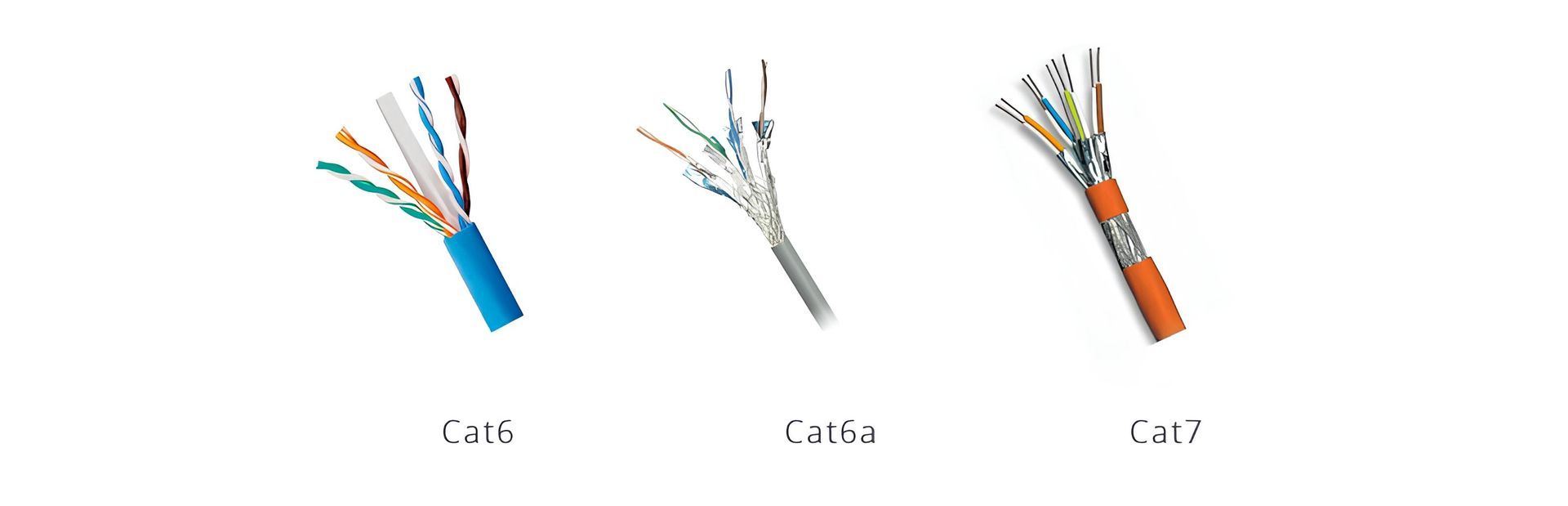
Table of Contents
- Understanding CAT7 Cable Specifications
- How Does CAT7 Shielding Impact Performance?
- CAT7 vs. Other Ethernet Categories: A Comparative Look
- The Controversy of CAT7 Connectors and Standards
- What Are the Ideal Applications for CAT7 Cabling?
- Frequently Asked Questions about CAT7 Performance
Understanding CAT7 Cable Specifications
Category 7 (CAT7) cable represents a significant leap in Ethernet technology, designed to meet the stringent demands of modern high-speed networks. Its specifications are defined by the ISO/IEC 11801 Class F standard, which outlines its performance capabilities. Understanding these core metrics—bandwidth, data rate, and frequency—is essential to appreciating its role in network infrastructure.
Defining Bandwidth and Data Rate
People often use the terms bandwidth and data rate (or speed) interchangeably, but they refer to different aspects of network performance. Bandwidth is the maximum frequency a cable can handle, measured in megahertz (MHz). It represents the “width of the highway,” indicating how much data can be transmitted simultaneously. A higher bandwidth reduces congestion and allows for more stable performance across multiple devices.
Data Rate, on the other hand, is the speed at which data travels through the cable, measured in gigabits per second (Gbps). This is the “speed limit” on the highway. While related, a cable’s data rate is ultimately enabled by its bandwidth. CAT7’s impressive specifications are a direct result of its high-frequency capacity.
The 600 MHz Frequency Standard
The defining feature of a CAT7 cable is its ability to support a bandwidth of up to 600 MHz. This is a substantial increase compared to its predecessors like CAT6 (250 MHz) and CAT5e (100 MHz). This higher frequency range is what allows CAT7 to handle more data without signal degradation, providing a cleaner and more reliable signal path. The ability to operate at 600 MHz is crucial for eliminating errors and maintaining signal integrity, especially in environments with high electronic noise.
Achieving 10 Gbps Over 100 Meters
Thanks to its 600 MHz bandwidth, a CAT7 cable is engineered to reliably support a data rate of 10 Gigabits per second (10GBASE-T) over a full distance of 100 meters (328 feet). This makes it an excellent choice for creating a robust backbone for a home or office network. While some tests show CAT7 can support even higher speeds like 40 Gbps over very short distances (around 50 meters), its official standard is built around the 10 Gbps mark for full-length runs, ensuring consistent and dependable performance for most applications.
How Does CAT7 Shielding Impact Performance?
One of the most critical advancements in CAT7 cabling is its mandatory and extensive shielding. This shielding is not just an added feature; it is fundamental to achieving the 600 MHz bandwidth and protecting the 10 Gbps data rate from interference. Without this robust protection, the cable’s performance would be severely compromised, especially in modern electronic-dense environments.
S/FTP Construction Explained
CAT7 cables exclusively use a construction known as Screened/Shielded Fully Shielded Twisted Pair (S/FTP). This multi-layered defense system provides comprehensive protection against interference.
- Individual Pair Shielding: Each of the four twisted pairs of copper wires inside the cable is wrapped in its own foil shield. This step is vital for preventing near-end crosstalk (NEXT) and far-end crosstalk (FEXT) between the pairs within the same cable.
- Overall Braided Shield: After each pair is individually shielded, all four pairs are encased together in an outer braided screen made of copper or tin. This overall shield protects the entire cable from external electromagnetic interference (EMI) and radio frequency interference (RFI) generated by power lines, fluorescent lights, motors, and other electronic devices.
This dual-layer shielding makes CAT7 physically thicker and less flexible than unshielded (UTP) cables but provides unparalleled signal protection.
Benefits in High-Interference Environments
The primary benefit of S/FTP shielding is superior performance in environments with significant electronic “noise.” In data centers, manufacturing facilities, or even homes crowded with smart devices and wireless signals, unshielded cables can suffer from signal degradation, leading to slower speeds, packet loss, and connection instability. The robust shielding of CAT7 cables creates a secure data channel, ensuring that the signal remains clean and strong from end to end. This results in a more reliable, stable, and consistently fast network connection, which is critical for activities like 4K video streaming, competitive online gaming, and large file transfers.
CAT7 vs. Other Ethernet Categories: A Comparative Look
Choosing the right Ethernet cable involves understanding how different categories compare in performance, cost, and application. CAT7 offers significant advantages over older standards, but it’s also important to weigh it against its closest competitors, CAT6A and CAT8, to make an informed decision.
CAT7 vs. CAT6A: The Battle for 10 Gbps
Both CAT7 and CAT6A are designed to deliver 10 Gbps speeds over 100 meters. However, they achieve this through different specifications. CAT6A operates at a bandwidth of 500 MHz, while CAT7 pushes this to 600 MHz. The primary advantage of CAT7’s higher bandwidth and mandatory S/FTP shielding is its superior resistance to crosstalk and external noise. While CAT6A is the TIA-recognized standard for 10GBASE-T and often more cost-effective, CAT7 provides an extra layer of performance assurance, especially in noisy environments.
Is CAT7 a True Upgrade from CAT6?
Absolutely. CAT6 cables support a bandwidth of 250 MHz and are rated for 1 Gbps speeds up to 100 meters, though they can achieve 10 Gbps over much shorter distances (typically under 55 meters). Moving to CAT7 provides a significant upgrade: a 2.4x increase in bandwidth (600 MHz vs. 250 MHz) and the ability to maintain a stable 10 Gbps connection over the full 100-meter channel length. For anyone looking to build a network that can handle future speed demands, CAT7 is a far more capable and “future-proof” option than CAT6.
CAT7 vs. CAT8: Choosing for Future Demands
CAT8 is the next generation of Ethernet cabling, designed primarily for data center applications. It boasts an incredible bandwidth of 2000 MHz and supports data rates of 25 Gbps or even 40 Gbps, but only over a maximum distance of 30 meters. For most home and office networks, where runs often exceed 30 meters, CAT8’s capabilities are unnecessary and its distance limitation is a major drawback. CAT7 remains the more practical and cost-effective choice for achieving 10 Gbps performance over standard in-building distances.
| Category | Max Bandwidth | Max Data Rate | Typical Shielding |
|---|---|---|---|
| CAT6 | 250 MHz | 1 Gbps @ 100m / 10 Gbps @ <55m | UTP or F/UTP |
| CAT6A | 500 MHz | 10 Gbps @ 100m | UTP or F/UTP |
| CAT7 | 600 MHz | 10 Gbps @ 100m | S/FTP (Mandatory) |
| CAT8 | 2000 MHz | 25/40 Gbps @ 30m | S/FTP (Mandatory) |
The Controversy of CAT7 Connectors and Standards
While CAT7 offers impressive on-paper specifications, its adoption has been complicated by issues surrounding official standards and connector compatibility. This has led to some confusion in the market and is an important factor to consider when planning a network installation.
The TIA vs. ISO Standard Discrepancy
The performance standards for Ethernet cabling are primarily set by two major bodies: the International Organization for Standardization (ISO) and the Telecommunications Industry Association (TIA). The CAT7 standard (Class F) is an ISO/IEC standard and is widely recognized in Europe and other parts of the world. However, the TIA, which sets the standards predominantly followed in North America, never officially recognized CAT7. Instead, the TIA moved directly from CAT6A to CAT8. This lack of TIA recognition means that for projects requiring strict TIA compliance, CAT6A is often the specified cable for 10 Gbps applications.
GG45/TERA vs. the Common RJ45 Connector
A significant part of the CAT7 standard involves the connector type. The original ISO/IEC standard for CAT7 called for new, advanced connectors like the GG45 or TERA connector. These connectors were designed to take full advantage of the 600 MHz frequency and offer superior performance. However, the ubiquitous 8P8C connector, commonly known as the RJ45, remained the industry standard for networking equipment like routers, switches, and computers. To address this, many manufacturers produce “CAT7” cables terminated with standard RJ45 connectors. While these cables benefit from CAT7’s superior shielding and high-quality copper, they are technically not fully compliant with the Class F standard because the RJ45 connector itself is a limiting factor on performance. For all practical purposes, a CAT7 cable with RJ45 ends functions as a very high-quality, exceptionally well-shielded CAT6A cable.
What Are the Ideal Applications for CAT7 Cabling?
Despite the standards controversy, CAT7’s robust construction and high-performance specifications make it an excellent choice for a variety of demanding applications. Its superior shielding provides a tangible benefit in any environment where signal integrity is a top priority.
High-Performance Home Networks and Gaming
For serious online gamers, streamers, and homeowners with high-speed fiber internet, network stability is paramount. A wired connection with a CAT7 cable minimizes latency (ping) and eliminates the signal drops common with Wi-Fi. The S/FTP shielding ensures that interference from other household electronics does not impact connection quality, providing a smooth and responsive experience for gaming, 4K/8K video streaming, and managing a home media server.
Smart Homes and IoT Devices
As homes become increasingly connected with dozens of Internet of Things (IoT) devices, the potential for network congestion and interference grows. Using CAT7 for the network backbone—connecting routers, switches, and access points—ensures there is ample bandwidth to support smart TVs, security cameras, smart speakers, and other devices simultaneously without performance degradation. The shielding protects data streams, which is especially important for security-related devices.
Small Business and Office Setups
In a business environment, a reliable network is non-negotiable. CAT7 is well-suited for connecting workstations, servers, and network-attached storage (NAS) devices that handle large file transfers. Its 10 Gbps capability provides the speed needed for data-intensive tasks, while its shielding protects against EMI from office equipment, ensuring business operations run smoothly and efficiently. It’s a solid investment for building a network infrastructure that can support a company’s growth.
Frequently Asked Questions about CAT7 Performance
Can CAT7 handle speeds higher than 10 Gbps?
While the official standard for CAT7 is 10 Gbps up to 100 meters, it has been shown to support higher speeds like 40 Gbps over shorter distances (under 50 meters) and even 100 Gbps over very short distances (under 15 meters). However, these are not guaranteed by the standard. For certified performance beyond 10 Gbps, CAT8 is the appropriate choice, albeit with its own distance limitations.
Is CAT7 backward compatible?
Yes, CAT7 cables are fully backward compatible with all previous Ethernet standards, including CAT6A, CAT6, and CAT5e. When you connect a CAT7 cable to a device with a slower port (e.g., a 1 Gbps port), the connection will simply operate at the lowest speed supported by the hardware. This ensures you can install CAT7 cables to future-proof your network without worrying about compatibility with your current equipment.
Why should I choose a quality CAT7 cable?
The performance of a CAT7 cable is heavily dependent on its manufacturing quality. Inferior cables may use subpar materials like copper-clad aluminum (CCA) instead of pure bare copper, or they may have inadequate shielding. This can lead to a failure to achieve the promised speeds and poor resistance to interference. Choosing a reputable supplier like Dlaycable ensures your CAT7 cables are constructed with high-quality materials and superior S/FTP shielding. This guarantees you achieve the stable, high-speed connection necessary for demanding applications, free from frustrating signal degradation.