


A PoE power supply cable is a standard Ethernet cable, such as Cat6 or Cat6A, that simultaneously transmits both data and electrical power to compatible devices.
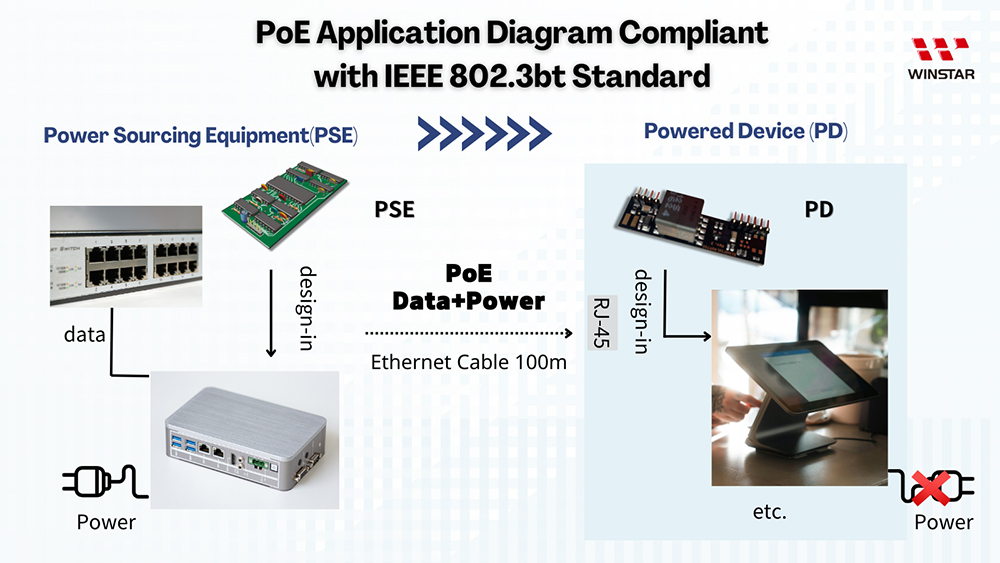
Table of Contents
- What Exactly is a Power over Ethernet (PoE) Cable?
- How Does PoE Technology Transmit Power and Data?
- Which Ethernet Cable Categories are Suitable for PoE?
- A Deep Dive into PoE Standards and Power Levels
- Why is Cable Quality Crucial for PoE Performance?
- What are the Key Applications for PoE Cabling?
- How to Choose the Right PoE Cable for Your Needs?
What Exactly is a Power over Ethernet (PoE) Cable?
Power over Ethernet (PoE) revolutionizes network installations by delivering low-voltage electrical power alongside data signals over a single twisted-pair Ethernet cable. It’s important to understand that there is no “special” PoE cable. Rather, PoE technology utilizes standard network cables that you are already familiar with, like Category 5e (Cat5e), Category 6 (Cat6), and Category 6A (Cat6A). The key is that both the equipment sending the power and the device receiving it are PoE-compliant.
The system consists of two main components. The Power Sourcing Equipment (PSE), such as a PoE network switch or a PoE injector, is responsible for sending power down the line. The Powered Device (PD) is the endpoint that receives this power to operate, such as an IP camera, a VoIP phone, or a wireless access point. This integrated approach eliminates the need for separate power adapters and nearby electrical outlets for each device, dramatically simplifying installation, reducing clutter, and lowering overall infrastructure costs.
How Does PoE Technology Transmit Power and Data?
The transmission of power and data through a single Ethernet cable is achieved by leveraging the internal pairs of copper wires. Standard Ethernet cables contain four twisted pairs of wires (for a total of eight conductors). Depending on the network speed (10/100BASE-T), only two of these pairs are used for data transmission, leaving the other two “spare.” PoE technology cleverly utilizes these wire pairs to carry the electrical current.
A critical safety feature of PoE is the “handshake” process. Before the PSE sends any significant power, it communicates with the connected device to verify that it is a compatible PD and determines its power requirements. This negotiation prevents the PSE from sending power to non-PoE devices, which could potentially cause damage. This intelligent power delivery ensures a safe and efficient operation across the network.
Understanding PoE Modes: Mode A vs. Mode B
PoE transmits power using one of two methods, known as Mode A and Mode B. The choice of mode is determined by the manufacturer of the PSE.
- Mode A: Power is delivered on the same two pairs of wires that carry the data (the data pairs). This is sometimes referred to as “phantom power” because the DC voltage is superimposed onto the data transmission without interfering with it.
- Mode B: Power is delivered on the two “spare” pairs of wires that are not used for data in 10/100BASE-T networks. In Gigabit Ethernet, all four pairs are used for data, so power is similarly delivered via a phantom feed.
Modern Powered Devices (PDs) are designed to be compatible with both Mode A and Mode B, so you rarely need to worry about which mode your switch or injector is using. The device will automatically detect how power is being delivered and adapt accordingly.
Which Ethernet Cable Categories are Suitable for PoE?
While PoE works over several types of Ethernet cables, the choice of category has a significant impact on performance, reliability, and the amount of power that can be delivered safely—especially over longer distances. The primary difference lies in conductor thickness and overall construction quality.
Cat5e: The Baseline for Basic PoE
Category 5e is the minimum requirement for PoE applications. It can comfortably handle the power levels of the original PoE standard (IEEE 802.3af), which delivers up to 15.4 watts of power from the source. It is adequate for low-power devices like basic VoIP phones or simple IP cameras. However, its thinner conductors (typically 24 AWG) can lead to higher DC resistance and more significant heat buildup under higher power loads, making it less ideal for modern, power-hungry applications.
Cat6: The Recommended Standard for Modern PoE
For most modern PoE and PoE+ (IEEE 802.3at) installations, Cat6 is the recommended standard. Cat6 cables feature thicker copper conductors (typically 23 AWG) compared to Cat5e. This reduced wire gauge results in lower electrical resistance, which means less power is lost as heat during transmission. Consequently, Cat6 cables can deliver power more efficiently and safely, making them perfect for devices like pan-tilt-zoom (PTZ) cameras, multi-radio wireless access points, and video phones that require up to 30 watts of power.
Cat6A and Beyond: Essential for High-Power PoE++
When deploying the highest power PoE standards, known as PoE++ or 4PPoE (IEEE 802.3bt), which deliver 60W to 100W, Category 6A is essential. The substantial power running through the cable generates significant heat. Cat6A cables are designed with even thicker conductors and often include better insulation and shielding to dissipate this heat effectively. Using lower-category cables for these high-power applications can lead to performance degradation, data errors, and even pose a safety risk. High-quality Cat6A cables, like those from trusted manufacturers such as D-Lay Cable, are engineered to handle these thermal loads while maintaining flawless 10-Gigabit data performance.
A Deep Dive into PoE Standards and Power Levels
The Institute of Electrical and Electronics Engineers (IEEE) defines the standards that govern PoE technology. These standards specify the maximum power that can be delivered by the PSE and received by the PD. Understanding these standards is critical for matching your power source with your devices.
| Standard | PoE Type | Max. Power from PSE | Max. Power to PD | Common Devices |
|---|---|---|---|---|
| IEEE 802.3af | Type 1 (PoE) | 15.4W | 12.95W | VoIP phones, static security cameras, sensors |
| IEEE 802.3at | Type 2 (PoE+) | 30W | 25.5W | PTZ cameras, video phones, dual-band WAPs |
| IEEE 802.3bt | Type 3 (PoE++) | 60W | 51W | Video conferencing systems, building management devices |
| IEEE 802.3bt | Type 4 (PoE++) | 100W | 71.3W | Digital signage, high-power WAPs, smart lighting |
Notice the difference between the power from the PSE and the power available at the PD. This discrepancy accounts for power that is naturally lost as heat along the length of the cable. This power loss is more pronounced in lower-quality or thinner-gauge cables.
Why is Cable Quality Crucial for PoE Performance?
For PoE applications, the Ethernet cable is not just a data conduit; it is an integral part of the power delivery system. The quality of its construction directly affects safety, efficiency, and network reliability.
The Impact of Conductor Material and Size
The single most important factor in a PoE cable is its conductor. For optimal safety and performance, always insist on cables made with 100% solid bare copper conductors. Cheaper alternatives, such as Copper Clad Aluminum (CCA), have higher electrical resistance. This causes greater heat buildup, increased power loss, and a higher risk of fire, especially with high-power PoE++. Reputable manufacturers like D-Lay Cable ensure their products meet stringent specifications for pure copper conductors to guarantee reliable power delivery and data integrity.
The conductor size, measured in American Wire Gauge (AWG), is also vital. A lower AWG number indicates a thicker wire. A thicker wire (e.g., 23 AWG in Cat6) has less resistance than a thinner one (e.g., 24 AWG in Cat5e), allowing it to run cooler and deliver power more efficiently over the maximum channel length of 100 meters (328 feet).
Shielding’s Role in a PoE Environment
While Unshielded Twisted Pair (UTP) cables are common, Shielded Twisted Pair (STP) cables offer distinct advantages in certain PoE installations. Shielding, which is a layer of foil or braid around the wire pairs, protects the data signal from electromagnetic interference (EMI) from sources like fluorescent lights, motors, or adjacent power cables. In a PoE context, shielding can also help dissipate heat more effectively, contributing to better thermal management for high-power applications.
What are the Key Applications for PoE Cabling?
The simplicity and cost-effectiveness of PoE have made it the go-to solution for powering a wide range of network-connected devices. Common applications include:
- IP Security Cameras: Easily install cameras in optimal locations (ceilings, exterior walls) without worrying about nearby power outlets.
- VoIP Phones: Streamline office desk setups with a single cable for both network connectivity and phone power.
- Wireless Access Points (WAPs): Mount WAPs on ceilings or high on walls for the best signal coverage, powered and connected by one cable.
- Smart Building & IoT: Power and connect a growing ecosystem of devices like smart lighting, access control panels, and environmental sensors efficiently.
- Digital Signage: Deploy informational displays in public spaces without the complexity of additional electrical wiring.
How to Choose the Right PoE Cable for Your Needs?
Selecting the correct cable involves considering your specific application’s requirements. Follow these steps to make an informed decision:
- Identify Your Device’s Power Requirement: Check the device’s specifications for its required PoE standard (e.g., 802.3at or PoE+). This will determine the minimum cable category you should consider.
- Determine the Cable Run Length: While the maximum channel length is 100 meters, power drop-off and heat buildup are more significant on longer runs. For runs approaching the maximum length with high-power devices, a higher-quality cable (Cat6A) is a wise investment.
- Assess the Installation Environment: Is the cable being run through areas with high EMI? If so, a shielded (STP) cable is recommended. Will it be run in plenum spaces? Ensure you use plenum-rated (CMP) cable jackets to comply with fire safety codes.
- Future-Proof Your Network: Device power requirements are constantly increasing. Investing in high-performance cabling, such as Cat6A, ensures your infrastructure is ready for future-generation devices without needing a costly replacement. Partnering with an experienced cable supplier like D-Lay Cable provides access to expertly engineered solutions that support both current needs and future growth.