


In today’s digitally-driven world, the demand for faster, more reliable network connections is non-negotiable. From bustling data centers to smart homes and high-powered office environments, the backbone of our connectivity is the humble-yet-critical Ethernet cable. Among the various options, Cat6a (Category 6 Augmented) has emerged as a powerful standard for future-proofing network infrastructure.
As a leading manufacturer of high-quality network cabling solutions, we at D-Lay Cable believe in empowering our clients with knowledge. dlaycable will break down exactly what Cat6a is, how it differs from its predecessors, and when it’s the right choice for your project.
Table of Contents
- What is Cat6a? The Definition and Core Specifications
- The Key Difference: Cat6a vs. Cat6
- Understanding Cat6a Construction: Shielding and Design
- When Should You Choose Cat6a Cable?
- The Benefits and Considerations of Using Cat6a
- Frequently Asked Questions (FAQ) about Cat6a
- The D-Lay Cable Commitment: Why Quality Matters for Cat6a
What is Cat6a? The Definition and Core Specifications
Cat6a (Category 6 Augmented) is a standardized twisted pair cable for Ethernet that is defined by the TIA/EIA-568-C.2 standard. It represents a significant enhancement over its predecessor, Cat6. Its primary purpose is to deliver reliable, high-speed performance and reduce interference, especially in demanding environments.
The core specifications that set Cat6a apart are:
- Data Rate: Supports 10 Gigabits per second (Gbps), also known as 10GBASE-T.
- Distance: Maintains this 10 Gbps speed over the full maximum channel length of 100 meters (328 feet).
- Bandwidth: Operates at a frequency of up to 500 MHz, double that of Cat6. This higher bandwidth allows it to handle more data simultaneously.
- Crosstalk Performance: Features significantly improved protection against Alien Crosstalk (ANEXT), which is interference from adjacent cables.
The Key Difference: Cat6a vs. Cat6
While both are excellent cables, the choice between Cat6 and Cat6a depends entirely on your performance requirements and long-term goals. The “a” in Cat6a for “augmented” signifies crucial improvements that directly impact network capability.
Here’s a clear comparison:
| Feature | Cat6 | Cat6a |
|---|---|---|
| Max Data Rate | 10 Gbps | 10 Gbps |
| Distance for 10 Gbps | Up to 55 meters (180 ft) | Up to 100 meters (328 ft) |
| Bandwidth | 250 MHz | 500 MHz |
| Alien Crosstalk (ANEXT) | Sufficient for lower speeds | Significantly improved mitigation |
| Physical Size | Standard | Thicker and heavier due to tighter twists and/or shielding |
| Cost | Lower | Higher |
The primary takeaway is that while Cat6 can technically achieve 10 Gbps, it can only do so over shorter distances and is more susceptible to interference in dense installations. Cat6a is engineered specifically to deliver a stable 10 Gbps performance over the full 100-meter distance, making it the true standard for 10GBASE-T networking.
Understanding Cat6a Construction: Shielding and Design
To achieve its superior performance, Cat6a cable construction is more robust. This is where the difference between unshielded and shielded cables becomes critical.
- U/UTP (Unshielded Twisted Pair): Cat6a U/UTP cables combat crosstalk through innovative design features like tighter wire twists, larger conductors, and an internal spline that physically separates the pairs. However, they can still be susceptible to strong external EMI (Electromagnetic Interference).
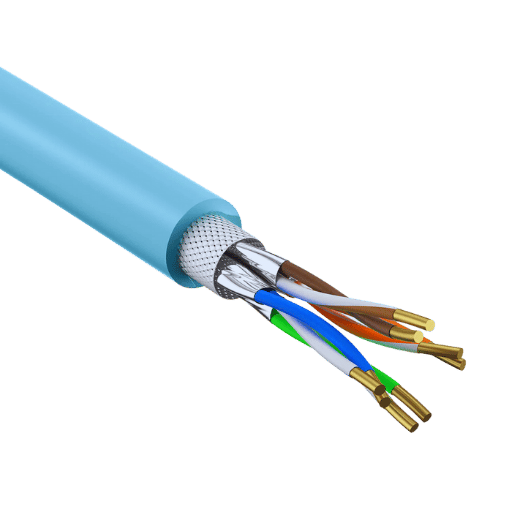
- F/UTP (Foiled/Unshielded Twisted Pair): This is a very common type of Cat6a cable. It features an overall foil shield wrapped around all four unshielded twisted pairs. This shield provides excellent protection against Alien Crosstalk and external EMI, ensuring signal integrity.
The enhanced construction makes Cat6a cables thicker and less flexible than Cat6, a key consideration for installation planning in terms of conduit size and bend radius.
When Should You Choose Cat6a Cable?
Investing in Cat6a is a strategic decision. It is the ideal choice for applications that require maximum performance, reliability, and longevity.
- Data Centers: For connecting servers, switches, and storage area networks where 10 Gbps speeds are the standard, Cat6a is essential.
- Future-Proofing Commercial and Residential Networks: Installing Cat6a today ensures your network infrastructure can handle future speed increases and the growing number of connected devices without needing a costly re-wire.
- Power over Ethernet (PoE): Cat6a’s thicker conductors handle the heat generated by high-power PoE applications (PoE+, PoE++) more effectively than lower-category cables, making it safer and more reliable for powering devices like WAPs, IP cameras, and VoIP phones.
- Healthcare and Education: Environments that rely on transferring large files (like medical images or research data) and have a high density of users benefit immensely from the stable, high-bandwidth connection Cat6a provides.
The Benefits and Considerations of Using Cat6a
Advantages
- Superior Performance: Guaranteed 10 Gbps over 100 meters.
- Future-Proof Investment: Built to handle the network demands of tomorrow.
- Enhanced Reliability: Reduced crosstalk and better EMI resistance lead to fewer data errors and a more stable connection.
- Excellent for PoE: Better heat dissipation for high-power device support.
Considerations
- Cost: Cat6a cables and compatible components (keystone jacks, patch panels) are more expensive upfront.
- Size and Flexibility: The thicker diameter requires larger conduits and careful attention to bend radius limits during installation.
- Termination: Terminating thicker, often shielded, Cat6a cable can be more challenging and requires the correct tools and connectors.
Frequently Asked Questions (FAQ) about Cat6a
Is Cat6a backward compatible?
Yes. A Cat6a cable can be used in a network with lower-rated components (like a Cat6 or Cat5e jack). The connection will simply operate at the speed of the lowest-rated component in the channel.
Can I use Cat6 connectors on Cat6a cable?
It is strongly discouraged. Cat6a cables have larger conductors (typically 23 AWG) and a thicker overall diameter. Using Cat6 connectors can lead to a poor connection, signal loss, and failure to meet Cat6a performance standards. Always use connectors specifically rated for Cat6a.
Is Cat6a necessary for my home network?
For the average home user with a standard 1 Gbps internet connection, Cat6 is often sufficient. However, if you are a power user, have a home lab, transfer large files locally, or want to ensure your home is ready for future multi-gig internet speeds, installing Cat6a is an excellent future-proofing strategy.
The D-Lay Cable Commitment: Why Quality Matters for Cat6a
Understanding Cat6a specifications is one thing; ensuring the cable you purchase actually meets them is another. As a dedicated manufacturer, D-Lay Cable takes performance and quality personally. The “augmented” performance of Cat6a can only be realized through precision engineering, high-quality materials, and stringent testing.
When you choose D-Lay Cable, you are choosing a partner committed to excellence. Our Cat6a cables are:
- Manufactured to Strict Standards: We control the entire production process, ensuring every cable adheres precisely to TIA/EIA performance specifications.
- Certified for Trust: Our products carry essential certifications like UL, ETL, CE, and RoHS, guaranteeing safety, quality, and compliance.
- Engineered for a Complete Solution: We provide not just bulk cable, but a full ecosystem of Cat6a-rated patch cords, keystone jacks, and patch panels designed to work together for guaranteed channel performance.
A network is only as strong as its weakest link. Investing in certified, high-quality Cat6a cabling from a trusted manufacturer like D-Lay Cable is the most effective way to build a robust, reliable, and future-ready network foundation.