


CAT8 cable is the highest standard in twisted-pair copper cabling, supporting 2000 MHz bandwidth and data rates of 25/40Gbps up to 30 meters.
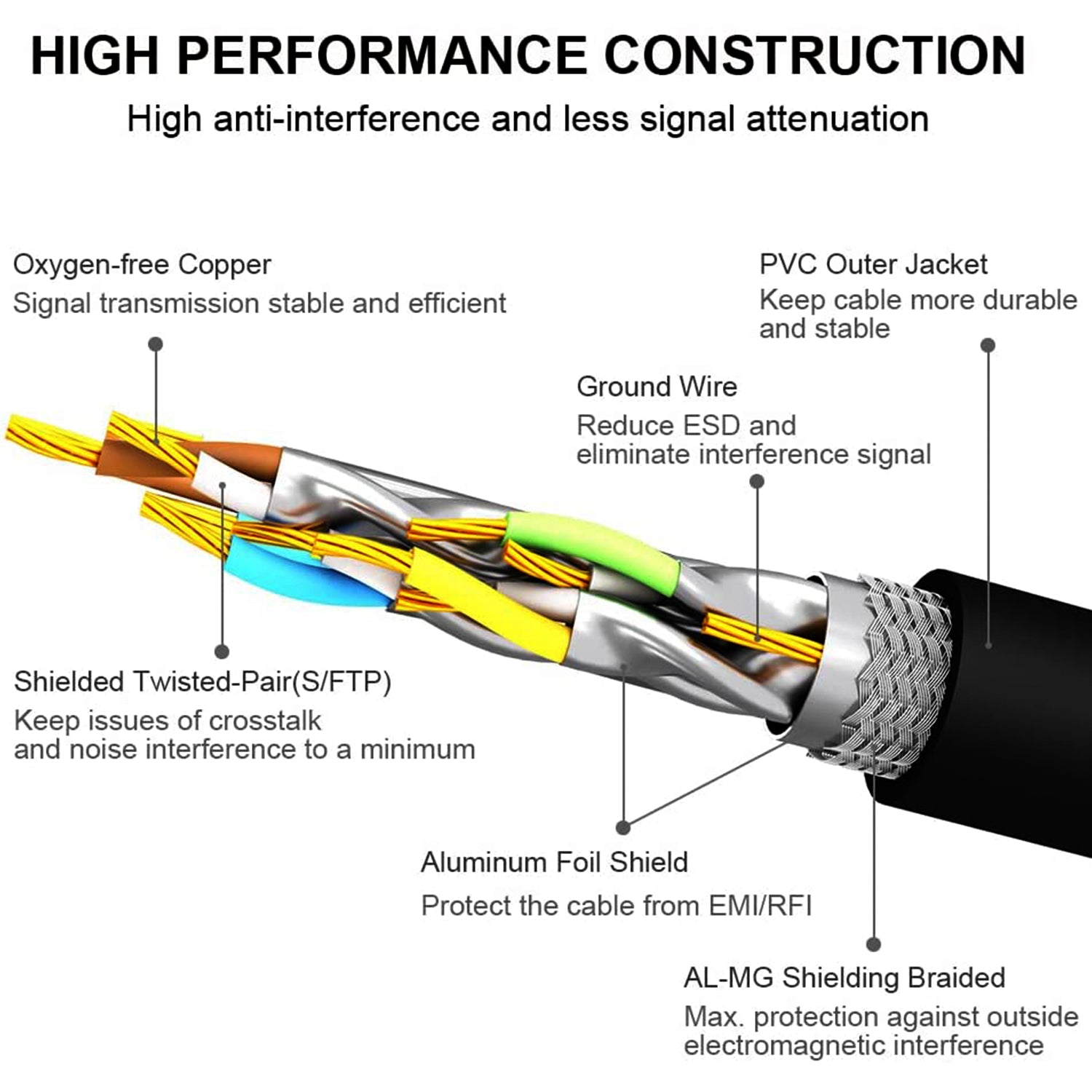
Table of Contents
- Understanding the Core Specifications of Category 8 Cabling
- How Does CAT8 Compare to Other Ethernet Categories?
- What Are the Primary Applications for CAT8 Cable?
- Key Considerations Before Deploying CAT8
- Choosing a Reliable CAT8 Cable Supplier
Understanding the Core Specifications of Category 8 Cabling
Category 8, or CAT8, represents a significant leap in the evolution of copper Ethernet cabling. Defined by the ANSI/TIA-568-C.2-1 standard, it was developed specifically to support emerging 25GBASE-T and 40GBASE-T applications. Its performance characteristics are a direct response to the immense bandwidth demands of modern data centers. Unlike its predecessors, which were designed for more general use, CAT8 is a specialized solution for high-performance, short-distance links.
Unprecedented Speed and Bandwidth
The defining feature of CAT8 cable is its astounding performance. It supports a bandwidth of up to 2000 MHz, which is four times that of CAT6A (500 MHz) and more than double that of CAT7 (600-1000 MHz). This massive bandwidth allows it to transmit data at speeds of 25 Gbps or even 40 Gbps. This capability is essential for connecting servers, storage area networks (SANs), and network switches within a data center, where data throughput is the most critical performance metric. The ability to handle such high frequencies over twisted-pair copper makes it a cost-effective alternative to fiber optics for specific applications.
The Critical 30-Meter Distance Limitation
While the speed is impressive, it comes with a significant trade-off: distance. CAT8 cabling is designed for a maximum channel length of just 30 meters (98 feet). This channel consists of up to 24 meters of horizontal cabling and a total of 6 meters of patch cords. This limitation is a physical constraint; at 2000 MHz, signal degradation (attenuation) becomes too severe over longer distances. This makes CAT8 an ideal solution for connections within a single server rack or between adjacent racks—known as Top-of-Rack (ToR) or End-of-Row (EoR) network architectures—but entirely unsuitable for backbone cabling or connecting workstations across an office building.
Shielding: The Non-Negotiable Standard
To achieve its remarkable performance and manage the extremely high frequencies, CAT8 cable requires robust shielding. The standard specifies a fully shielded construction, typically S/FTP (Screened/Foiled Twisted Pair). In this design, each of the four individual wire pairs is wrapped in a foil shield, and then all four pairs are encased together in an overall braided screen. This dual-layer shielding is critical for mitigating crosstalk, especially Alien Crosstalk (ANEXT), which is the interference between adjacent cables in a bundle. In the dense, high-bandwidth environment of a data center, eliminating this interference is non-negotiable for maintaining signal integrity and network stability.
How Does CAT8 Compare to Other Ethernet Categories?
Understanding where CAT8 fits requires comparing it to other common standards. Each category was designed for the networking technologies of its time, with progressive improvements in speed and frequency. The following table illustrates the key differences between the most relevant cabling generations.
| Feature | CAT6 | CAT6A | CAT7 | CAT8 |
|---|---|---|---|---|
| Max Speed | 1 Gbps (up to 10 Gbps at <55m) | 10 Gbps | 10 Gbps | 25 / 40 Gbps |
| Max Bandwidth | 250 MHz | 500 MHz | 600 MHz | 2000 MHz |
| Max Distance | 100 meters | 100 meters | 100 meters | 30 meters |
| Shielding | UTP or Shielded | UTP or Shielded | Required (S/FTP) | Required (S/FTP, F/FTP) |
| Primary Application | General Office/Home Networks | Business Networks, Data Centers | Data Centers, High-End AV | Data Centers (Switch-to-Server) |
What Are the Primary Applications for CAT8 Cable?
The specific design and performance characteristics of CAT8 cable dictate its use in very particular environments. It is not an all-purpose solution but rather a high-precision tool for solving the most demanding network challenges.
The Data Center Environment
The primary and intended environment for CAT8 is the data center. As data centers upgrade their equipment to support faster speeds, the connections between servers and switches become a bottleneck. CAT8 is designed to eliminate this bottleneck, providing a copper-based path for 25G and 40G Ethernet. Its 30-meter length is perfectly suited for interconnecting equipment within the structured “point-to-point” topology of a data center, such as connecting servers in a rack to the Top-of-Rack switch.
Switch-to-Server Connections
Specifically, CAT8 excels at the “edge” of the data center network—the final link between the network infrastructure and the servers themselves. As server network interface cards (NICs) evolve to 25Gbps and beyond, a corresponding cable is needed to deliver that speed reliably. Using CAT8 for these critical connections ensures that the server’s full network potential can be utilized without being constrained by older, slower cabling like CAT6A.
Is CAT8 Suitable for Home Networks or Gaming?
This is a common question, and the answer is generally no. While marketing for some consumer products may tout CAT8 as the “best” for gaming or streaming, it is almost always unnecessary. Most home internet connections do not exceed 1 Gbps, a speed that CAT6 and CAT6A can handle perfectly over the full 100-meter distance needed for a typical house. Furthermore, home networking equipment like routers and PCs rarely have 25/40Gbps ports that could even take advantage of CAT8’s capabilities. For residential or office use, investing in high-quality CAT6A is a far more practical and cost-effective choice for future-proofing.
Key Considerations Before Deploying CAT8
Implementing a CAT8 cabling infrastructure requires careful planning and attention to detail. The high-performance nature of the standard means that every component in the channel must be up to the task.
Connector Compatibility and Requirements
CAT8 uses the standard RJ45 connector, ensuring backward compatibility with older network equipment. However, to achieve CAT8 performance, all connecting hardware—including keystone jacks, patch panels, and the RJ45 plugs themselves—must be specifically rated for Category 8. These components are engineered with superior shielding and tighter tolerances to handle the 2000 MHz frequency. Using lower-rated components (like a CAT6A jack) with CAT8 cable will create a bottleneck, and the channel will only perform to the level of its weakest link.
The Importance of Proper Installation
The sensitivity of high-frequency signals makes proper installation technique absolutely essential. Installers must adhere to the specified minimum bend radius to avoid damaging the internal structure of the cable. Terminations must be precise, and the grounding of the shield must be correctly implemented to ensure its effectiveness. Poor installation practices can easily compromise the performance of a CAT8 channel, leading to signal loss and a failure to meet the promised speeds. This is why professional installation is highly recommended.
Is Category 8 a Future-Proof Investment?
For its intended application—data centers—CAT8 is an excellent future-proofing investment. It provides a clear roadmap for upgrading network speeds from 10G to 40G without having to install new cabling. By installing a CAT8 infrastructure today, data center managers can ensure their physical layer is ready for the next generation of active equipment. Outside of the data center, however, its future-proofing value is limited due to the 30-meter distance constraint. For horizontal office cabling, CAT6A remains the recommended standard for future-proofing up to 10Gbps.
Choosing a Reliable CAT8 Cable Supplier
When sourcing CAT8 cable, the quality of manufacturing is paramount. The tight tolerances and performance demands of the standard leave no room for error. A reliable supplier is one that demonstrates a commitment to quality through rigorous testing and adherence to industry standards.
Look for cables that are verified by third-party organizations like UL or ETL to meet the ANSI/TIA-568 specifications. This verification ensures the product has been independently tested and performs as advertised. Additionally, insist on cables made with 100% solid bare copper conductors. Cheaper alternatives like Copper Clad Aluminum (CCA) have higher resistance and do not perform reliably at high frequencies, often failing to meet CAT8 standards.
At DLAYCABLE, we manufacture high-performance CAT8 S/FTP cabling built for the mission-critical demands of modern data centers. Our products are engineered with premium materials and undergo stringent quality control to guarantee compliance with all performance metrics. By choosing a manufacturer with proven expertise, you ensure the integrity and longevity of your network infrastructure.