


In our increasingly wireless world, it’s easy to forget the humble hero of network reliability: the Ethernet cable. While Wi-Fi offers convenience, a physical, wired connection provides the unparalleled speed, stability, and security required for everything from high-stakes gaming to critical business operations. But navigating the world of Ethernet cables can be confusing, with a jumble of terms like Cat5e, Cat6, and Cat7.
As a leading manufacturer and supplier of network cabling solutions with over 15 years of experience, we at D-Lay Cable understand the importance of choosing the right foundation for your network. dlaycable will demystify the differences between these common cable types, helping you make an informed decision that balances performance, cost, and future-proofing for your specific needs.
Article Directory
- Quick Comparison: Cat5e vs. Cat6 vs. Cat7 at a Glance
- The Reliable Standard: Understanding Cat5e
- The Performance Upgrade: Why Choose Cat6?
- The High-Frequency Powerhouse: Demystifying Cat7
- The Core Differences That Matter
- How to Choose the Right Cable for Your Application
- The D-Lay Cable Advantage: Quality You Can Trust
Quick Comparison: Cat5e vs. Cat6 vs. Cat7 at a Glance
For those who need a quick answer, here’s a straightforward comparison table. We’ll dive into the details of what these specifications mean for you below.
| Feature | Cat5e (Category 5e) | Cat6 (Category 6) | Cat7 (Category 7) |
|---|---|---|---|
| Max Speed (Data Rate) | 1 Gbps @ 100 meters | 10 Gbps up to 55 meters; 1 Gbps @ 100 meters | 10 Gbps @ 100 meters |
| Max Bandwidth (Frequency) | 100 MHz | 250 MHz | 600 MHz |
| Shielding & Construction | Typically Unshielded (UTP) | Can be Unshielded (UTP) or Shielded (STP); features tighter wire twists and often a spline. | Always Shielded (S/FTP), with shielding on individual pairs and an overall braid shield. |
| Best For | Basic home networking, small offices, VoIP phones. | Modern homes, gaming, 4K streaming, new office installations. | Data centers, server rooms, smart homes, and high-interference environments. |
| Cost | Lowest | Moderate | Highest |
The Reliable Standard: Understanding Cat5e
Cat5e (Category 5 enhanced) has been the go-to standard for years and remains a highly capable choice for many applications. It was designed to reliably support Gigabit Ethernet (1 Gbps) speeds over a distance of up to 100 meters (328 feet).
Key Characteristics:
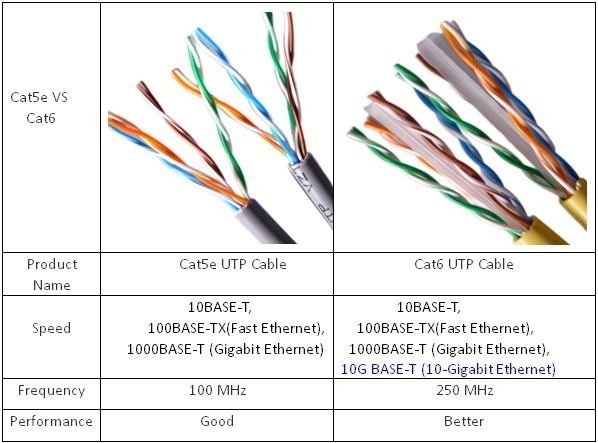
- Performance: With a bandwidth of 100 MHz, it can handle data rates up to 1 Gbps, which is sufficient for most home internet plans, HD streaming, and general office work.
- Construction: Most Cat5e cables are Unshielded Twisted Pair (UTP), meaning the internal copper wires are twisted together to reduce interference, but there is no additional metallic shield. This makes them flexible and inexpensive.
- Bottom Line: Cat5e is the economical workhorse. If your internet speed is 1 Gbps or less and you’re on a budget, it’s a perfectly functional and cost-effective solution.
The Performance Upgrade: Why Choose Cat6?
Cat6 (Category 6) represents a significant step up in performance, designed to handle higher speeds and reduce interference more effectively. It is quickly becoming the new minimum standard for modern installations.
Key Characteristics:
- Performance: Cat6 boasts a higher bandwidth of 250 MHz. This allows it to support 10 Gbps speeds, although this is typically limited to shorter distances (up to 55 meters). For the full 100-meter length, it reliably delivers 1 Gbps, just like Cat5e, but with much more headroom and stability.
- Construction: The magic of Cat6 lies in its construction. It features more tightly twisted wire pairs and, often, a plastic spine (called a spline) that runs down the center, physically separating the pairs. This drastically reduces “crosstalk”—the signal interference between wires—which is the primary limiting factor for speed.
- The Cat6a Variant: It’s worth mentioning Cat6a (Augmented Category 6), which operates at 500 MHz and can maintain 10 Gbps speeds over the full 100-meter distance. It is the preferred choice for future-proofing new business and high-end residential networks.
- Bottom Line: Cat6 is the sweet spot for most new installations. It provides a more robust and future-proof network, ideal for gamers, 4K video streamers, and businesses that need a rock-solid connection.
The High-Frequency Powerhouse: Demystifying Cat7
Cat7 (Category 7) is a high-performance cable designed for the most demanding environments. Its main advantage isn’t just a higher theoretical speed, but its incredible resistance to interference.
Key Characteristics:
- Performance: Cat7 supports 10 Gbps at the full 100 meters and offers a massive bandwidth of 600 MHz. This extra bandwidth doesn’t necessarily make your internet faster, but it provides immense capacity and stability for data-intensive applications.
- Construction: This is the key differentiator. Cat7 cables are always shielded. They use a design called S/FTP (Screened/Foiled Twisted Pair), where each individual pair of wires is wrapped in foil, and then all four pairs are wrapped in an overall metallic braid. This makes Cat7 virtually immune to both internal crosstalk and external electromagnetic interference (EMI) from power lines or heavy machinery.
- Connector Note: While technically specified with a GG45 or TERA connector for full performance, most Cat7 cables on the market are terminated with standard RJ45 heads for backward compatibility. However, this means they don’t always deliver the full promise of the Cat7 standard.
- Bottom Line: Cat7 is a specialized solution. It’s overkill for most homes but is an excellent choice for data centers, server rooms, professional audio/video applications, or any environment where signal integrity is absolutely critical.
The Core Differences That Matter
Let’s boil it down to the three factors that should guide your decision:
- Bandwidth vs. Speed: Think of bandwidth (MHz) as a highway’s number of lanes and speed (Gbps) as the speed limit. A 10-lane highway (Cat7’s 600 MHz) and a 4-lane highway (Cat6’s 250 MHz) might have the same 10 Gbps speed limit, but the 10-lane highway can handle far more traffic simultaneously without congestion. Higher bandwidth means more reliable performance, especially in data-heavy networks.
- Crosstalk and Shielding: This is the most important physical difference. The tighter twists in Cat6 and the mandatory, extensive shielding in Cat7 are all designed to combat crosstalk. If your cables will be bundled together or run near power sources, better shielding is not a luxury—it’s a necessity for a stable connection.
- Cost vs. Future-Proofing: Cat5e is cheapest, Cat7 is most expensive. While it may be tempting to save money with Cat5e, installing Cat6 or Cat6a now can save you the significant cost and hassle of re-wiring your walls in a few years when 10 Gbps networking becomes standard.
How to Choose the Right Cable for Your Application
As a solutions provider, our goal is to match you with the right product. Here’s our recommendation based on common scenarios:
- For Standard Home Use (Email, Web, HD Streaming): Cat5e is generally sufficient and very budget-friendly. However, for a few dollars more, Cat6 provides better performance for streaming and gaming.
- For Gamers, 4K Streamers, and Home Offices: Cat6 is the clear winner. It provides the stability and bandwidth needed for low-latency, high-throughput activities without breaking the bank.
- For New Construction or a Major Renovation (Future-Proofing): We strongly recommend installing Cat6a. It guarantees 10 Gbps performance for the future and is the gold standard for modern smart homes and offices.
- For Data Centers, Server Rooms, or Industrial Settings: Cat7 (or its successor, Cat8) is the correct choice. The superior shielding is essential to protect signal integrity in these high-density, high-interference environments.
The D-Lay Cable Advantage: Quality You Can Trust
Regardless of the category you choose, the quality of the cable itself is paramount. A poorly made Cat7 cable can perform worse than a well-made Cat6. That’s where D-Lay Cable makes the difference.
As a dedicated manufacturer, we offer:
-
- Pure Bare Copper Conductors: We use 100% pure copper in our cables, not cheap Copper Clad Aluminum (CCA). This ensures superior conductivity, durability, and compliance with safety standards.
- Rigorous Testing and Certification: All our products, from Cat5e to Cat8 and beyond, undergo fluke testing and meet or exceed industry standards like UL, ETL, CE, and RoHS.
li>One-Stop Solution: Beyond just cables, we provide a full range of networking hardware, including patch panels, keystone jacks, and tools, ensuring compatibility and quality across your entire infrastructure.
- Expertise & Customization: With 15+ years of experience and robust OEM/ODM capabilities, we can provide expert guidance and create custom cabling solutions tailored to your exact specifications.
Choosing the right Ethernet cable is a critical investment in your network’s performance. By understanding the key differences in speed, construction, and application, you can build a reliable and future-ready connection. If you have any questions or need a custom solution for your project, contact the experts at D-Lay Cable today.