


# Will Cat8 Improve My Internet Speed? The Expert Answer
While Cat8 cable is the fastest copper Ethernet standard ever developed, it will **not** improve your internet speed if your connection is limited by your Internet Service Provider (ISP) plan. For the vast majority of home and office users, the true bottleneck is the speed you pay for each month—not the cable connecting your router to your devices. Cat8 is an incredibly powerful cable designed for high-bandwidth, short-distance connections inside data centers, supporting speeds up to 40Gbps. This capacity far exceeds even the fastest residential internet plans available today, making it unnecessary for boosting your Netflix stream or online gaming performance.
Table of Contents
- What is Cat8 Cable? Unpacking the Next-Generation Standard
- The Crucial Difference: Internet Speed vs. Local Network (LAN) Speed
- Cat8 vs. Its Predecessors: A Head-to-Head Comparison
- So, When is a Cat8 Cable a Smart Investment?
- Why Cat8 is Likely Overkill for Your Home Network
- What Ethernet Cable Should I Use? The Smart Choice for Today and Tomorrow
- The Final Verdict: Choosing the Right Cable for Your Needs
What is Cat8 Cable? Unpacking the Next-Generation Standard
Category 8, or Cat8, represents the cutting edge of twisted-pair copper cabling technology. It was developed by the ANSI/TIA-568 committee specifically to support 25GBASE-T and 40GBASE-T applications, which are primarily found in data centers. It’s a leap in performance so significant that it operates in a different league than the cables most people are familiar with.
The Core Specifications: Blazing Speed and Massive Bandwidth
The defining characteristic of Cat8 is its astounding performance ceiling. It is engineered to support:
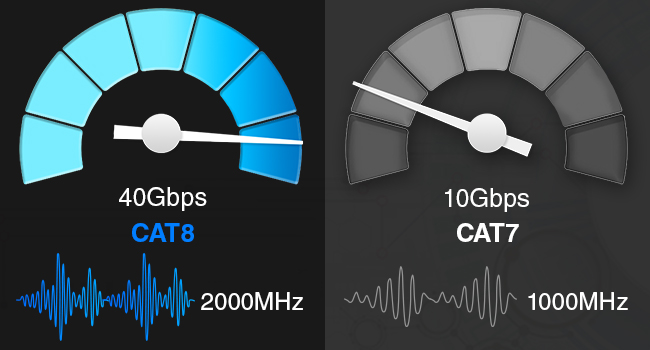
- Data Transfer Speeds of up to 40 Gigabits per second (Gbps).
- Bandwidth (Frequency) of up to 2000 MHz.
To put this in perspective, this is four times the speed and four times the bandwidth of the already impressive Cat6a standard. This immense capacity allows Cat8 to handle the most demanding data throughput tasks imaginable, but it comes with a major caveat: these speeds are only achievable over a maximum distance of 30 meters (about 98 feet). This short-distance limitation is a key reason why its use is so specific.
Key Features: Superior Shielding and Construction
To achieve its incredible performance, Cat8 cabling requires a robust and sophisticated construction. Unlike its unshielded predecessors, Cat8 cables are mandatorily shielded. They use **S/FTP (Screened/Foiled Twisted Pair)** construction, meaning each individual pair of copper wires is wrapped in a foil shield, and then a larger, overall screen braid encases all four pairs. This dual-layer shielding is critical for mitigating alien crosstalk (ANEXT) and electromagnetic interference (EMI), especially at its high 2000 MHz frequency. This construction makes the cables thicker, stiffer, and less flexible than Cat6 or Cat6a, which is an important consideration for installation.
The Crucial Difference: Internet Speed vs. Local Network (LAN) Speed
The core of the Cat8 question lies in understanding that your “speed” is not a single number. There are two distinct networks you use daily, and they have very different performance limits.
Think of your **internet speed** as the main highway that connects your town to the rest of the world. Your Internet Service Provider (ISP) builds and maintains this highway, and the plan you pay for determines your speed limit—say, 1 Gbps (1,000 Mbps). No matter how fast your car is, you can’t go faster than the highway’s speed limit.
Your **Local Area Network (LAN)**, on the other hand, is like the private roads and driveway within your own property. This network connects your personal devices: your computer, gaming console, Smart TV, and Network-Attached Storage (NAS) drive. The speed of your LAN is determined by your router, switches, and the Ethernet cables connecting them. Using a Cat8 cable is like paving your driveway for a Formula 1 car. It’s an incredibly high-performance surface, but if the main highway is limited to 60 MPH, the F1 car in your driveway can’t make your trip across town any faster. Your internet speed will *always* be limited by your ISP plan, regardless of whether you use a Cat6, Cat6a, or Cat8 cable.
Cat8 vs. Its Predecessors: A Head-to-Head Comparison
Seeing the evolution of Ethernet cables helps clarify where Cat8 fits. As cabling experts, we believe in using the right tool for the job. This table breaks down the key differences between the most common cable categories.
| Feature | Cat5e | Cat6 | Cat6a | Cat7 | Cat8 |
|---|---|---|---|---|---|
| Max Speed (at 100m) | 1 Gbps | 1 Gbps | 10 Gbps | 10 Gbps | N/A (30m limit) |
| Max Speed (at <100m) | 1 Gbps | 10 Gbps (at 55m) | 10 Gbps (at 100m) | 10 Gbps (at 100m) | 40 Gbps (at 30m) |
| Bandwidth | 100 MHz | 250 MHz | 500 MHz | 600 MHz | 2000 MHz |
| Shielding | Optional (UTP common) | Optional (UTP common) | Recommended (U/FTP, F/UTP) | Required (S/FTP) | Required (S/FTP) |
| Ideal Use Case | Basic home/office use, <1Gbps internet | 1Gbps networks, budget-conscious gaming | Modern homes, offices, 1-10Gbps networks, future-proofing | Data centers, proprietary systems (non-standard) | Data centers, short-range server-to-switch links |
So, When is a Cat8 Cable a Smart Investment?
If Cat8 isn’t for speeding up your home internet, what is its purpose? Its design is highly specialized for environments where massive amounts of data need to be moved very quickly over short distances.
The Prime Use Case: Data Centers and Enterprise Networks
The primary driver for Cat8’s development was the data center. In these facilities, countless servers are stacked in racks and need to communicate with network switches located in the same or an adjacent rack. These connections are typically very short, well under the 30-meter limit of Cat8. Here, a 40Gbps link is not overkill; it’s essential for aggregating data from multiple servers, handling cloud computing demands, and ensuring the entire network backbone operates without internal bottlenecks. Cat8 serves as the perfect copper-based solution for these high-speed, short-haul “end-of-row” or “top-of-rack” switching architectures.
Niche Professional Applications
Outside the data center, there are a few hyper-specific scenarios where Cat8 could be beneficial. A media production house that needs to transfer huge 8K raw video files between an editing workstation and a central NAS would see a real benefit from a 40Gbps LAN speed. Similarly, scientific research facilities or financial institutions processing massive datasets locally could leverage Cat8’s power. For these users, the bottleneck isn’t the internet; it’s the time it takes to move terabytes of data across their internal network.
Why Cat8 is Likely Overkill for Your Home Network
For the average—and even the most enthusiastic—home user, investing in Cat8 cabling is not a practical decision. The potential benefits are purely theoretical and are constrained by several real-world limitations.
The Real-World Bottleneck: Your ISP, Router, and Devices
As established, your ISP plan is the first and foremost bottleneck. Even if you have a top-tier 2Gbps fiber internet plan, a Cat6a cable can handle that at 10Gbps with 80% of its capacity to spare. Furthermore, very few consumer-grade devices (routers, motherboards, switches) are equipped with 25G or 40G Ethernet ports. Plugging a Cat8 cable into a standard 1Gbps or 2.5Gbps port will not magically make that port faster; it will simply operate at the port’s maximum rated speed.
The Myth of “Future-Proofing” with Cat8
Some argue for Cat8 as a “future-proofing” measure. However, this is a flawed perspective. The sensible approach to future-proofing is to install a solution that can handle the technological advancements of the next 5-10 years. **Cat6a is the ideal future-proofing cable for residential use.** It supports 10Gbps, a speed that home internet plans are unlikely to widely surpass in the next decade. By the time 40Gbps internet becomes a residential reality, it is highly probable that a newer, more efficient, and more practical cabling standard (perhaps fiber optic) will be the recommended choice.
Cost and Practicality Concerns
Cat8 cables are significantly more expensive than their Cat6a counterparts due to their complex construction and heavy shielding. They are also much thicker and more rigid, making them difficult to bend around corners, route through walls, or terminate. For residential installations, the added cost and installation hassle provide absolutely no tangible performance benefit over a properly installed Cat6a system.
What Ethernet Cable Should I Use? The Smart Choice for Today and Tomorrow
At DlayCable, we believe in providing our customers with the best solution for their needs. For home and office networking, the choice is clear.
**The Champion for Modern Homes: Cat6a**
For any new installation or for users with internet speeds of 1Gbps or higher, **Cat6a is the undisputed best choice.** It provides 10Gbps of throughput up to 100 meters and 500 MHz of bandwidth. This is more than enough to handle the fastest available residential internet plans, demanding 4K/8K streaming, competitive online gaming, and large local file transfers, with plenty of performance headroom for years to come. A high-quality shielded Cat6a cable will ensure a stable, interference-free connection that maximizes the performance of your entire network.
**The Reliable Standard: Cat6**
If your internet speed is below 1Gbps and you are on a tighter budget, a **Cat6 cable remains a solid and reliable option.** It comfortably handles 1Gbps speeds and is sufficient for the majority of current internet plans. It’s a cost-effective way to get a stable, wired connection that is superior to Wi-Fi.
Ultimately, the quality of the cable’s construction is paramount. A well-made, certified Cat6a cable from a reputable supplier like DlayCable will always outperform a poorly constructed, uncertified Cat8 cable. It’s not just about the category number; it’s about the quality of the materials and manufacturing.
The Final Verdict: Choosing the Right Cable for Your Needs
So, will a Cat8 cable improve your internet speed? For 99.9% of users, the answer is a definitive **no**. Your internet speed is dictated by your ISP, and a Cat8 cable cannot overcome that limitation. Its true purpose lies within the high-density, short-range environment of the modern data center.
Making an informed decision about your network cabling is key to achieving optimal performance.
- Choose Cat8 only if you are building or maintaining a data center or professional network requiring 25G/40G speeds over short distances.
- Choose Cat6a for a future-proof, high-performance home or office network that can handle any internet speed available today and for the foreseeable future.
- Choose Cat6 for a reliable and budget-friendly solution for networks up to 1Gbps.
By understanding these distinctions, you can invest wisely in your network’s foundation and ensure you have the right hardware for a fast, stable, and reliable connection. If you have any questions about selecting the perfect cable for your project, our experts at DlayCable are always here to help.