


In today’s fast-paced, digitally driven world, a reliable and high-speed internet connection is more important than ever. Whether you’re streaming 4K videos, gaming online, or managing a data-heavy business network, the quality of your Ethernet cable can make all the difference. Among the many options available, Cat 7 Ethernet cables stand out as a premium choice for those seeking top-tier performance. But what exactly are Cat 7 cables, and how do they fit into modern networking?
This guide dives deep into the world of Cat 7 Ethernet cables, exploring their technical specifications, practical applications, and key differences from other cable types. We’ll also debunk common myths, offer practical advice for choosing the right cable, and explain why Cat 7 might—or might not—be the best fit for your needs.
What is a Cat 7 Ethernet Cable?
Definition and Standards
Cat 7 Ethernet cables, or Category 7 cables, are advanced networking cables that adhere to the ISO/IEC 11801:2002 Class F standard. They’re engineered for high-speed Gigabit Ethernet setups, connecting devices like servers, switches, and computers in professional and industrial networks. Cat 7 cables are built to handle faster data rates and higher frequencies than earlier categories, making them a go-to solution for performance-critical applications.

Physical Characteristics
Cat 7 cables are shielded twisted pair (STP) cables with a robust design:
- Four twisted copper pairs, each individually shielded to minimize crosstalk (interference between wires).
- Overall shielding (typically braided or foiled) to protect against electromagnetic interference (EMI) from external sources like power lines or machinery.

This S/FTP (Shielded Foiled Twisted Pair) construction ensures reliable data transmission, even in challenging environments like factories or crowded data centers.
Connectors
Cat 7 cables are optimized for GG45 or TERA connectors, which are designed to maximize the cable’s shielding and high-frequency performance. However, many Cat 7 cables on the market come with RJ45 connectors for broader compatibility with standard devices. While convenient, RJ45 doesn’t fully leverage Cat 7’s shielding, which can slightly limit its effectiveness in high-interference settings.
Performance and Specifications
Cat 7 cables are all about speed, stability, and future-readiness. Here’s what they bring to the table:
- Speed: Officially supports 10 Gbps over 100 meters. In controlled tests, Cat 7 has demonstrated potential for 40 Gbps over 50 meters or even 100 Gbps over 15 meters, though these speeds depend on specialized hardware.
- Frequency: Operates at up to 600 MHz, far surpassing Cat 6 (250 MHz) and Cat 6a (500 MHz). This higher bandwidth reduces interference and supports more data-intensive tasks.
- Backward Compatibility: Works seamlessly with older standards like Cat 5e, Cat 6, and Cat 6a, making it versatile for mixed networks.
Comparison with Other Categories
To see how Cat 7 stacks up, here’s a quick comparison with other popular Ethernet cables:
| Category | Frequency | Max Speed | Max Distance | Shielding |
| Cat 5e | 100 MHz | 1 Gbps | 100 meters | Optional |
| Cat 6 | 250 MHz | 10 Gbps | 55 meters | Optional |
| Cat 6a | 500 MHz | 10 Gbps | 100 meters | Often shielded |
| Cat 7 | 600 MHz | 10 Gbps | 100 meters | Fully shielded |
| Cat 8 | 2000 MHz | 40 Gbps | 30 meters | Fully shielded |
Cat 7 shines with its high frequency and full shielding, but Cat 6a offers similar 10 Gbps performance over 100 meters at a lower cost, while Cat 8 takes speed to the next level for shorter runs.
Use Cases for Cat 7 Ethernet Cables
Where Cat 7 Excels
Cat 7 cables are tailored for environments that demand peak performance:
- Data Centers: Perfect for transferring massive datasets between servers and storage systems with minimal latency or interference.
- Industrial Environments: The robust shielding protects against EMI from heavy machinery, ensuring stable connections in factories or warehouses.
- High-Bandwidth Networks: Ideal for applications like 4K/8K streaming, large-scale gaming servers, or high-frequency financial trading.
Home Use Considerations
For home users, Cat 7 might be overkill:
- Compatibility: Most consumer devices use RJ45 connectors, not GG45 or TERA, limiting Cat 7’s full potential.
- Cost: The advanced construction drives up the price, but the benefits may not be noticeable in typical home setups.
- Installation: Thicker and less flexible than lower categories, Cat 7 can be tricky to install in tight spaces.
Cat 7 vs. Alternatives
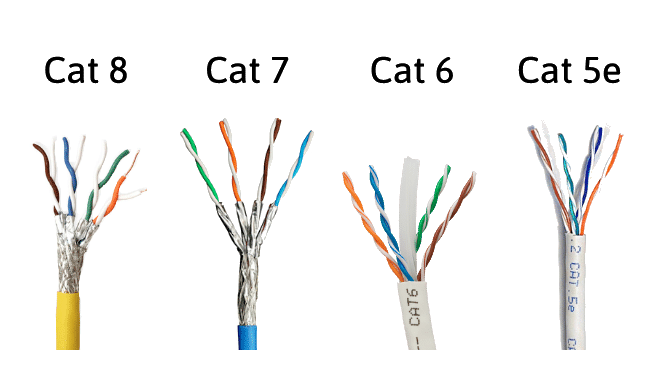
Cat 7 vs. Cat 6a
- Performance: Both deliver 10 Gbps over 100 meters, but Cat 7’s 600 MHz frequency offers better noise resistance.
- Compatibility: Cat 6a’s RJ45 connectors are more universal, while Cat 7’s shielding isn’t fully utilized with RJ45.
- Cost: Cat 6a is more budget-friendly, making it a practical choice for most users.
Cat 7 vs. Cat 8
- Speed: Cat 8 supports 40 Gbps over 30 meters, outpacing Cat 7 for short, ultra-high-speed connections.
- Distance: Cat 7 maintains 10 Gbps over 100 meters, while Cat 8 is limited to shorter runs.
Future-Proofing
Cat 7 is a solid choice for networks planning beyond 10 Gbps, but Cat 8 or fiber optic cables (like OM3) may be better for extreme speeds or longer distances. Note that Cat 7 isn’t recognized by ANSI/TIA standards in North America, which could affect its use in some regions.
Common Misconceptions About Cat 7
- Mislabeling: Some “Cat 7” cables sold online are actually Cat 5e or Cat 6 in disguise. Always buy from trusted sources.
- Overhyped Benefits: Marketed as “future-proof,” Cat 7’s advantages are diminished with RJ45 connectors, aligning its real-world performance closer to Cat 6a.
- Worth the Price?: For most users, the extra cost doesn’t justify the marginal gains over cheaper alternatives.
Practical Tips for Choosing Ethernet Cables
For Home Users
- Best Pick: Cat 6a handles 10 Gbps for gaming, streaming, and smart homes at a reasonable price.
- Watch Out: Avoid counterfeit cables by choosing reputable suppliers.
For Businesses
- Evaluate Needs: Consider speed, EMI exposure, and budget. Cat 7 suits high-interference settings; Cat 6a works for most offices.
- Professional Help: Cat 7’s stiffness and shielding require expert installation for best results.
When to Go with Cat 7
- High-EMI Areas: Where interference could corrupt data.
- Future Planning: If you anticipate needing more than 10 Gbps soon (though Cat 8 might be a better long-term bet).
Conclusion
Cat 7 Ethernet cables deliver exceptional performance with their 600 MHz frequency and double-shielded design, making them a powerhouse for data centers, industrial setups, and high-speed networks. However, for everyday home or small business use, Cat 6a often strikes the perfect balance of cost and capability. Your choice should hinge on your specific requirements—speed, environment, and budget.
Looking for top-quality Cat 7 cables? Guangdong DLAY Cable Technology Co., Ltd. provides certified, high-performance solutions you can trust.
FAQs
What’s the difference between Cat 7 and Cat 6a?
Cat 7 offers a higher frequency (600 MHz vs. 500 MHz) and better shielding, but both support 10 Gbps over 100 meters. Cat 6a is cheaper and more compatible with standard connectors.
Can I use Cat 7 with RJ45 connectors?
Yes, but RJ45 doesn’t fully ground the shielding, reducing Cat 7’s edge over Cat 6a.
Is Cat 7 worth it for home use?
Not usually—its benefits are best in high-interference or professional settings, and it’s pricier than needed for most homes.
How does Cat 7 compare to Cat 8?
Cat 7 supports 10 Gbps over 100 meters; Cat 8 hits 40 Gbps but only over 30 meters.